This blog covers the Kelowna and Central Okanagan real estate market with straightforward information you can actually use. You'll find local market stats, buyer education, neighbourhood breakdowns, and commentary on what's happening in the Okanagan. No fluff. Written by Michael A. Jones - PREC*, a REALTOR® with Royal LePage Kelowna.

July 9, 2026

Is Kelowna a Good Place to Live? It Depends on You

Michael A. Jones - PREC* | Royal LePage Kelowna

Is Kelowna a good place to live? Yes for some people, genuinely no for others, and after years of checking in with clients a year after their move, I can tell you the difference is predictable. Kelowna is a good place to live if you are moving for the lifestyle: the lake, the sun, the most physically active city I know in Canada. It is a poor fit if you are moving for a payoff: a bigger house for the money, a fast profit, a career ladder. This post sorts the profiles honestly, including the ones better served by a different city.

Kelowna rewards people who move here for the life and disappoints people who move here for the payoff.

What to know:

  • Kelowna proper holds about 144,000 people and the Central Okanagan Regional District more than 220,000 (Statistics Canada), yet the social texture runs closer to a small town than the population suggests.
  • The region earns its 2,000 hours of annual sunshine (Environment and Climate Change Canada), but almost none of it lands between November and January. The winter grey is the single most common surprise my relocated clients report.
  • By profile, retirees and remote workers rate the move highest. Career-builders who need a deep local job market rate it lowest.
  • The two assumptions I correct most often in a first meeting: your money buys more house here than it does, and a Kelowna purchase guarantees a profitable resale sooner than later. Neither expectation matches the market.
  • Friendships here take work. Kelowna runs clique-ish, and the newcomers who build a real circle do it by joining organizations, leagues, and clubs in year one.

Retro travel poster style illustration of relocating to Kelowna and Okanagan Lake, BC

What do relocated buyers say after their first year in Kelowna?

One year in, my clients report a consistent pattern: the lifestyle delivered and the finances surprised them. The sunshine, the lake, and the active culture met or beat expectations. The house their money bought ran smaller than expected, the resale math ran slower than expected, and the winter ran greyer than expected.

I make a habit of checking in with relocated clients around the one-year mark, and the debriefs have taught me more about this question than any statistic. The happiest ones came for contentedness and got it. That word comes up in their own language: the pace, the seasons, the feeling that the week belongs to them again. Several told me the Okanagan summer light has no equal anywhere they have lived, and they only wish it stretched across the whole calendar.

The complaints cluster just as tightly. Winter skies run grey from November into January, which surprises people who moved here for sun. More than one client now plans the winter around Kelowna International Airport and a cheap flight to Phoenix or Las Vegas in January. And nearly everyone arrived expecting their money to buy more home than it did. If you want that math before you commit, I have run it in detail for buyers coming from Calgary and Toronto.

Is Kelowna a good place to retire?

For most retirees, yes, and they rate the move higher than any other group I work with. Mild winters, long golf and trail seasons, wine country, and Kelowna General Hospital anchor the case. The honest caveats: BC family-doctor waitlists, grey November-to-January skies, and housing prices above most arrival budgets.

The retirees who thrive here planned around the caveats instead of discovering them. They registered with the BC Health Connect Registry the week they got a BC address. They budgeted for a winter escape south, or they took up skiing at Big White, 45 minutes from downtown. And they came with a realistic number in hand rather than a hope; the ongoing costs live in my Kelowna cost of living breakdown.

One more thing the brochures skip: this city keeps you moving. Any morning of the year you will find people out running, cycling, paddling, or walking the waterfront. Retired clients tell me the culture pulls them outside more than any resolution ever did. For a retirement measured in healthy years, that counts for something real.

Is Kelowna a good place to raise a family?

Yes, with a financial condition attached. The outdoor childhood is real: lake summers, ski winters, and School District 23 serving the region. The condition: housing costs run high against local wages, so the families who settle in comfortably arrive with equity from a previous market or an income that travels with them.

What families get here, they get in the daily texture. Beaches within fifteen minutes of most neighbourhoods, minor sports leagues, orchards and trail networks, and a university (UBC Okanagan, roughly 12,000 students per its enrolment reporting) that keeps post-secondary within reach. The trade-offs deserve equal weight: childcare waitlists, the same family-doctor shortage the rest of BC carries, and distance from grandparents, which sounds small in the planning stage and feels large in February.

The full picture of neighbourhoods, sub-markets, and what daily life looks like lives in my cornerstone on living in Kelowna.

Is Kelowna a good place for young professionals?

Conditionally, and this is the profile I caution most. Remote workers with a salary from Vancouver, Toronto, or Seattle get the full lifestyle with none of the local job-market problem. Career-builders who need a deep local market face narrower options, thinner salaries relative to housing, and slower professional networks than any major metro.

I moved here expecting more big-city attitude and ambition than I found. Kelowna carries more small-town feel than its population suggests, and I say that as someone who likes the place. Healthcare, technology, agriculture, tourism, and education all hire, but the depth in any single specialized field runs shallow. If your career plan requires three potential employers competing for you, count the actual employers in your field here before you sell anything back home.

The remote-work carve-out changes everything. A Toronto salary against Okanagan geography works. An Okanagan salary against Okanagan housing takes discipline, roommates, or family help. Same city, two different verdicts, and the difference is the paycheque's origin.

Is it hard to make friends in Kelowna?

Yes. Harder than I expected when I moved here, and harder than most of my clients expected too. Kelowna runs clique-ish; the established circles formed decades ago and rarely recruit newcomers. The newcomers who build real friendships join things: leagues, clubs, service organizations, faith communities. The city opens up to joiners.

I will make this personal, because the pattern held for me. I assumed a friendly city meant easy friendships, and Kelowna corrected me. The circles here fill up through commitment: a league, a club, a volunteer board, the same faces at the same places until showing up turns into belonging. Clients who joined a cycling club, a curling league, or a volunteer board in their first year tell a similar story by year two.

The good news hides inside the same fact: the whole city exercises, and every trailhead, pool, gym, and league doubles as a social scene. If your plan for community is to wait and see who knocks, expect a quiet first winter. If your plan is two memberships and a standing Saturday commitment, the odds move to your side.

Is buying a home in Kelowna a good investment?

Buy here for the life, and let any appreciation arrive as a bonus. Nearly every relocating buyer I meet assumes a Kelowna home will resell at a profit sooner than later. I correct that assumption in the first conversation. Recent cycles have punished short holds, and transaction costs eat thin gains.

This runs against what the postcard version of Kelowna implies, so let me say it plainly: demand for the lifestyle stays strong, and that still does not make every purchase a good investment on a three-year clock. The buyers who end up satisfied bought a home that fits their actual week, in a neighbourhood they would choose again, at a payment they can hold through a slow market. The buyers who end up calling me disappointed bought a thesis about appreciation and got a market instead.

Timing matters less than sequence, but it still matters; I mapped how Kelowna's seasonal market rhythm differs from Calgary's and Toronto's in my seasonal cycle guide. Read that before you assume the month you happen to land is the month you should buy.

Who should not move to Kelowna?

Kelowna is the wrong city for anyone who needs a deep corporate job market, metropolitan transit and nightlife, a guaranteed short-term real estate profit, or an instant social circle. It also demands honest thought from anyone with respiratory sensitivity, because late-summer wildfire smoke belongs to the regional calendar.

Here is the same verdict framework I walk through with clients, condensed.

Kelowna fit by relocator profile, from the author's client debriefs, July 2026
Who you are What Kelowna delivers What it does not Verdict
Retiree or pre-retiree Mild winters, active culture, regional hospital, wine country Easy family-doctor access, winter sun Good fit
Remote worker Full lifestyle on an outside salary A backup plan if the remote job ends Good fit
Family with school-age kids Outdoor childhood, SD23 schools, UBC Okanagan in reach Cheap housing, easy childcare, nearby grandparents Good fit with money conditions
Career-builder needing a deep local market A foothold in tech, healthcare, or trades Employer depth, big-metro salaries, fast ladders Weak fit
Big-city urbanite A walkable core for a city this size Transit-first living, metro nightlife and arts depth Wrong city
Buyer counting on a fast resale profit A home and a lifestyle A guaranteed return on a short clock Wrong reason

If you found yourself in the top half of that table, the next question shifts from whether to where, and for how much. The texture of daily life lives in living in Kelowna, and the real monthly numbers live in the cost of living breakdown. If you found yourself in the bottom half, I would rather tell you now than after a possession date. Either answer costs you nothing today, and getting it right is worth more than my commission on getting it wrong.

Frequently Asked Questions

Is Kelowna a good place to live?

Yes, if you move for the lifestyle. Kelowna offers Okanagan Lake, roughly 2,000 hours of annual sunshine (Environment and Climate Change Canada), and one of the most physically active populations in Canada. The fit weakens if you need deep corporate career options, fast real estate appreciation, or an instant social circle. The city of about 144,000 (Statistics Canada) behaves socially like a much smaller town, and friendships take deliberate effort through clubs, sport, and volunteer organizations.

Is Kelowna a good place to retire?

For most retirees, yes. Winters run mild by Canadian standards, the golf and trail seasons run long, and Kelowna General Hospital anchors healthcare for the region. Two honest caveats: family-doctor waitlists in BC are real, so register with the provincial Health Connect Registry as soon as you have a BC address, and the skies run grey from November through January. Many retired clients treat Kelowna International Airport as part of the retirement plan and fly to Phoenix or Las Vegas for winter sun.

Is it hard to make friends in Kelowna?

Harder than most newcomers expect. Established social circles here date back decades, and Kelowna has a reputation among newcomers for being clique-ish. The reliable path runs through organizations: sports leagues, service clubs, Toastmasters, faith communities, volunteer groups. People who join two or three things in their first year report a real circle by year two. People who wait for friendship to arrive on its own tend to report loneliness at the one-year mark.

What are winters really like in Kelowna?

Mild but grey. Temperatures hover near freezing and snowfall stays moderate, gentler than Calgary, Edmonton, or Winnipeg. The trade-off: valley cloud settles over the Okanagan from November through January, and the sunshine that defines the region mostly disappears for those months. Skiers get Big White, 45 minutes from downtown. Sun-seekers get flights south from Kelowna International Airport. Most people who thrive here budget for one or the other.

Is buying a home in Kelowna a good investment?

Buy in Kelowna for the life you want to live here, and treat appreciation as a bonus rather than the plan. Relocating buyers regularly arrive assuming a Kelowna purchase guarantees a profitable resale within a few years. Recent market cycles have not rewarded that assumption, and transaction costs consume thin gains. A home you love in a neighbourhood that fits your actual week is the purchase that survives every market. This is general information, not personalized financial advice.

All for now,
Michael

Michael A. Jones - PREC* is a REALTOR® with Royal LePage Kelowna, licensed in British Columbia. He writes about Central Okanagan housing — Kelowna, West Kelowna, Lake Country, and Vernon — under the byline The Real Estate Novelist. Member of the Association of Interior REALTORS® and the Canadian Real Estate Association (CREA). Reach him at 250-258-4663 or yourkelownahomes.com.

General market information for the Central Okanagan. Not personalized financial, legal, or tax advice. Confirm specifics with a licensed REALTOR® or appropriate professional. Nothing here constitutes investment advice; housing outcomes vary by property, timing, and individual circumstance.
July 5, 2026

When Is the Best Time to Buy a Home in Kelowna? A Relocator's Guide to the Seasonal Cycle

Michael A. Jones - PREC* | Royal LePage Kelowna

If you have already decided to move to Kelowna, the month you buy matters almost as much as the price you pay. Kelowna's real estate market runs on a seasonal cycle, and it does not line up with the one you know from Calgary or Toronto. Competition and prices firm through late spring and hold into summer, then supply and leverage swing back toward the buyer through late fall and winter. The best time to buy a home in Kelowna on price and negotiating room falls between November and January, when listings thin out and the sellers still on the market have a reason to deal. The catch: that window sits opposite the season most relocators would otherwise pick for the move.

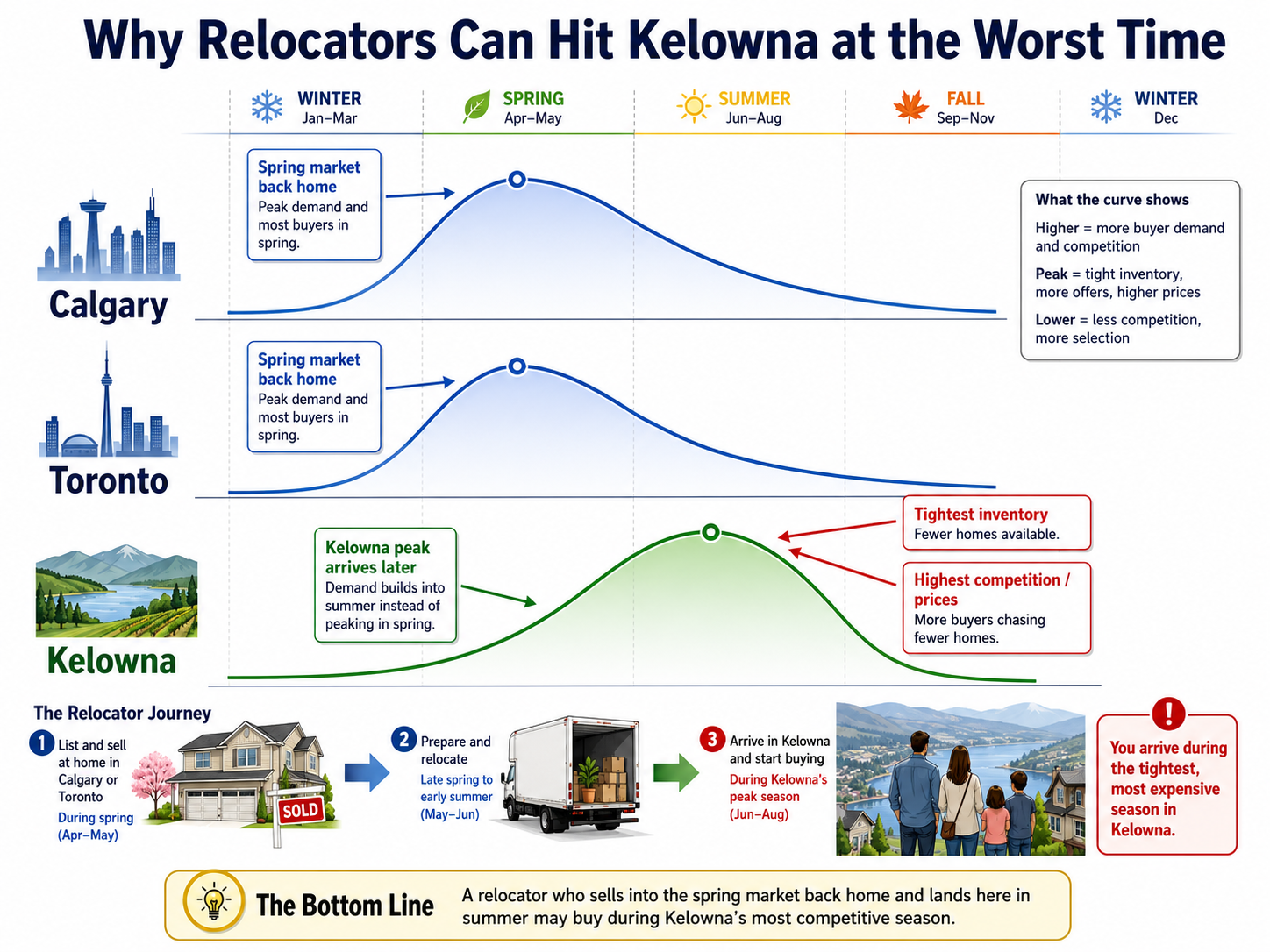
Kelowna's buying competition peaks a few weeks later than Calgary's or Toronto's, so a relocator who sells into the spring market back home and lands here in summer buys into Kelowna's tightest, most expensive season.

What to know:

  • Kelowna sales climb from a January floor to a June and July peak, then fade through fall to a December bottom, per the Association of Interior REALTORS 13-month record.
  • Central Okanagan homes took 92 days to sell in January 2026, the slowest month of the year, against 51 to 52 days the prior spring (Author's analysis of Association of Interior REALTORS MLS data).
  • Toronto home prices historically peak in May, with a 62.5% chance May marks the spring high, per Toronto Realty Blog's read of TRREB data.
  • Calgary follows the same spring-uplift, winter-slowdown arc, with sales sliding to 1,553 by December 2025, per the Calgary Real Estate Board.
  • Kelowna's summer runs hotter and longer than the big metros because recreational and lifestyle demand extends the season past the spring peak.
  • List your home before you shop, not after. A Kelowna seller takes a buyer with a listed or sold home far more seriously, and an offer conditional on selling a home that is not yet listed almost always gets declined.

Best time to buy a home in Kelowna: seasonal timing trap for buyers relocating from Calgary and Toronto

How does Kelowna's real estate calendar move through the year?

Kelowna's market builds in spring, peaks around midsummer, and empties out by winter. Sales rose from 306 in February 2025 to a July peak of 482, then slid to 226 by January 2026, per the Association of Interior REALTORS 13-month comparison. Active inventory traced the same arc, cresting near 4,500 listings in June and thinning to roughly 3,150 by December.

Read those two lines together and the seasons sort themselves into buyer weather and seller weather. Spring is when the choice arrives. New listings flood in, and by May a buyer has the widest field of homes to walk through all year. Summer is when the competition shows up to meet that choice, and prices firm. Then fall thins the field, and winter clears it. By January, homes took 92 days to sell across the Central Okanagan, the slowest month in the record, against 51 to 52 days the previous spring. A house that has sat for 92 days has a seller who has watched three months pass, and that patience running out is where a buyer finds room to negotiate.

The relocator's mistake is reading "most listings" as "best time to buy." The widest selection and the best price rarely share a month. Spring hands you the most doors to knock on and the most company knocking beside you. Winter hands you fewer doors and no company at all.

When is the best time to buy a home in Kelowna?

The short answer: for selection, buy in spring, when new listings peak and you can compare the most homes side by side. For price and negotiating leverage, buy from late fall through January, when inventory bottoms, days-on-market stretch past 80, and the remaining sellers have a reason to deal. Most relocators cannot split the difference, so the honest answer turns on whether choice or leverage matters more to your move.

If you are after a specific kind of home in short supply, a single-level rancher, a lake-view condo, a walkable Lower Mission property, spring and early summer give you the only real selection, and paying near the top of the season buys you the home you actually want. If you are flexible on the property and firm on the budget, winter is your season. In a thin market, one motivated seller and no competing offer beats twenty listings you have to bid against.

How is Kelowna's cycle different from Calgary's and Toronto's?

All three markets share the same seasonal skeleton, a spring build, a summer plateau, a fall fade, and a winter trough, but the peaks land in different months. Toronto's average price historically tops out in May. Calgary's activity crests in spring and slides through the back half of the year. Kelowna's peak runs later, into June and July, because recreational and lifestyle demand keeps buyers active through the summer after the big metros have already turned down.

That lag is the whole story for a relocator. When you sell in Calgary or Toronto, you sell into a market that peaks in spring. When you buy in Kelowna, you often arrive in summer, right as Kelowna hits its own peak. You catch both markets near their most expensive, selling high only to turn around and buy high.

Seasonal calendar: Kelowna vs Calgary vs Toronto (GTA)
  Toronto (GTA) Calgary Kelowna / Central Okanagan
Activity / price peak May (price) Spring June and July (sales)
Slowest month December and January December January
What drives the summer Fades after May Fades after spring Recreational and lifestyle demand holds it up
Best buyer-leverage window Late fall and winter Late fall and winter November to January
Widest selection Spring Spring May and June
Sources: TRREB via Toronto Realty Blog; Calgary Real Estate Board; Association of Interior REALTORS MLS data, 2025 to 2026.

Relocation timing blueprint for buying a home in Kelowna from another province

If I am selling in Calgary or Toronto and buying in Kelowna, how do I time both?

The clean play and the convenient play point in opposite directions. To sell high, list back home into the spring market, February through May, when buyer demand and prices peak in Calgary and Toronto. To buy with leverage in Kelowna, purchase in the late-fall-to-winter window. Those two windows sit roughly six months apart, and that gap is the coordination problem no one warns you about.

You have three honest ways through it. Sell in spring and rent locally or in Kelowna until winter, trading a few months of carrying cost for a stronger buy. Sell and buy in the same season, accepting that you trade near the top on both ends, which stays simplest and is often what family timing forces anyway. Or stretch the move across a full year, listing back home in spring and buying in Kelowna the following winter, if your life allows the bridge. None of these comes free. The point is to choose the tradeoff on purpose rather than discover it after you have committed to both sides.

One rule matters more than the season, and buyers get it backwards more than any other. List your home before you shop for the next one, not after. Most people want to find the Kelowna place first and list back home once they have it. That order works against you. Sellers here want qualified buyers, and qualification runs in tiers. A buyer whose home is already listed is qualified. A buyer whose home has already sold is the strongest kind of all. A buyer who has not listed is a promise, and a thin one. Write an offer subject to selling a home that is not yet on the market, and a Kelowna listing agent will almost always decline it, or at best attach a short time clause, commonly 24 to 72 hours. That clause keeps the seller's home on the market and lets them take a stronger offer the moment one lands, which bumps you to the back of the line.

I will say it plainly, because it is how I work. I would never let a seller of mine tie up their home for a buyer who has not even listed their own, and I would want to know why we let an unqualified buyer through the door at all. So list first, and shop second. Once your home is on the market, you can still protect yourself. Accept an offer on it subject to you finding a suitable property to buy, and you keep your footing on both sides. You sell from strength, and you shop as the only kind of buyer a Kelowna seller takes seriously.

Why is summer the hardest time to buy in Kelowna?

Summer feels like the natural time to move. School is out, the lake is warm, and the calendar opens up, so it draws the most relocating buyers all at once. That same pull makes it the toughest season to buy well. Kelowna's out-of-province and second-home demand concentrates in the summer months, stacking lifestyle buyers on top of the local market and holding prices at their seasonal high.

This is the trap built into a relocation. The season that is easiest to move in carries the most competition and the least negotiating room. It does not mean you should rule out a summer move; sometimes the job or the school year decides for you. It means you should walk in knowing you are buying into the peak, budget for it, and resist the feeling that a fast, competitive market forces you to overpay to win.

Does the yearly trend override the seasonal pattern?

Yes. When the broader market is moving, the annual trend sits on top of the seasonal one, and you have to read both. The seasonal cycle tells you the best month within a normal year. The market trend tells you whether this year is normal. In June 2026, Kelowna posted its strongest sales month in a year on falling inventory, and Toronto and Vancouver turned up the same month, per board data. When the big markets firm, a winter that would normally hand buyers leverage can stay tighter than the calendar suggests.

So use the season to fine-tune, not to gamble. In a flat or softening market, the winter leverage window is real and worth the wait. In a firming market, the seasonal discount shrinks, and holding out for winter can cost you more in rising prices than it saves in negotiating room. Your job as a relocator is to know which kind of year you are buying into, and that is a conversation worth having before you settle on a moving date.

All for now,
Michael

Michael A. Jones - PREC* is a REALTOR® with Royal LePage Kelowna, licensed in British Columbia. He writes about Central Okanagan housing, Kelowna, West Kelowna, Lake Country, and Vernon, under the byline The Real Estate Novelist. Member of the Association of Interior REALTORS® and the Canadian Real Estate Association (CREA). Reach him at 250-258-4663 or yourkelownahomes.com.

General market information for the Central Okanagan. Not personalized financial, legal, or tax advice. Real estate market conditions and seasonal patterns vary by year, property type, and price band. Confirm specifics with a licensed REALTOR® or appropriate professional.
May 14, 2026

Kelowna Cost of Living in 2026: The Real Monthly Numbers

Michael A. Jones - PREC* | Royal LePage Kelowna

What to know:

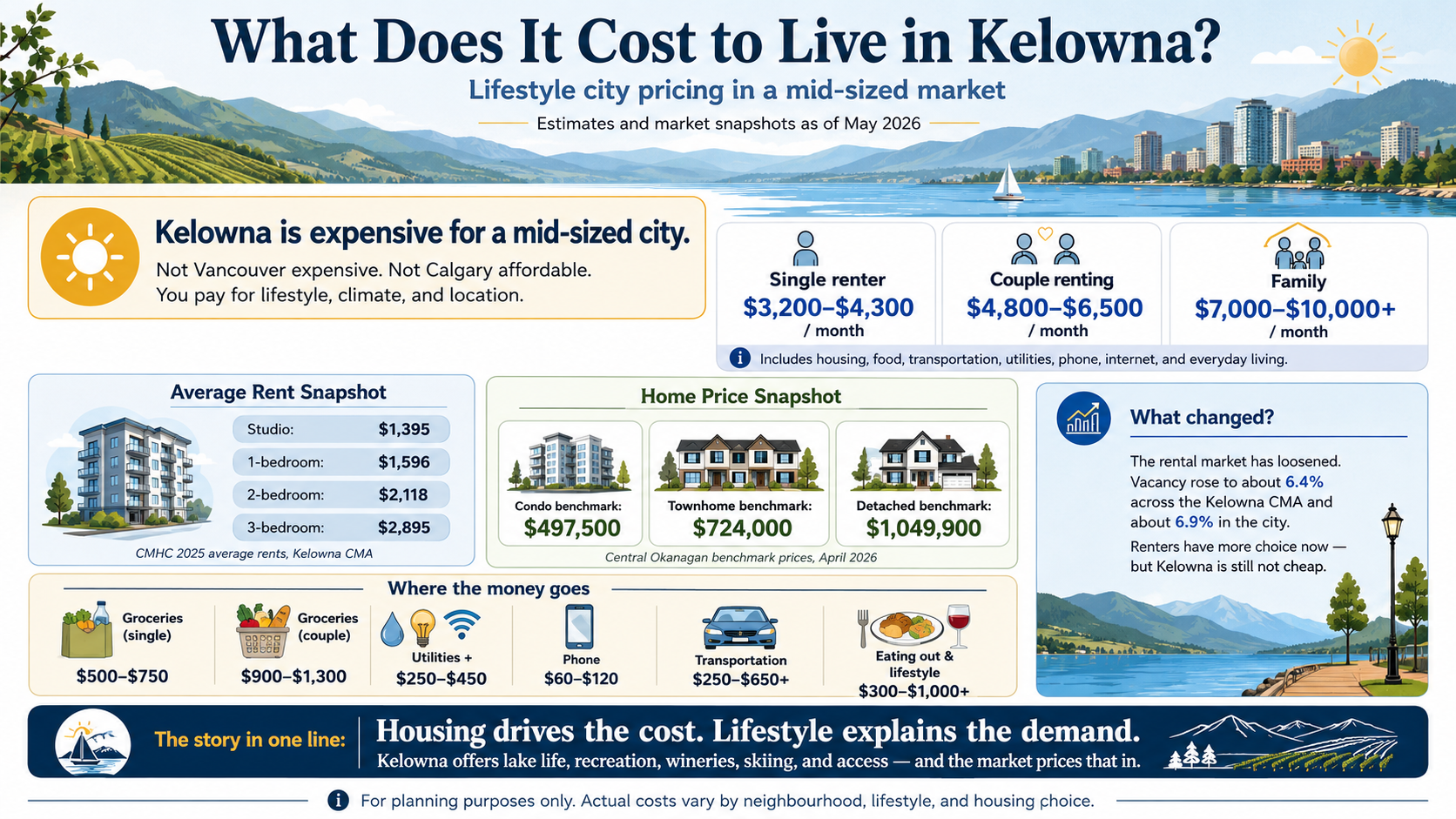
  • A single person renting a one-bedroom in Kelowna spends roughly $2,800 to $3,300 per month all-in. A couple in a two-bedroom: $4,300 to $5,000. A family of four owning an $850,000 home with one child in licensed care: $8,000 to $9,500.
  • The biggest line item is housing. The second is transportation. Kelowna is car-dependent, and ICBC plus fuel adds $400 to $700 per month for a typical two-car household (ICBC, BC Statistics fuel prices).
  • BC has no monthly MSP premium for individuals (eliminated January 1, 2020). Healthcare is effectively free at the point of access; extended benefits and family-doctor wait-lists are separate considerations.
  • Property tax in Kelowna runs about 0.45–0.55% of assessed value annually — meaningfully lower than Toronto, similar to or below Vancouver, higher than no-property-tax illusions Albertans sometimes hold (Alberta has property tax too; it just isn't structured the same way).
  • The hidden cost most newcomers miss: home insurance. Kelowna is wildfire country, and premiums run higher than what you paid in Calgary or Toronto. Get a quote on the specific property before you remove subjects.

Most relocators ask "what does a house cost in Kelowna" before they ask "what does it cost to live in Kelowna." Those are different questions, and the second one tends to surprise people more than the first.

This post is the second question. The recurring monthly numbers — what you actually spend, line by line, after you have moved in. I have covered the equity-transfer math for Alberta and Ontario buyers in the Calgary post and the Toronto post. This one is the budget that follows once the move is done.

Kelowna cost of living guide, Okanagan BC

Housing: Rent and Mortgage

Housing is the biggest single line in every household budget I have run with relocators. Rents and mortgage carrying costs both moved up significantly between 2020 and 2024, then steadied. The numbers below reflect early 2026 conditions.

Rentals. One-bedroom asking rents in the Central Okanagan have actually softened over the last year. The average asking rent for a one-bedroom in April 2026 was $1,530 — the lowest since May 2023, and the third decline in four months (Castanet Classifieds, drawn from 42 listings). Two-bedroom asking rent moved the other way in April, up $105 from March to $2,145 across 60 listings — but that two-bedroom average is still at least $100 below where it sat in each of the previous three Aprils. Three-bedroom houses run roughly $3,000 to $3,800 depending on neighbourhood and condition. Newer or waterfront-adjacent product carries a premium on top of these averages; older inventory and Rutland locations sit below.

Mortgage carrying cost. On a $750,000 purchase with 20 percent down ($600,000 mortgage), a five-year fixed mortgage at current rates produces a monthly payment of approximately $3,500. On an $850,000 purchase ($680,000 mortgage), about $4,000 monthly. On a $1,000,000 purchase ($800,000 mortgage), about $4,700 monthly. These figures assume a 25-year amortization and current Bank of Canada rate environment; your actual payment depends on the specific rate locked, term length, and amortization period chosen with your lender.

Property Tax and Strata Fees

Property tax in the City of Kelowna runs approximately 0.45 to 0.55 percent of assessed value annually for residential properties, combining the municipal, school, and regional district levies (City of Kelowna). On a $1,000,000 assessed home, the annual tax bill typically lands in the $4,500 to $5,500 range, or about $375 to $460 per month when reserved.

The Home Owner Grant reduces the bill on principal residences. The basic grant in 2026 is $570, with an additional $275 for properties in rural or northern areas. Eligibility and amounts adjust annually; verify current figures with the City of Kelowna or the Province before counting on the offset.

If you are buying a condominium or townhome, strata fees layer on top of property tax. Typical strata fees in Kelowna run $300 to $700 per month for standard apartment-style buildings, $200 to $500 for townhome complexes, and $700 to $1,500 or more for luxury waterfront or full-service buildings. Strata fees vary widely by building age, amenity load, and contingency reserve health. Review the strata documents before any purchase.

Utilities

Utilities are typically the most predictable monthly line item. A typical Kelowna single-family home runs the following ranges (BC Hydro, FortisBC, City of Kelowna utility schedules):

Utility Typical Monthly Cost Source
Electricity (BC Hydro) $100 – $150 BC Hydro residential tiered rates
Natural gas (FortisBC) $60 – $130 (seasonal) FortisBC residential rate schedule
Water, sewer, garbage (City of Kelowna) $70 – $110 City of Kelowna utility rates
Internet (Rogers, Telus, others) $80 – $120 Published 2026 provider plans
Total utilities range $310 – $510

Apartment and condo households generally fall on the lower end. Detached homes with electric heating or large square footage land higher, particularly in winter months when natural gas usage rises.

Home Insurance

Home insurance is the line item most relocators underestimate. Kelowna sits in wildfire country, and insurance premiums reflect that. A typical detached home in a low-to-moderate wildfire-risk neighbourhood runs $1,800 to $3,200 per year for full replacement coverage ($150 to $267 per month). Properties in higher-risk zones, particularly those flagged in the Kelowna Wildfire Resiliency Plan or in interface neighbourhoods like Wilden, Upper Mission, parts of West Kelowna, or rural Lake Country, can run materially higher or face limited coverage availability.

If you are coming from Calgary or Toronto, expect insurance to run 30 to 60 percent higher than what you paid there for an equivalent home. Get a quote on the specific property before you remove subjects on the purchase. I will say this more than once in this post because it catches people consistently.

Vehicle Costs

Kelowna is car-dependent. Public transit covers the major corridors and the university, but most lives are organized around a personal vehicle.

ICBC insurance. Basic Autoplan coverage is mandatory in BC and runs through ICBC as a provincial monopoly. For a driver with a clean record on a common passenger vehicle, basic coverage runs approximately $1,400 to $2,000 annually. Adding collision and comprehensive coverage brings the total to roughly $1,800 to $3,000 annually, or $150 to $250 per month per vehicle (ICBC published rate schedules).

Fuel. BC gasoline prices include provincial fuel tax, carbon tax, and (in the Lower Mainland) the TransLink levy. Kelowna fuel prices in 2026 typically run $1.80 to $2.10 per litre depending on global oil pricing and seasonal demand (BC Statistics fuel price tracking). A typical household with two vehicles burning 100 litres each per month spends $360 to $420 on fuel.

Parking. Most residential parking is free or included with housing. Downtown Kelowna parking for workers ranges from $80 to $180 per month at parkades. Beach parking in summer requires forethought; the city operates pay parking at major beach access points.

Healthcare

British Columbia eliminated MSP premiums for individuals on January 1, 2020. Residents pay no monthly premium for basic medical coverage under the Medical Services Plan once enrolled (Government of British Columbia). Funding shifted to the Employer Health Tax, paid by employers with annual payroll above $500,000.

Extended health and dental benefits are separate. If your employer covers them, budget zero. If not, family extended health coverage runs $100 to $200 per month through private insurers, depending on plan structure and dependents.

Family doctor wait-lists are a real issue in BC and the Okanagan reflects that. The BC Provincial Health Connect Registry is the central waitlist for unattached patients. Add yourself as soon as you have a BC address. Walk-in clinics, virtual care services, and Kelowna General Hospital handle acute issues in the meantime.

Groceries and Dining

Grocery prices in Kelowna align closely with the BC provincial average, which sits slightly above the Canadian average per Statistics Canada food CPI. A typical family of four spends $1,200 to $1,600 monthly on groceries; a couple spends $700 to $900; a single person typically spends $400 to $600.

Dining out is where Kelowna's tourism economy shows up. The local restaurant scene is strong for a city this size but pricing reflects a tourist market in summer. Expect Vancouver-equivalent pricing at the better restaurants, particularly downtown and in Lower Mission. Wine pairings with dinner add up quickly given the local wine country premium.

Childcare

British Columbia operates the $10 A Day Child Care BC program, which subsidizes participating licensed childcare providers down to a $10-per-day fee for eligible families. The program has expanded significantly since 2018 but spots are limited and wait-lists are common, particularly in Kelowna. Full-time enrolment under the program runs approximately $200 per month per child.

Outside the $10-a-day program, market-rate licensed childcare in Kelowna runs $1,200 to $1,800 per month per child for full-time care. Home-based daycare options sit at the lower end; centre-based and infant care sit at the higher end. The BC Affordable Child Care Benefit reduces costs further for eligible families based on income.

If you are moving with young children, get on Kelowna childcare wait-lists as soon as you know your move date. The supply gap is real.

Sample Monthly Budgets

Three realistic profiles. Numbers are illustrative ranges; your actual budget will vary.

Line Single renter Couple, two-bed Family of 4, owned home
Housing $1,530 $2,145 $4,000 (mortgage)
Property tax (reserved) $400
Home insurance $25 (tenant) $35 (tenant) $220
Utilities $200 $330 $450
Phone $70 $140 $220
ICBC + fuel $250 (1 car) $500 (2 cars) $550 (2 cars)
Groceries $500 $800 $1,400
Dining, personal $350 $500 $500
Childcare $300–$1,500
Extended health $50 $100 $180
Approx. total $2,975 $4,550 $8,220 – $9,420

These budgets do not include discretionary spending on travel, recreation, gym or sports memberships, hobbies, or savings contributions. Add what your actual life requires.

What Costs More Here Than Calgary, Toronto, or Vancouver

Home insurance vs Calgary or Toronto. Wildfire risk pricing adds 30 to 60 percent for an equivalent home compared to a prairie or central-Ontario equivalent. Get the quote before you remove subjects.

Fuel vs Calgary. BC has provincial fuel tax and carbon tax that Alberta does not impose at the same level. Expect to pay $0.30 to $0.50 more per litre than in Alberta, which works out to roughly $60 to $120 more per month for a typical two-car household.

Restaurant pricing vs Calgary. Kelowna's tourism economy supports a higher restaurant price point than Calgary, particularly during the summer months. The gap narrows in winter.

Wine and recreation. If you actually engage with the wine country lifestyle, the consumption pattern adds up faster than it would in Calgary or Edmonton. Local wines run from $20 entry to $80-plus for premium product, and tasting fees at wineries are now standard.

What Costs Less Than Vancouver or Toronto

Housing carrying cost vs Vancouver. A comparable family home in Kelowna's mid-tier neighbourhoods carries for $1,000 to $2,000 less per month than the Greater Vancouver equivalent, depending on the specific neighbourhood comparison. The gap has narrowed since 2020 but is still meaningful.

Property tax vs Toronto. The City of Toronto adds municipal land transfer tax on purchases (one-time) and runs a property tax mill rate broadly comparable to Kelowna's, but Toronto's MLTT plus higher provincial LTT on entry costs significantly more upfront than BC's PTT. On the ongoing annual property tax line, the two markets are closer than most relocators expect.

Transit-related costs (because there aren't many). Kelowna's car-dependent layout means no transit pass costs build into a budget. Whether that nets out as a saving or a cost depends on how you compare it to subway/streetcar passes in Toronto or SkyTrain passes in Vancouver versus the cost of running a second vehicle here.

Hidden Costs Newcomers Miss

The two-vehicle creep. Couples who arrived as one-vehicle households in Toronto or Vancouver often become two-vehicle households here within twelve months. The car-dependent geography makes a single shared vehicle hard to sustain once both partners have local commitments. Build a second vehicle into your one-year forecast even if you do not buy one immediately.

Smoke-season indoor adjustments. If wildfire smoke is bad in a given summer, indoor air filtration becomes a quality-of-life expense. Decent HEPA filters run $200 to $500 each; HVAC upgrades for higher-grade filtration can run $1,500 to $3,500 one-time. Not every year, but enough years to plan for.

Seasonal travel back home. Many Kelowna relocators fly back to Vancouver, Calgary, or Toronto more often than they expected — for family, work, healthcare specialists, or specific events. Flights from YLW run $300 to $500 return to Vancouver, $400 to $700 to Calgary, $700 to $1,200 to Toronto. Two or three trips a year per family member adds up.

Outdoor recreation gear. The lake-life lifestyle requires gear if you actually plan to live it. Paddleboards, bikes, ski passes, boat moorage, vineyard memberships — none of these are required, but most relocators end up with a meaningful share of them within the first two years. Budget honestly for what you will actually do.

The Real Test

The way I run a real cost-of-living conversation with relocator clients is to take their current household budget and walk through it line by line, swapping in Kelowna numbers and naming the things that change. That exercise tends to reveal the actual financial shift faster than a generic comparison ever does.

If you are running the numbers seriously and want to do that exercise together, get in touch. The first conversation is always about the real picture, not the brochure.

Frequently Asked Questions

How much does it cost to live in Kelowna per month for a single person in 2026?

A single person renting a one-bedroom apartment in Kelowna typically spends $2,800 to $3,300 per month covering rent, utilities, transportation, groceries, phone, and basic discretionary spending. The average asking rent for a one-bedroom in the Central Okanagan in April 2026 was $1,530 — the lowest since May 2023 (Castanet Classifieds, drawn from 42 listings). Utilities, insurance, and ICBC vehicle coverage layer on top. Downtown waterfront and active-lifestyle budgets can land closer to $3,500 to $4,000.

How much does a family of four spend monthly in Kelowna?

A family of four owning an $850,000 home, with two vehicles and one child in licensed daycare, typically spends $8,000 to $9,500 per month covering mortgage, property tax, home insurance, utilities, two ICBC policies, fuel, groceries, childcare, activities, and basic extended health coverage. The largest single line is the mortgage (about $4,000 monthly at current rates on a 20% down purchase). Childcare ranges widely depending on access to the BC $10-a-day program versus market rates.

Is Kelowna more expensive than Calgary, Toronto, or Vancouver?

Kelowna runs less expensive than Vancouver and Toronto on housing and most carrying costs, and more expensive than Calgary on housing but comparable on most other monthly expenses. Property tax is meaningfully lower than Toronto. Home insurance is meaningfully higher than Calgary or Toronto due to wildfire risk pricing. Fuel and provincial taxes are higher than Calgary. Compared to Vancouver, Kelowna comes in lower on housing carrying cost, property tax, and most utilities, but the cost gap has narrowed substantially since 2020.

What is the property tax rate in Kelowna in 2026?

The combined property tax rate for a residential property in the City of Kelowna in 2026 runs approximately 0.45 to 0.55 percent of assessed value annually, depending on the specific tax classes and area levies that apply (City of Kelowna). On a $1,000,000 assessed home, the annual property tax bill typically lands in the $4,500 to $5,500 range. Add school tax and regional district levies to the municipal portion to arrive at the full annual amount. The Home Owner Grant offsets a portion for principal residences.

Does BC have monthly MSP premiums for residents?

No. British Columbia eliminated MSP premiums for individuals on January 1, 2020. Residents pay no monthly premium for basic medical coverage under the Medical Services Plan once enrolled (Government of British Columbia). Funding shifted to the Employer Health Tax, which is paid by employers with annual payroll above $500,000. Extended health and dental coverage is separate and either employer-provided or privately purchased; budget $100 to $200 per month for a family if you do not have employer coverage.

All for now,
Michael

This blog post is for general informational purposes only. It does not constitute financial, tax, mortgage, or legal advice. Cost figures referenced are illustrative ranges based on publicly available 2026 source data from BC Hydro, FortisBC, the City of Kelowna, ICBC, the Government of British Columbia, the Association of Interior REALTORS, Castanet Classifieds rental tracking, and Statistics Canada, and will vary by specific household, property, and consumption pattern. Mortgage qualification and rates depend on individual circumstances and must be assessed by a licensed mortgage professional. Property tax rates, utility tariffs, ICBC premiums, and provincial program eligibility (including the $10 A Day Child Care BC program and the BC Affordable Child Care Benefit) are subject to change; verify current figures with the relevant authority before relying on them. Michael A. Jones is a licensed REALTOR® with Royal LePage Kelowna and a member of the Canadian Real Estate Association (CREA) and the Association of Interior REALTORS®. He is not a lawyer, tax advisor, mortgage broker, or financial planner. Always seek qualified professional advice in the relevant discipline before making relocation or financial decisions.
May 14, 2026

Living in Kelowna: An Honest Read for Anyone Considering the Move

Michael A. Jones - PREC* | Royal LePage Kelowna

What to know:

  • Kelowna proper has about 144,000 residents; the Central Okanagan Regional District — Kelowna, West Kelowna, Lake Country, and Peachland — has more than 220,000 (Statistics Canada). It is one of the fastest-growing regions in BC.
  • Climate runs four real seasons. Summers are hot and dry with wildfire-smoke risk in August and September. Winters are mild by Canadian standards. The lake moderates the extremes you would feel in Calgary or Edmonton.
  • The economy mixes healthcare, technology, agriculture, tourism, education, and government. Diverse for a city this size, but the corporate professional market is narrower than Toronto or Vancouver.
  • The four sub-markets — Kelowna, West Kelowna, Lake Country, Peachland — each have a distinct character. Most relocators land in Kelowna proper and figure out the right fit once they have spent time here.
  • The trade-offs are real: car-dependent, summer crowds, occasional smoke, smaller corporate job market. What most relocators find worth the move is the lake, the rhythm of the seasons, and the human scale.

Most of the people I work with ask the same question before they ask any of the others. Not "what does it cost" — that comes later. Not "where should I live" — that comes after they have arrived. The first question is the honest one: what is it actually like to live there?

This post is my best answer to that question. Not a brochure. Not a pitch. The actual texture of the place, from the inside, written for someone weighing the move.

Golden hour on the Kelowna waterfront, Okanagan Lake, Kelowna BC

The Rhythm of the Place

Kelowna sits on the east shore of Okanagan Lake in BC's Central Okanagan, about an hour's flight east of Vancouver or an hour west of Calgary. The lake is the defining feature. Most of the city orients itself either toward the water or away from it; both work, and the choice shapes what daily life looks like.

The seasons here are real and distinct. Summers are hot and dry — daytime highs run from the high 20s into the mid 30s Celsius, the lake warms enough to swim from June through September, and the city absorbs a significant tourism wave between July and Labour Day. Late summer brings wildfire-smoke risk; some years the air stays clear, others bring two or three weeks of degraded air quality. This is interior BC and the smoke is part of the calendar.

Fall is the underrated season. September and October bring crisp mornings, warm afternoons, vineyard harvest, and a noticeable drop in tourism. Winters are mild by any Canadian standard — temperatures hover near freezing, snowfall is moderate, and the lake moderates the extremes that hit Calgary, Edmonton, or even Vancouver Island. Spring arrives early. By late March most years, the orchards are blossoming and people are back on patios.

If you have lived anywhere east of the Rockies, the Kelowna winter will surprise you in a good way. If you have lived on the BC coast, the summer dryness and the seasonal smoke will take adjustment.

Who Actually Lives in Kelowna

The City of Kelowna has approximately 144,000 residents. The wider Central Okanagan Regional District — which includes Kelowna, West Kelowna, Lake Country, Peachland, and surrounding electoral areas — has more than 220,000 (Statistics Canada). The region has been one of the fastest-growing in BC for a decade, with growth rates regularly outpacing the national average.

The newcomer mix changes the place every year. Interprovincial migration drives most of the growth, with Alberta, Ontario, and the BC Lower Mainland as the largest origin markets. Retirees and pre-retirees remain a strong demographic, but the under-40 newcomer cohort has grown materially since 2020, fuelled by remote-work flexibility and the lifestyle pull. The city has a meaningful Indigenous community — the syilx Okanagan Nation are the traditional stewards of this territory, and Westbank First Nation is a significant economic and governance presence on the west side of the lake.

Compared to the Lower Mainland or the GTA, Kelowna is less ethnically diverse, though that is shifting. Compared to Calgary, the political and cultural orientation runs slightly more centrist with a stronger environmental sensibility. The local university (UBC Okanagan) brings about 12,000 students into the mix during the school year, which keeps a youth presence in the city core.

Where People Live: The Sub-Market Overview

Most relocators arrive thinking of "Kelowna" as a single place. It is functionally four communities that share a regional district and a lake.

Kelowna proper is the regional centre and the biggest of the four. Downtown anchors the cultural and professional life of the city. The Mission neighbourhoods (Lower Mission, Upper Mission) sit south of downtown along the lake and carry the highest residential price points. Glenmore and Wilden sit north and bring a family-and-professional character with strong school catchments. Rutland is the most affordable major neighbourhood and the fastest-changing — it has gone from working-class to mixed in the last fifteen years. The full breakdown lives in our Best Neighbourhoods to Buy in Kelowna piece.

West Kelowna sits across the William R. Bennett Bridge on the west side of the lake. The character is slightly more suburban and the access to wineries, beaches, and boating is direct. West Kelowna includes Westbank, Lakeview Heights, Glenrosa, and Shannon Lake. Bridge traffic during peak summer can be a real consideration if you commute into Kelowna daily for work.

Lake Country sits north of Kelowna along the lake corridor toward Vernon. More rural, more acreage, more orchard-and-vineyard land. Families looking for space and people relocating from Alberta land here often. Internet coverage is more variable here than in Kelowna proper; confirm before committing to a specific property.

Peachland sits south of West Kelowna, hugging the lake. Smaller, quieter, with a higher proportion of retirees and a relaxed pace. People who land here generally know why — they want lake access without the activity of Kelowna or West Kelowna.

For a deeper area-by-area breakdown including population, schools, recreation, and home types, the Kelowna Area Guide covers all four communities in detail.

Daily Life: What Actually Happens in a Week

Kelowna is car-dependent. Public transit exists and works for the university and the major corridors, but most people drive, and most lives are organized around fifteen-minute drive radii. From Lower Mission to Glenmore is roughly fifteen minutes outside of peak. From downtown Kelowna to West Kelowna across the bridge is fifteen to twenty-five depending on the season. From Kelowna to Lake Country runs twenty to thirty.

The rhythm of a typical week leans outdoor. Summer evenings are lake evenings — paddleboards, boats, beaches, vineyards within thirty minutes of most neighbourhoods. Winters bring skiing at Big White (45 minutes from downtown) and quieter trails. Spring and fall are the trail seasons — Knox Mountain, Myra Canyon, the Mission Creek Greenway, and dozens of viewpoints within a short drive.

Restaurant and bar density is strong downtown and in Pandosy Village. The local dining scene punches above its weight for a city this size, helped by the wine region. Live music, theatre, and arts are present but smaller-scale than what you would find in Toronto, Vancouver, or Calgary; visiting acts come through regularly, but the depth is not what it is in a major metro.

Healthcare runs through Kelowna General Hospital, the largest hospital between Vancouver and Calgary. Family doctor wait-lists are a real issue in BC and the Okanagan is no exception. If primary care access matters for your situation, get on the BC Provincial Health Connect Registry as soon as you have a BC address.

Work, Economy, and Connectivity

The Central Okanagan economy is more diversified than most cities its size. Healthcare, technology (notably software and digital media in the Innovation Centre cluster), agriculture and wine, tourism, education, and government all contribute meaningfully. That said, the absolute scale of the corporate professional market is smaller than what is available in Vancouver, Calgary, or Toronto.

What this means practically: if you are a remote worker whose employer is elsewhere, Kelowna gives you most of the lifestyle without the commute or the cost-of-living of a major metro. If you plan to find local employment after you arrive, research your specific sector before you sell your home in another province. The job market exists, but the depth in any specialized field is narrower.

Kelowna International Airport handles flights to and from Vancouver, Calgary, Edmonton, Toronto, Seattle, and seasonally further. Connectivity is meaningful for a city this size. The flight to Vancouver is under an hour; to Calgary, about an hour and ten minutes. The drive to Vancouver is four to five hours through the mountains and shifts considerably with seasonal road conditions.

What Changes When You Arrive From...

Vancouver. The pace slows. The pace of weather slows even more — you will notice four distinct seasons in a way that Vancouver does not deliver. Cost of housing becomes more reasonable. The professional network is smaller, the ethnic and cultural diversity is more modest, and the rain pattern of the Lower Mainland gets replaced by a dry-summer / mild-winter rhythm. People who move from Vancouver and stay tend to do so because the seasons and the scale make life feel more navigable.

Calgary. The winter shifts dramatically — you will feel like you have moved to a different climate, because you have. The Okanagan is roughly four climate zones removed from the prairie. Real estate runs more expensive than what you may have paid in Calgary, but the equity transfer often closes that gap (we cover the math in What Your Alberta Equity Buys in 2026). The lake culture and the wine country lifestyle replace the rodeo-and-foothills cultural texture; whether that swap works depends on your specific tastes.

Toronto. The scale change is the biggest adjustment. Kelowna's downtown core is walkable for what it is, but it is not a metropolitan downtown. Restaurant and arts depth runs strong for a city this size but does not match what you had access to in the GTA. The lake replaces the lake (Ontario to Okanagan), but the geography is more dramatic — mountains on both sides, dry interior climate, distinct seasons. Most Toronto transplants come for the slower pace and the equity transfer; we run the actual numbers in What Your Toronto Equity Buys in Kelowna.

What Kelowna Is Not

Kelowna is not a major metro. The corporate professional market is narrower than what you will find in Vancouver, Calgary, or Toronto. If you depend on a specialized professional network, weigh this carefully.

Kelowna is not affordable in the way the Prairies are affordable. Housing prices have risen significantly over the last fifteen years and continue to run above the national average. The equity-transfer math works for many relocators, but the absolute price points are real.

Kelowna is not a quiet small town. The summer months bring substantial tourism, traffic, and noise. The city handles it, but the rhythm of July and August is different from the rhythm of February and March.

Kelowna is not a transit-first city. If car-free urban life is important to you, this is a hard adjustment from Vancouver or Toronto. The downtown core has improved, but most of the city is organized for driving.

Kelowna is not immune to wildfire smoke. Late summer can be hard. Some years are clear, others are not. Anyone with a respiratory sensitivity should weigh this honestly before committing to the move.

Should You Make the Move

That question is yours to answer, not mine. What I can offer is the honest picture — the rhythm, the trade-offs, the real shape of the place — so you have the information to decide for yourself.

If you are at the stage of running numbers, working through the sub-market question, or trying to understand what your equity actually buys here, get in touch. I work with relocating buyers regularly and the first conversation is always about getting the full picture in front of you, not selling you on a city.

Frequently Asked Questions

What is it like to live in Kelowna, BC?

Kelowna is a lake-anchored city in BC's Central Okanagan with about 144,000 residents in the city proper and more than 220,000 across the regional district. The lifestyle is outdoor-leaning, car-dependent, four-season, and built around Okanagan Lake. Summers are hot, dry, and busy with tourism and wildfire-smoke risk in August and September. Winters are mild by Canadian standards. The economy mixes healthcare, technology, agriculture, tourism, education, and government. The pace is slower than Vancouver or Toronto and the scale is smaller than Calgary, but the city has a regional hospital, university, international airport, and full professional services.

How big is Kelowna's population in 2026?

The City of Kelowna has approximately 144,000 residents. The Central Okanagan Regional District — which includes Kelowna, West Kelowna, Lake Country, Peachland, and surrounding electoral areas — has more than 220,000 residents and is one of the fastest-growing regions in BC (Statistics Canada). The metro area continues to grow at a rate well above the national average, driven primarily by interprovincial migration.

What is Kelowna's climate like year-round?

Kelowna averages more than 2,000 hours of sunshine per year (Environment and Climate Change Canada), among the highest in Canada. Summers are hot and dry, with July and August temperatures routinely in the high 20s to mid 30s Celsius. Winters are mild by Canadian standards — temperatures hover near freezing, snowfall is moderate, and lake-effect moderation keeps extremes lower than in Calgary or Edmonton. Spring and fall are the most pleasant months. Wildfire smoke from interior BC fires is a real seasonal risk in August and September; some years are clear, others see weeks of degraded air quality.

What is the difference between Kelowna, West Kelowna, Lake Country, and Peachland?

Kelowna is the largest city and the regional centre — hospital, university, airport, downtown, most professional services. West Kelowna sits across the bridge on the west side of the lake, with a slightly suburban character and quick access to wineries and boating. Lake Country is north of Kelowna along the lake corridor, more rural, popular with families and people who want acreage. Peachland is south of West Kelowna, a smaller community with a relaxed pace and significant retiree population. The regional district covers all four. Most relocators land in Kelowna proper or West Kelowna and discover which sub-market actually fits after they have spent time in the region.

Is Kelowna a good place for remote workers in 2026?

Yes, with caveats. High-speed internet is widely available across Kelowna and West Kelowna; rural Lake Country and Peachland are more variable, confirm coverage before committing to a specific property. Co-working spaces and cafés are well-established downtown and in Lower Mission. The local professional job market is narrower than in major metros, so workers who depend on Toronto or Vancouver employers find Kelowna more flexible than workers who plan to find local employment after they arrive. Remote workers report the lifestyle and seasonal climate as the strongest draws.

All for now,
Michael

This blog post is for general informational purposes only. It does not constitute professional advice in any field. Population data references Statistics Canada census information and post-census estimates, which may be updated. Climate data references Environment and Climate Change Canada. Healthcare access varies by individual circumstance and BC Provincial Health Connect Registry status. Internet coverage varies by specific address and provider. Real estate market conditions change; verify current pricing and inventory with a licensed REALTOR® before making decisions. Michael A. Jones is a licensed REALTOR® with Royal LePage Kelowna and a member of the Canadian Real Estate Association (CREA) and the Association of Interior REALTORS®. Always seek qualified professional advice in the relevant discipline before making relocation, financial, or real estate decisions.
April 5, 2026

Were 1980s Mortgage Rates Really Worse? The Math Says No!

Michael A. Jones - PREC* | Royal LePage Kelowna

People love to say mortgage rates in the '80s were worse. They point to +10% mortgages like that settles the argument.

It doesn't.

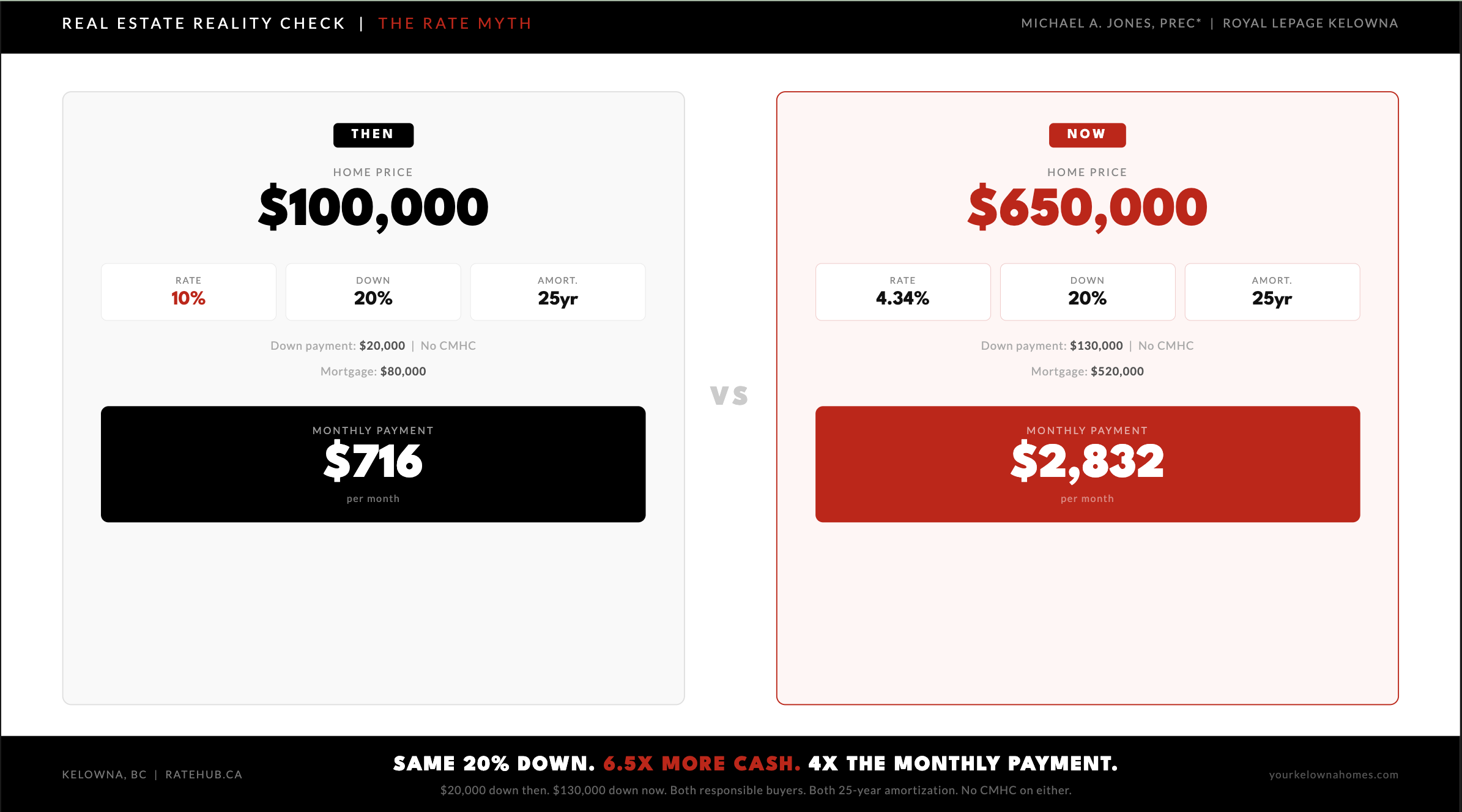
A $100,000 home at 10% cost $716 a month. A $650,000 home today at 4.34% costs $2,832 a month. Same city. Same 25-year amortization. Same monthly payment frequency. Six and a half times the home price produced a mortgage payment four times larger, even with rates less than half as high.

Comparing 1980s mortgage rates to today's Kelowna home prices is apples to avocados


The Numbers, Side by Side

Here is the straight comparison with no spin. Both scenarios use 20% down, a 25-year amortization, and no CMHC insurance. Both buyers did everything right.

  • Then: $100,000 home, 10% rate, $20,000 down, mortgage of $80,000. Monthly payment: $716.
  • Now: $650,000 home, 4.34% rate, $130,000 down, mortgage of $520,000. Monthly payment: $2,832.

The "then" buyer needed $20,000 saved. The "now" buyer needs $130,000 saved before getting to the front door. One buyer saved for a year. The other saved for a decade. Both put down 20%. Both avoided mortgage insurance. One is celebrated as a homeowner. The other is told they are not trying hard enough.

Side by side mortgage payment comparison Kelowna 1980s versus 2026


Buyers Today Carry More of Everything

Buyers today carry more debt, need more income to qualify, and put down more cash just to reach the same front door. The rate is lower. Everything else is harder.

That is not an opinion. That is what the numbers show when you run them without nostalgia in the way.

"But We Got Paid Less Back Then."

Sure. And a pound of apples cost thirty cents.

You cannot compare 1985 wages to 2026 prices. Everything changed. The house. The salary. The grocery bill. You do not get to cherry-pick the rate and freeze everything else.

This is the core error in the argument. People isolate one variable, the interest rate, and treat everything else as constant. But nothing else was constant. Not the price of the home. Not the income required to qualify. Not the down payment needed to avoid CMHC insurance. Not the cost of living that made saving that down payment possible in the first place.

Pulling one number out of a completely different economic era and using it to dismiss today's buyer is not analysis. It is nostalgia with a calculator.

Compare an apple to an avocado and all you get is gross guacamole.

“Compare an apple to an avocado and all you get is gross guacamole.”

— Michael A. Jones, PREC* | Royal LePage Kelowna

What This Means for Buyers in Kelowna Right Now

Anyone who tells you today's market is easier because rates dropped from the highs of the "uphill both ways '80s" has not run the numbers.

The Kelowna market in 2026 rewards buyers who go in with clear eyes and accurate information. The rate environment is more favorable than it was two years ago. That is real and it matters. But lower rates did not reset home prices. They did not refund your down payment. They did not lower the income threshold your lender uses to qualify you.

If you are running the numbers on a move to the Central Okanagan and want to know what your situation actually looks like, that conversation starts with real figures, not a comparison to a market that no longer exists.

I run these numbers every week.

All for now,
Michael

This blog post is for general informational purposes only. Mortgage payment figures are calculated using publicly available rate and amortization tools and are provided for illustrative comparison only. They do not constitute financial advice, mortgage advice, or a guarantee of any rate or payment. Mortgage qualification, rates, and payments vary by lender, borrower profile, and market conditions. All figures are in Canadian dollars. Michael A. Jones is a licensed REALTOR® with Royal LePage Kelowna and is not a mortgage broker, financial advisor, or lender. For mortgage advice specific to your situation, consult a licensed mortgage professional.


April 5, 2026

Central Okanagan Market Update – April 2026

Michael A. Jones - PREC* | Royal LePage Kelowna

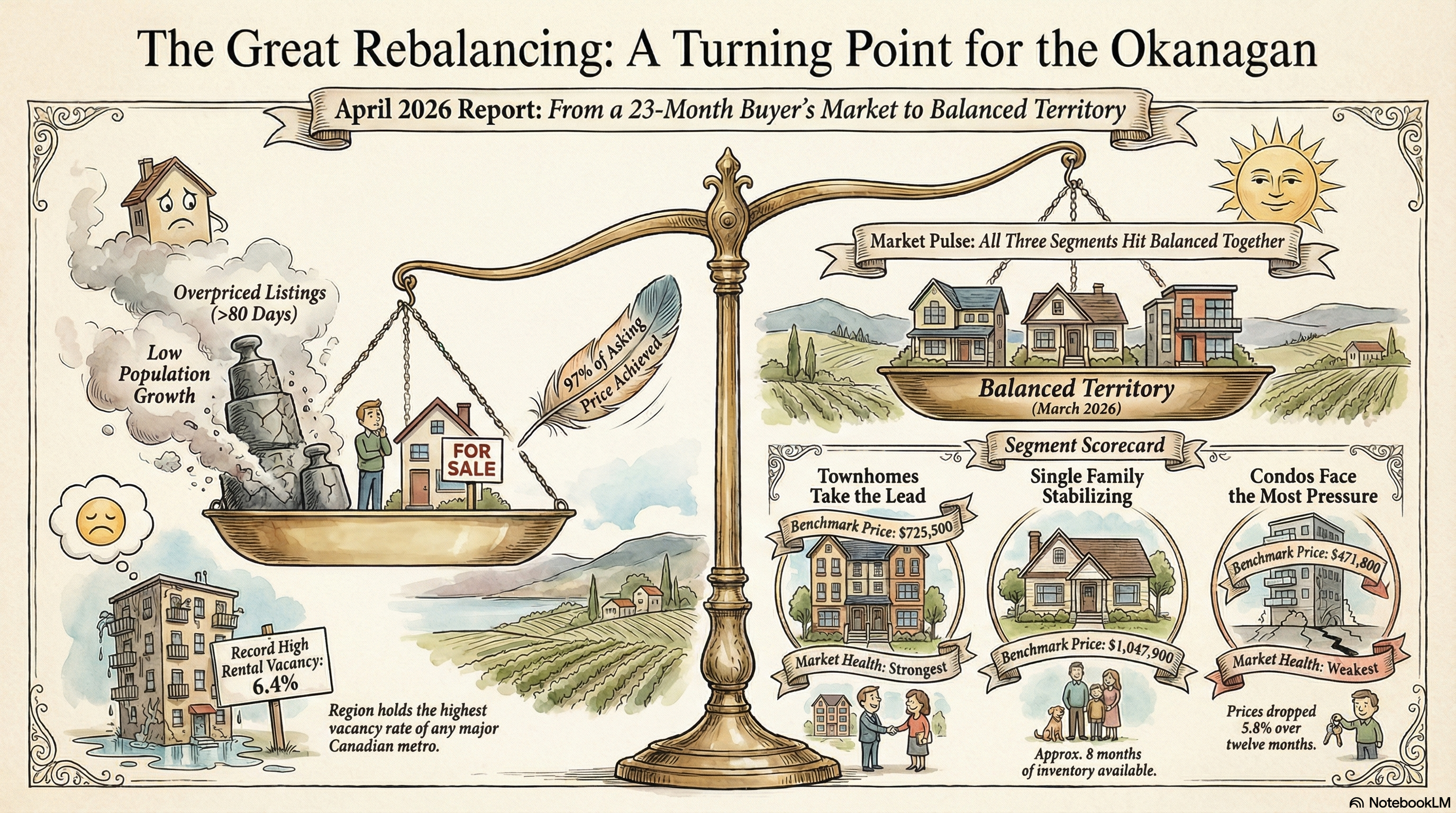
The Central Okanagan has spent 23 months in buyer's market territory. Since April 2024, every monthly report told the same story: more supply than demand, prices softening, homes sitting longer. The market tried to break out twice. October 2024 produced one month of balanced conditions. July 2025 produced another. Neither held past 30 days.

March 2026 delivered a third attempt. For the first time since April 2024, single family, condo, and townhouse segments all crossed into balanced territory in the same month. The question worth answering: what changed, and why does this attempt look different from the two that failed?

Central Okanagan real estate market update April 2026 by Michael Jones REALTOR Royal LePage Kelowna

The Central Okanagan includes Kelowna, West Kelowna, Lake Country, and Peachland. All figures in this report reflect residential sales data from the Association of Interior REALTORS®.

What Shifted: Supply Down, Demand Up — At the Same Time

Two things separated March from the false starts. First, inventory contracted. Active residential listings dropped to 2,801, down 9.6% from March 2025 and 22% from the June 2025 peak of 3,602. New listings came in 10.8% lighter than a year ago. Sellers who pulled listings over the winter have not all returned. Second, demand rose. March delivered 364 residential sales, up 33% from February and 6.1% above March 2025. Those two forces — shrinking supply and rising demand — moved together. In October 2024 and July 2025, only one side of the equation shifted.

Market at a Glance — March 2026

  • Sales: 364 residential (up 33.3% from February, up 6.1% from March 2025)
  • New Listings: 1,058 (up 12.9% from February, down 10.8% from March 2025)
  • Active Inventory: 2,801 (down 9.6% from March 2025)
  • Average Days to Sell: 65 (down 20.7% from February, up 4.8% from March 2025)
  • List-to-Sale Ratio: 97.0%

Days to sell dropped 17 from February to 65, the sharpest single-month improvement this year. The market still carries 8 months of inventory, above the 4 to 6 month balanced threshold, but that number has declined every month since June 2025. The list-to-sale ratio at 97.0% means sellers accept about 3% below asking on average. That gap narrows as inventory tightens.

Single Family Homes

  • Units Sold: 160 (up from 115 in February)
  • Average Price: $1,033,292 (up 0.7% from February)
  • Median Price: $934,163 (up 7.0% from February)
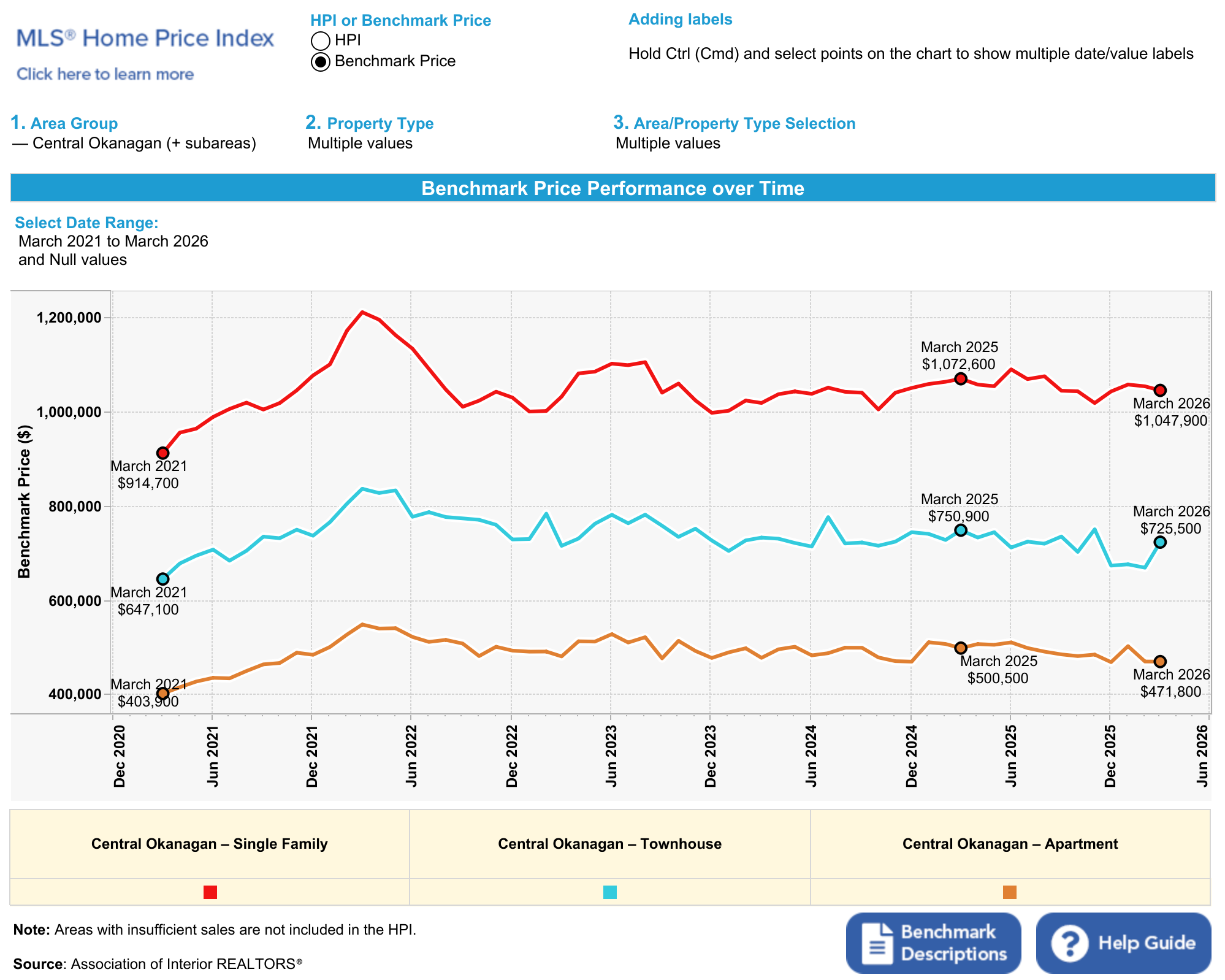
  • HPI Benchmark: $1,047,900
  • Days to Sell: 56 (down from 78 in February)
  • Active Listings: 1,139

160 sales compares to 148 in March 2025, an 8.1% year-over-year gain. The HPI benchmark at $1,047,900 tells the price story better than the average or median, because it tracks the same type of home over time rather than reflecting the mix of what sold. That benchmark sits 2.3% below March 2025 over 12 months, but up 0.2% over three months. The trough likely formed in the December to February window. Active listings dropped 16.2% from a year ago and new listings came in 20% lighter — the tightest supply picture for single family in over a year. The absorption rate crossed 14.05%, firmly in balanced territory.

Central Okanagan real estate market rebalancing chart showing the shift from buyer's market to balanced conditions in March 2026

Condos

  • Units Sold: 104 (up from 74 in February)
  • Average Price: $443,900 (down 10.7% from February)
  • Median Price: $421,967 (down 3.0% from February)
  • HPI Benchmark: $471,800
  • Days to Sell: 81 (up from 75 in February)
  • Active Listings: 756

Condos have carried the heaviest weight through the 23-month correction. The HPI benchmark at $471,800 dropped 5.8% over 12 months, the steepest decline of any segment. A condo buyer who purchased in 2023 now sits below breakeven. Two headwinds explain the gap. Kelowna's rental vacancy rate hit 6.4% in the most recent CMHC survey, the highest of any major Canadian metro, pushing investor buyers to the sidelines. And days to sell at 81 still runs 25 days longer than single family. The March signal mattered here, though. Condos crossed into balanced territory for the first time in 14 months at a 13.76% absorption rate, and unit sales jumped 13% year over year — the strongest growth rate of any segment. Recovery started later in this segment and has further to travel.

Townhomes

  • Units Sold: 62 (up from 45 in February)
  • Average Price: $780,184 (up 2.8% from February)
  • Median Price: $724,500 (up 11.5% from February)
  • HPI Benchmark: $725,500
  • Days to Sell: 60 (down from 77 in February)
  • Active Listings: 389

Townhomes arrived at the balanced line first and pushed furthest past it. The segment posted the highest absorption rate of any property type at 15.94%, the strongest list-to-sale ratio at 97.7%, and the lowest months of inventory at 6. The HPI benchmark at $725,500 jumped 8.1% in a single month. Townhomes occupy the price point between condos and detached homes, right where demand concentrates when single family pushes past the million-dollar mark. The year-over-year HPI still sits 3.4% below March 2025, but the three-month trajectory points upward at 7.4%. Of the three segments, townhomes showed the clearest momentum through the 23-month correction.

Kelowna and Central Okanagan HPI benchmark prices for single family condos and townhomes as of March 2026

Bank of Canada and Rate Environment

The Bank of Canada held the overnight rate at 2.25% on March 18. No move. The next announcement lands April 29, and market consensus points to another hold through the rest of 2026.

Canada's 5-year bond yield closed Q1 at 2.85%, up from the dip covered last month. Fixed rates track bond yields, not the overnight rate, and that climb pushed the best 5-year fixed to 3.89%. Best variable rates now sit at 3.45%, a 44 basis point discount below fixed. The trade-off remains the same: lower cost now with variable, or locked-in certainty with fixed.

Deloitte forecasts bond yields rising to 3.25% by Q4 2026, which would push the best fixed rates toward 4.10% to 4.25% by December. Variable stays tied to the overnight rate, and with the Bank holding at 2.25% through 2026, that 3.45% looks stable for now. Either way, today's rates sit near the low point for the year.

What This Means

March delivered the strongest structural signal this market has produced since April 2024. All three segments in balanced territory, inventory contracting from both the yearly and peak comparisons, and demand running above last spring. The two earlier breakout attempts collapsed because only supply or demand shifted, not both. This time, both moved.

That matters, but persistence matters more. April and May will confirm or deny the third attempt. Spring listings always bring fresh inventory. If absorption holds above 12% through May, the 23-month buyer's market chapter closes. If it fades after one month, we write the same footnote as October 2024.

Two things to watch beyond the local numbers. Bond yields point higher through December, and the best fixed rate available today at 3.89% likely represents the floor for the year. The CUSMA renegotiation scheduled for July carries weight across all of Canadian real estate. Trade clarity could unlock the second half of 2026. Uncertainty could extend the soft conditions well into 2027.

For 23 months, the Central Okanagan offered buyers something rare: time, selection, and negotiating room. March signalled that window may narrow. Whether you buy, sell, or watch — the next 60 days of data will tell us which story we write for the rest of the year.

If you're weighing your options in the Central Okanagan and want to talk through what these numbers mean for your specific situation, reach out here or call me at 250-258-4663.

All for now,
Michael

This report is for general informational purposes only and does not constitute real estate, financial, or investment advice. Market data sourced from the Association of Interior REALTORS®. Figures reflect the Central Okanagan region and may not apply to individual properties or transactions. Past market performance does not guarantee future results. Always consult a qualified professional for advice specific to your situation. Michael A. Jones is a licensed REALTOR® with Royal LePage Kelowna.

Read last month's report: Central Okanagan Market Update – March 2026


March 30, 2026

What the Iran War Actually Means for Kelowna Real Estate

Michael A. Jones - PREC* | Royal LePage Kelowna

Every headline right now is framing the Iran war and rising oil prices as bad news for real estate. Most of what you will find online agrees: uncertainty is bad, oil is bad, recession risk is bad, therefore housing is bad.

I want to argue the other side. Not because I am being contrarian for the sake of it, but because the structural data for Kelowna specifically points in a different direction than the headlines suggest. If you are a serious buyer who is already qualified and already motivated, this post is for you.

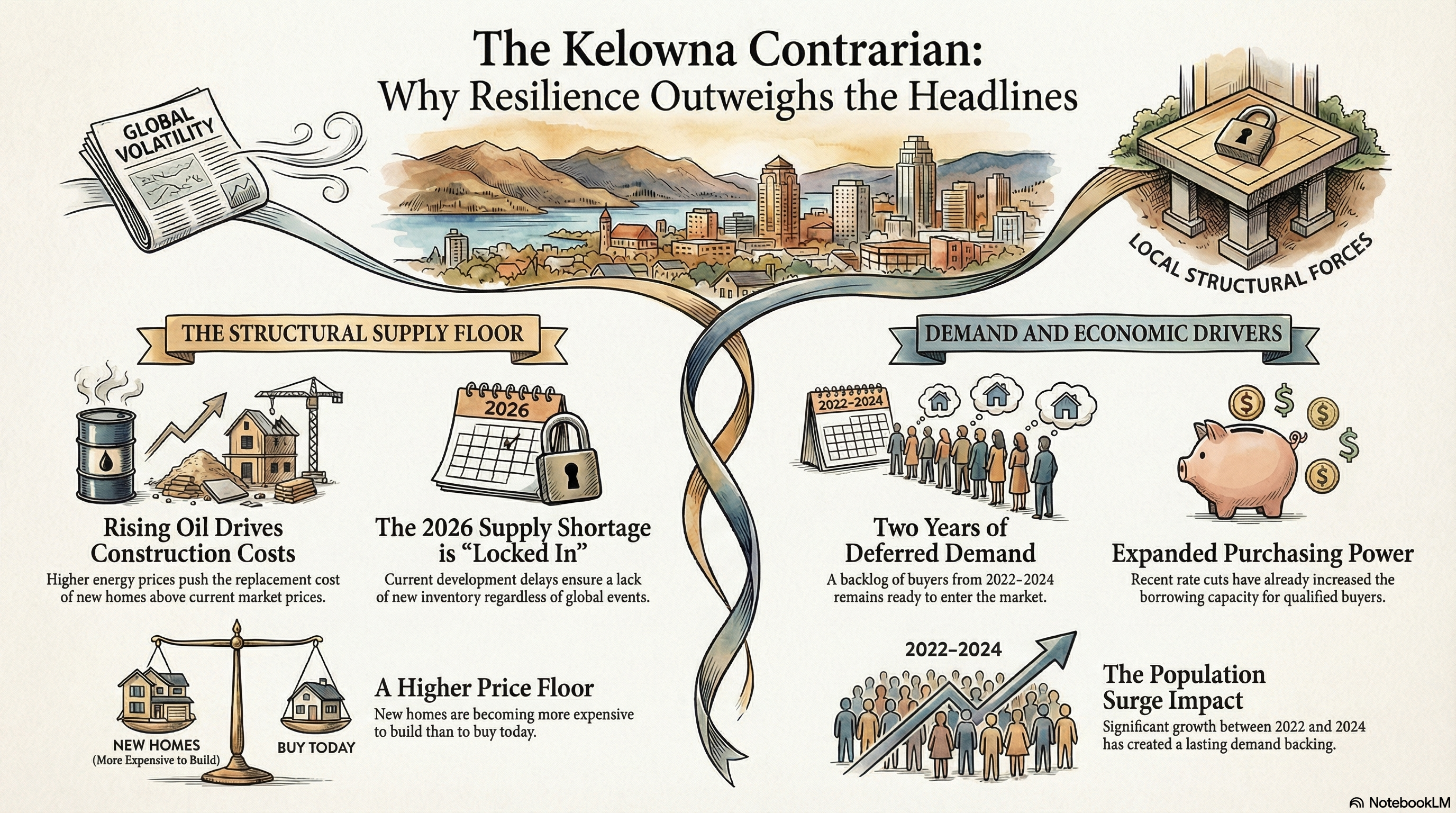
The Kelowna contrarian perspective on real estate during global uncertainty in 2026

The Honest Caveat First

I am not going to tell you prices will definitely rise no matter what. That claim overstates the case and I would rather be straight with you than sell you a feeling.

The realistic risk is this: if the oil shock triggers a recession severe enough to spike unemployment, demand does not just soften, it collapses. A collapsed buyer pool means distressed sellers do not wait for structural floors. They sell. Prices drift down. That scenario is real and worth naming.

What I am arguing is more specific. The structural forces already in motion in Kelowna are stronger than the headlines. For a buyer who is ready to act, the case for moving forward is more defensible than the case for waiting. Here is why.

Higher Oil Raises the Cost of Building, Not Just Buying

This is the argument most commentators miss. They see rising oil and conclude housing becomes less affordable. That is true for buyers. It is also true for builders, and the builder side of the equation matters more for prices in a supply-constrained market like Kelowna.

Construction in the Okanagan runs $300 to $425 per square foot before land in 2026. A 2,000 square foot home costs $600,000 to $850,000 to build before the lot, permits, and development cost charges. BC Energy Step Code compliance adds $15 to $40 per square foot on top of that. Construction costs rose 4% year-over-year in 2025, double the Bank of Canada's inflation target. Labour costs are up another 4% to 7% in 2026.

Brent crude surged from $73 per barrel on February 27 to above $113 by late March 2026 after the closure of the Strait of Hormuz. Oil feeds directly into construction through fuel surcharges on material transport, asphalt, petroleum-based building products, and equipment operation. Fertilizer disruptions raise food costs, which puts upward pressure on wages. Higher oil makes every construction input more expensive.

When resale prices fall below what it costs to build, builders stop building. Supply tightens. Prices recover. That mechanism does not care about global sentiment. It is arithmetic.

In most Kelowna family neighbourhoods, the all-in replacement cost of a new home sits at or above current resale prices. The gap between what you pay for a resale home and what it would cost to build a comparable one is narrow. Higher oil narrows it further.

Rising construction costs and inflation impact on Kelowna real estate market 2026

The Supply Shortage for 2026 Was Already Locked In Before the War

Housing supply operates on a multi-year lag. The homes available in Kelowna in 2026 were started in 2023, 2024, and 2025. The war did not change that. You cannot reverse a construction decision already made.

CMHC projects housing starts in BC will slow through 2026, with a more significant decline in 2027 and 2028. Condominium presales in Vancouver collapsed. Developers cannot reach the presale thresholds required to secure financing. New project launches have stalled.

Nationally, Canada needs 430,000 to 480,000 new units per year to restore affordability. In 2025, the country built 259,028. That is a 40% to 46% shortfall. 60% of the national housing supply gap is concentrated in Ontario and British Columbia. The Okanagan is part of that picture.

The war did not create this shortage. It will not resolve it either. The pipeline is thinning regardless of what happens in the Middle East.

Two Years of Deferred Buyers Are Still Waiting

BC experienced more than two years of below-average sales activity. BCREA reports MLS residential sales fell 2.2% in 2025 to 72,840 units, well below the long-term average. That suppressed activity represents deferred demand. People who needed to buy waited. Most of them are still waiting.

BCREA forecasts a 12% increase in MLS residential sales for 2026. A Leger survey found 10% of Canadians plan to buy in the next 12 months, up from 7% in mid-2025. Coldwell Banker reports millennial purchase intent rose to 20% in early 2026.

Deferred demand does not require optimism to release. It requires only that the most urgent buyers, those with expired leases, growing families, job relocations, and mortgage renewals, stop deferring. Those circumstances do not wait for global clarity.

In Kelowna specifically, active listings are elevated and detached homes and townhomes remain undersupplied relative to the type of buyer entering the market. When deferred demand releases into mismatched inventory, prices rise on the segments people actually want.

The Bank of Canada Cannot Hike Into This

The Bank of Canada cut its overnight rate nine times between June 2024 and October 2025, dropping it from 5.0% to 2.25%. It held steady through three consecutive announcements in early 2026, including after oil surged past $100.

Variable mortgage rates sit near 3.35%. Fixed rates sit around 3.7% to 3.9%. The purchasing power those cuts created is already in buyer budgets.

Here is the constraint the Bank faces: oil-driven inflation is cost-push, not demand-pull. Hiking rates into cost-push inflation slows an already weak economy without addressing the source of rising prices. Canadian GDP growth is projected at 0.7% for 2026. Hiking aggressively into a supply-side shock at 0.7% GDP growth is a policy error the Bank has shown no willingness to make.

If rates hold flat, the purchasing power gains already in place continue to support prices. If rates fall further because the economy weakens, purchasing power expands and prices rise faster. The scenario that genuinely threatens Kelowna prices requires a significant rate increase combined with spiking unemployment. That combination is not the path the Bank is on.

What This Actually Means for a Kelowna Buyer Right Now

Kelowna is a buyer's market by the numbers today. Active listings are elevated. Days on market are longer than 2022 and 2023. The list-to-sale ratio gives you negotiating room that did not exist two years ago.

That window is structural, not permanent. Construction costs are rising. The supply pipeline is thinning. Deferred buyers are preparing to act. Purchasing power from rate cuts is in place. None of those conditions reverse because of what is happening in the Strait of Hormuz.

If you are moving from Calgary or coming from Ontario, the equity math still works in your favour. The gap between what your home sells for there and what you can buy here has not closed. You are still arriving with more purchasing power than a local buyer building from scratch.

The question is not whether conditions are perfect. They are not. The question is whether waiting 12 months improves your position. Based on what the structural data says, it does not.

If you want to run the numbers on a specific property or neighbourhood in Kelowna, call me. I will give you the data without the noise.

All for now,
Michael

This blog post is for general informational purposes only. It does not constitute financial advice, investment advice, or real estate advice specific to your circumstances. Market projections, construction cost estimates, interest rate commentary, and economic forecasts referenced in this post are sourced from third parties including BCREA, CMHC, the Bank of Canada, Leger, and Coldwell Banker; they represent forward-looking estimates and are subject to change. Past market conditions are not a guarantee of future performance. Real estate decisions involve significant financial risk and should be made in consultation with a licensed REALTOR®, mortgage professional, and financial advisor. Michael A. Jones is a licensed REALTOR® with Royal LePage Kelowna and is not a financial advisor, mortgage broker, or investment professional.


March 15, 2026

The Okanagan Loophole: How American Buyers Can Still Purchase Property in BC

Michael A. Jones - PREC* | Royal LePage Kelowna

If you are an American looking at property in the Okanagan, you have probably heard about Canada's foreign buyer ban. You may have assumed that closes the door on you. It does not. The ban has a geographic exemption built into it, and parts of the Okanagan fall outside the boundary where the ban applies.

The opportunity is real. The costs are also real. This post lays out both so you can make an informed decision before you spend time or money on a search.

Naramata Okanagan BC property available to American buyers outside the foreign buyer ban boundary

Photo: Expedia.com

How the Foreign Buyer Ban Actually Works

The Prohibition on the Purchase of Residential Property by Non-Canadians Act came into force in January 2023. It prohibits non-Canadians from purchasing residential property in Canada until January 1, 2027.

The key word is "where." The ban only applies to properties located within a Census Metropolitan Area (CMA) or Census Agglomeration (CA) as defined by Statistics Canada. A CMA requires a total population of at least 100,000 with 50,000 or more in the urban core. A CA requires a core population of at least 10,000. Properties outside those boundaries are legally exempt from the ban.

Kelowna is a CMA. The ban applies there. But not every Okanagan community sits inside a CMA or CA boundary.

Where the Exemption Applies in the Okanagan

Naramata is a confirmed example. It sits near the Penticton CA but falls outside its boundary. American buyers can legally purchase residential property in Naramata right now.

Naramata is not an obscure rural outpost. It sits on the east bench of Okanagan Lake, south of Kelowna. Vineyards, lake views, and a tight community. It is exactly the kind of place American buyers are looking at when they picture an Okanagan property.

Other rural and semi-rural Okanagan communities may also fall outside CMA and CA boundaries. Each property needs to be verified individually because boundaries do not always follow municipal lines.

CMHC provides an interactive map tool for this. You enter any property address and it tells you whether the ban applies. Use it before you get attached to a listing.

Check Any Okanagan Address on the CMHC Map Tool

Being Exempt from the Ban Is Not the Whole Picture

This is where American buyers need to slow down and read carefully. Clearing the federal foreign buyer ban is step one. There are additional costs that apply specifically to non-Canadian buyers in BC, and they are significant.

BC Additional Property Transfer Tax: 20%

BC imposes a separate Additional Property Transfer Tax of 20% of the property's fair market value on foreign nationals purchasing residential property in designated regions. The Regional District of Central Okanagan is one of those regions.

This tax applies regardless of whether the property is inside or outside a CMA or CA boundary. Being exempt from the federal ban does not exempt you from this provincial tax.

On a $1,000,000 purchase, you owe approximately $200,000 in Additional PTT on top of the standard BC Property Transfer Tax. On top of that, the standard PTT on a $1,000,000 purchase is $18,000 (1% on the first $200,000, 2% on the next $1,800,000).

That is $218,000 in transfer taxes on a $1,000,000 purchase. Factor this into your budget before you go any further.

Some limited exemptions to the Additional PTT exist, including for BC Provincial Nominees. Confirm applicability with a qualified BC real estate lawyer before you proceed.

BC Speculation and Vacancy Tax: 3% Annually

BC levies an annual Speculation and Vacancy Tax on residential properties in designated regions. For foreign owners, the rate is 3% of the property's assessed value annually beginning in 2026.

This applies even if the federal ban does not. A property exempt from the foreign buyer ban can still be subject to the SVT every year you own it.

On a $1,000,000 property assessed at market value, that is $30,000 per year. Properties rented for a sufficient portion of the year may qualify for an exemption. A BC tax professional can confirm eligibility for your specific situation.

Standard BC Property Transfer Tax

All buyers, including Canadians, pay the standard BC Property Transfer Tax at the time of purchase. The rates are:

  • 1% on the first $200,000
  • 2% on the portion from $200,000 to $2,000,000
  • 3% on the portion from $2,000,000 to $3,000,000
  • 5% on any portion above $3,000,000

On a $1,000,000 purchase, this amounts to $18,000. For a non-Canadian buyer in the Central Okanagan, both the standard PTT and the 20% Additional PTT are owed at closing.

GST on New Construction

If the property is newly constructed, federal GST of 5% applies to the purchase price. Resale properties are not subject to GST. Some rebates exist for properties below certain price thresholds used as a primary residence, but these have limited application for non-resident foreign buyers. Confirm GST treatment with your lawyer before you commit.

Rental Income and Canadian Tax Obligations

If you plan to rent the property, you are subject to Canadian income tax on that rental income. A 25% withholding tax applies to gross rental income by default. You can elect to be taxed on net income instead by filing a Canadian tax return, which allows you to deduct eligible expenses including mortgage interest, management fees, and repairs.

US citizens must also report rental income to the IRS. The Canada-US Tax Treaty may provide credits to reduce double taxation, but a cross-border tax professional should be involved before you start renting.

Capital Gains When You Sell

When a non-resident sells Canadian property, any capital gain is subject to Canadian tax. The buyer's lawyer is required to withhold a portion of the sale proceeds at closing until the non-resident seller obtains a Clearance Certificate from the Canada Revenue Agency confirming their tax obligations are settled.

US citizens must also report the gain to the IRS. Treaty credits generally apply. Plan this in advance with a cross-border tax professional, not after you accept an offer.

Navigating the foreign buyer ban for US buyers purchasing property in the Okanagan BC

Photo: Expedia.com

Financing as an American Buyer

Getting a Canadian mortgage as a foreign national is possible. It is more restrictive than for Canadian residents. Most Canadian lenders require a down payment of 35% or more from non-residents, apply stricter income qualification criteria, and charge higher rates. US income can generally be used to qualify, but currency conversion and documentation requirements vary by lender.

Some buyers choose to purchase with cash or use US-based equity to avoid these complications. Either way, engage a Canadian mortgage broker experienced with non-resident buyers early in the process, before you make an offer.

Your Full Cost Checklist

Here is a summary of the costs that may apply to a non-Canadian buyer in the Okanagan. Not every item applies in every situation. Verify each one with legal and tax professionals before you proceed.

  • At purchase: Standard BC Property Transfer Tax (applies to all buyers)
  • At purchase: Additional BC Property Transfer Tax at 20% of fair market value (Central Okanagan, foreign nationals)
  • At purchase, new construction only: GST at 5% of purchase price
  • Annually: BC Speculation and Vacancy Tax at 3% of assessed value for foreign owners (unless exempt)
  • Annually, if renting: Canadian income tax on rental income (25% withholding on gross, or net income election)
  • On sale: Canadian capital gains tax; Clearance Certificate required from CRA before proceeds are released

What to Do Next

If you are an American buyer seriously looking at Okanagan property, the first step is to verify whether the specific properties you are interested in fall outside the CMA or CA boundary. Use the CMHC map tool linked above. Do that before anything else.

The second step is to get a BC real estate lawyer involved early. The provincial tax obligations for non-Canadian buyers are material. You need confirmed numbers, not estimates, before you write an offer.

If you want to talk through what is available in exempt areas of the Okanagan, I am happy to help. I work with buyers from the US regularly and I know where to look.

Contact me here and we can start with the basics.

All for now,
Michael

This blog post is for general informational purposes only. It does not constitute legal advice, tax advice, or financial advice. The Prohibition on the Purchase of Residential Property by Non-Canadians Act, its Regulations, and all referenced provincial tax legislation are subject to change. The foreign buyer ban is currently set to expire January 1, 2027. Geographic boundaries for CMA and CA designations should be verified using the CMHC interactive map tool for each specific property address. BC Additional Property Transfer Tax exemptions, Speculation and Vacancy Tax exemptions, and GST treatment must be confirmed with a qualified BC real estate lawyer and tax professional for your specific transaction. Canadian income tax obligations for non-residents, including withholding tax on rental income and capital gains tax on sale, should be reviewed with a Canadian accountant experienced in non-resident taxation. US citizens should also consult a cross-border tax professional regarding obligations to the IRS. Michael A. Jones is a licensed REALTOR® with Royal LePage Kelowna and is not a lawyer, tax advisor, or financial professional.


March 14, 2026

What Canada's February Jobs Report Means for Kelowna Real Estate Buyers

Michael A. Jones - PREC* | Royal LePage Kelowna

On March 13, 2026, Statistics Canada released the February Labour Force Survey. Canada lost 84,000 jobs. The unemployment rate climbed to 6.7%. Economists had expected a gain of 10,000 jobs. This was not a rounding error. It was one of the weakest monthly jobs reports in years outside of the pandemic.

BC lost 20,200 jobs in February. The provincial unemployment rate held at 6.1%, but only because people stopped looking for work altogether, not because conditions improved. Construction and finance, insurance, and real estate were among the hardest hit sectors in the province.

If you are watching the Kelowna real estate market, this report matters. Not because it crashes anything. It does not. But because it changes the calculation in specific, measurable ways.

Here is what you need to know.

Kelowna marina at night reflecting on Okanagan Lake, spring 2026

Photo: Amernhel Pascua

What the Numbers Actually Say

The national headline is 84,000 jobs lost in February. Full-time employment dropped by 108,000 positions. Private sector jobs fell by 73,000. Youth unemployment jumped to 14.1%. The labour force itself shrank, which is what kept the official unemployment rate from rising even higher.

For BC specifically, the 20,200 job losses were the province's largest since the pandemic. The sectors that took the biggest hits included construction (-6,900 jobs), finance, insurance, and real estate (-5,400 jobs), and health care (-4,900 jobs). Some gains appeared in accommodation and food services (+7,200) and technology (+5,300), but they were not enough to offset the losses elsewhere.

BC's unemployment rate of 6.1% is the fourth lowest in Canada. That context matters. Ontario sits at 7.6%. Alberta is at 6.3%. The national rate is 6.7%. BC is not immune to what is happening, but it is not leading the decline either.

What This Means for the Bank of Canada

The Bank of Canada held its policy rate at 2.25% at its January 28 meeting. The next decision is Wednesday, March 18, 2026.

The February jobs report changes the tone heading into that announcement. A report this weak makes it harder for the Bank to maintain a neutral or hawkish stance. Most economists as of mid-March were predicting a hold, but several noted the data opens the door to a cut.

Here is why this matters for you as a buyer: fixed mortgage rates in Canada track the 5-year Government of Canada bond yield, not the overnight rate directly. As of early March 2026, the best 5-year fixed rates were sitting near 3.79%. Variable rates also remain available and competitive.

The 2026 jobs report and what it means for Kelowna real estate buyers

If the jobs data leads to a rate cut, or simply shifts market expectations toward future cuts, bond yields can decline and fixed mortgage rates can follow. That directly affects what you can afford.

What to watch: Check the Bank of Canada announcement on March 18 at bankofcanada.ca. Do not make rate assumptions based on what was true last month.

What This Means for the Kelowna Real Estate Market

Kelowna entered 2026 already in a buyer's market. Active inventory is elevated. Days on market have increased. The list-to-sale ratio sits near 96%, which means buyers routinely get properties for 4% below asking. February saw a 22.6% month-over-month increase in sales compared to January, and townhome sales rose 25% in the same period. The spring market was beginning to show some life.

A weak national jobs report introduces friction into that recovery. It does not reverse it. But it does some specific things worth noting:

  • Buyer confidence slows. Households facing job uncertainty, or who know someone facing it, pull back on large financial commitments. This is rational. It extends the window during which buyers have negotiating room.
  • Seller urgency can increase. Homeowners who are employed in affected sectors may become motivated sellers. Motivated sellers price to move. That creates opportunity for prepared buyers.
  • New build risk rises. Kelowna already had pre-sale condo projects where appraisals came in below contract prices. Weaker employment conditions make lenders more conservative. If you are buying a new build or a pre-sale unit, understand your appraisal risk before you firm up.
  • Relocation buyers may pause. Alberta's unemployment rate is 6.3%. Some of the equity buyers that Kelowna relies on as a feeder market are also watching their own job security before they pull the trigger on a relocation purchase.

What Smart Buyers Will Do Right Now

Economic uncertainty creates hesitation in the market. Hesitation is often misread as lack of opportunity. It is not. It means the people competing against you have paused. If your own employment is stable and your financing is in order, this is worth paying attention to.

Here is what the buyers who end up with good outcomes do in markets like this one:

  • Get pre-approved now, not after rates move. Pre-approval locks your rate for a period. If rates drop between now and when you write an offer, you benefit. If they rise, you are protected. Waiting to see what happens is not a neutral position. It is a gamble.
  • Focus on your household's income stability, not the headlines. Canada losing 84,000 jobs is significant. Whether those jobs are in your industry, your company, or your household is a separate question. Buy based on your actual financial position.
  • Understand the difference between fixed and variable rate risk. Fixed mortgage rates track bond yields. Variable rates track the overnight rate. These move for different reasons at different times. Ask your mortgage professional to walk you through both scenarios with current numbers before you commit to either.
  • Negotiate harder on properties that have been sitting. Kelowna's inventory is elevated across most property types. Properties over 60 days on market are candidates for meaningful price reductions. The February data gives buyers additional leverage to ask for it.
  • Build in longer subjects. An uncertain economic backdrop is not the time to waive financing or inspection conditions to compete. You do not need to compete right now. There is enough inventory to be deliberate.

What to Watch Out For

There are also some traps in this environment worth naming directly.

Waiting indefinitely for the perfect conditions. If you are waiting for rates to drop further and the jobs market to stabilize and prices to fall and inventory to increase, you are stacking conditions that may not arrive simultaneously. Each of those factors moves on its own timeline. Buyers who waited through 2024 for a rate cut that came later than expected ended up paying for that delay in other ways.

New build appraisal gaps. Several Kelowna condo projects already have buyers facing appraisal shortfalls at completion. Weaker economic conditions can widen that gap. If you are considering a pre-sale unit, price the worst-case scenario: what happens if the appraisal comes in 10% below your contract price? Do you have the cash to bridge it?

Over-leveraging on the assumption that rates will drop significantly. The Bank of Canada is at 2.25%. Before the 2024 rate cutting cycle began, the rate was at 5%. Nine cuts brought it down. Most economists now expect the rate to hold at 2.25% through end-2026, with cuts only possible if economic conditions deteriorate further. Do not build your purchase plan on a rate that does not yet exist.

Confusing a slow market with a broken market. Kelowna is not broken. Prices on single-family homes are holding. The million-dollar benchmark for detached homes in the Central Okanagan remains intact. The market is slow and selective, not collapsing. Buyers who conflate those two things either overpay for fear of missing out or miss good properties while waiting for a crash that is not coming.

The Bigger Picture

Canada's economy has faced meaningful headwinds in early 2026. U.S. tariffs, trade uncertainty, and a labour market that has given back most of last fall's gains are real factors. BC has held up better than most provinces, but 20,200 job losses in a single month is not noise.

For Kelowna buyers, the practical reality is this: the market was already tilted in your favour before this report came out. The jobs data extends the window during which that remains true. It may also create downward pressure on fixed mortgage rates if the Bank of Canada moves or markets price in future cuts.

That combination, more inventory, more time, motivated sellers in certain segments, and potentially lower borrowing costs, is not a reason to panic. It is a reason to be prepared.

If you want to understand how the current data applies to your specific situation in Kelowna, call me. I will give you the numbers as they actually stand, not as they were six months ago.

All for now,
Michael

This blog post is for general informational purposes only. It does not constitute financial advice, mortgage advice, or investment advice. Labour market conditions, interest rates, and real estate market data change frequently and may have shifted after the date of publication. Bank of Canada rate decisions should be confirmed directly at bankofcanada.ca before making any financing decisions. Mortgage rate information should be verified with a licensed mortgage professional. Real estate market conditions vary by property type, neighbourhood, and individual transaction. Michael A. Jones is a licensed REALTOR® with Royal LePage Kelowna, registered with the BC Financial Services Authority (BCFSA) and a member of the Canadian Real Estate Association (CREA). He is not a mortgage professional, financial advisor, or economist. For financial planning and mortgage decisions, consult a licensed mortgage professional and a qualified financial advisor.


March 13, 2026

5 Things Vancouver Buyers Don't Expect About the Kelowna Real Estate Market

Michael A. Jones - PREC* | Royal LePage Kelowna

You have bought property in Vancouver or the Lower Mainland. You know how BC real estate works. You understand subjects, strata, PTT, and the pace of a competitive market.

Kelowna is still BC. But the Central Okanagan operates differently in ways that catch Vancouver buyers off guard. Some of the differences are logistical. Some affect your financing. Some can affect whether you can insure the property at all.

Here are five things you need to know before you start writing offers in this market.

Night photo of Kelowna taken from West Kelowna by James A. Jansen

1. Many Homes Are on Well Water and Septic

In Metro Vancouver, municipal water and sewer are standard. In the Central Okanagan, they are not universal.

A significant number of properties in Kelowna and the surrounding area rely on private wells for drinking water and septic systems for waste. This applies to rural and semi-rural properties, acreage, lake-access homes, and older subdivisions outside city utility boundaries. It also applies to some properties that look, from the street, like ordinary suburban homes.

What this means for you as a buyer:

  • You need a well water test before you remove subjects. This checks water quality, flow rate, and recovery. Flow rate matters if you are planning for irrigation, a pool, or a large household.
  • You need a septic inspection. A licensed inspector assesses the tank, field, and overall system condition. A failing septic system is expensive to replace.
  • Both tests take time. Build them into your subjects timeline.
  • The costs for well and septic maintenance fall entirely on you as the homeowner. There is no municipal utility managing the infrastructure.

Your realtor should disclose well and septic status upfront. If you are viewing properties and this has not come up, ask directly.

2. Wildfire Insurance Is Not a Formality

Kelowna has experienced major wildfires. The 2003 Okanagan Mountain Park Fire, the 2009 fires, and the 2023 McDougall Creek Fire each caused significant property losses. The insurance industry has responded.

For buyers, this means two things.

First, not every property in every neighbourhood qualifies for standard coverage at standard rates. Properties in the urban-wildland interface, which includes parts of the Lower Mission, Glenmore, Black Mountain, Lake Country, and the west side, may face limited insurer options, higher premiums, or specific exclusions around fire.

Second, confirming insurability should happen before you remove subjects. Do not wait until closing week to call an insurer. Some buyers have found themselves committed to a purchase on a property where insurance was difficult to obtain or priced significantly higher than budgeted.

Get quotes during your subject period. Treat it like a financing condition, not an afterthought.

If you are buying in a higher-risk zone, also look at FireSmart compliance. Some insurers factor property-level mitigation into their underwriting decisions.

3. Some of the Best-Located Properties Are on Leasehold Land

This one surprises almost every buyer from the Lower Mainland.

A substantial portion of West Kelowna real estate sits on Westbank First Nation reserve land. WFN has been self-governing since 2005 under its own constitution and land registry. When you buy on WFN land, you purchase a long-term sublease, typically 99 or 125 years, rather than fee simple title. You own the home. You do not own the ground beneath it.

Vancouver buyers are sometimes familiar with the concept of leasehold from areas like False Creek or the Musqueam lease lands. WFN leasehold operates under a different legal framework, but the core concept is similar.

The practical differences:

  • Fewer lenders offer leasehold mortgages. Your Vancouver lender may not fund this purchase. You need to confirm your lender approves the specific development before you make an offer.
  • Governance is through a Homeowner Association rather than a strata corporation under BC's Strata Property Act. Review the head lease and sublease documents carefully. The rules that govern the property flow from those documents, not provincial strata legislation.
  • Most WFN leasehold properties are exempt from BC's Property Transfer Tax. On an $800,000 purchase, that saves you roughly $12,000 at closing.
  • WFN properties are also exempt from BC's Speculation and Vacancy Tax, even though Kelowna and West Kelowna are designated taxable regions for freehold properties.

Leasehold is not inferior ownership. It is different ownership. Some of the most desirable locations in the area sit on WFN land precisely because that land was never available for freehold subdivision. Understand what you are buying, verify your financing, and read the documents.

4. The Market Pace Is Different

The Lower Mainland has conditioned many buyers to expect urgency: limited inventory, multiple offers, waived subjects, and quick decisions. Kelowna does not operate that way right now.

As of early 2026, the Central Okanagan is a buyer's market. The list-to-sale ratio for residential properties is running near 96%. Homes are sitting on the market longer. Sellers are negotiating. Subject offers are accepted.

This is not a weakness in the market. It is an advantage for you as a buyer. But it requires a different mindset.

Buyers who arrive from Vancouver expecting that they need to act in 48 hours sometimes overbid out of habit when there is no competing offer driving the price. Take your time. Use the market conditions. The subjects you waived in Vancouver to be competitive should be back in your offers here.

Well inspection, septic inspection, insurance confirmation, title review, strata or HOA document review. All of it. Put it in the contract.

5. BC Property Transfer Tax Applies, But Not Always the Way You Think

PTT is not news to you. You have paid it before. But there are two things in the Kelowna market that are worth understanding specifically.

First, as covered above, most WFN leasehold properties are exempt from PTT. When you are comparing a $750,000 leasehold property in West Kelowna to a $760,000 freehold property across the bridge, the PTT difference changes the real cost comparison by approximately $10,000 to $12,000. Factor that in before you decide a freehold property is cheaper.

Second, the BC First Home Buyers' Exemption has income and purchase price thresholds. As of 2026, the full exemption applies to purchases up to $500,000, with a partial exemption to $525,000. The Kelowna market sits mostly above these thresholds for detached homes. Condos and some townhomes may qualify. Know whether you are eligible before you budget closing costs.

Closing costs in BC on a freehold purchase typically run between 1.5% and 4% of the purchase price depending on PTT, legal fees, title insurance, home inspection, and any lender fees. Budget on the higher end until you have quotes in hand.

One More Thing: Local Market Knowledge Still Matters

The Central Okanagan has distinct micro-markets. Lower Mission, Glenmore, Lake Country, West Kelowna, and Peachland each behave differently. Inventory levels, buyer demand, and typical price negotiation vary by area and property type.

A buyer's agent who knows the market and is not also representing the seller is not a formality here. The surprises in this list are things a good local agent flags before you make an offer, not after.

If you are relocating from Vancouver or buying in Kelowna for the first time, reach out. I will walk you through the specific properties you are considering and make sure you understand exactly what you are buying.

All for now,
Michael

This blog post is for general informational purposes only. It does not constitute legal advice, insurance advice, mortgage advice, or financial advice. Well water, septic, leasehold ownership structures, wildfire insurance, Property Transfer Tax treatment, and financing eligibility all vary by property and individual transaction. Buyers are strongly encouraged to engage qualified professionals, including a licensed BC real estate lawyer, a mortgage broker familiar with leasehold financing, and a licensed insurance broker, before committing to a purchase. Michael A. Jones is a licensed REALTOR® with Royal LePage Kelowna, regulated by the BC Financial Services Authority (BCFSA) under the Real Estate Services Act. He is not a lawyer, mortgage professional, or insurance advisor. This content references general market conditions as of early 2026 and is subject to change. Verify all information specific to your transaction with qualified professionals.