This blog covers the Kelowna and Central Okanagan real estate market with straightforward information you can actually use. You'll find local market stats, buyer education, neighbourhood breakdowns, and commentary on what's happening in the Okanagan. No fluff. Written by Michael A. Jones - PREC*, a REALTOR® with Royal LePage Kelowna.

March 12, 2026

What Your Toronto Equity Buys in Kelowna, and What It Doesn't

Michael A. Jones - PREC* | Royal LePage Kelowna

What to know:

  • Toronto detached homes averaged $1,325,654 in February 2026 (TRREB); Kelowna single-family detached averaged $1,025,816 (Association of Interior REALTORS) — a spread of about $300,000 in Kelowna's favour.
  • A Toronto detached seller often walks with $800,000 to $900,000 in net proceeds — enough to buy in most Kelowna neighbourhoods without a mortgage, or in a premium area with one that does not strain finances.
  • BC Property Transfer Tax runs about $16,000 on a $1 million Kelowna purchase. It is paid in cash at closing and cannot be added to the mortgage. Ontario buyers who already own a home do not qualify for the first-time buyer exemption.
  • BC Speculation and Vacancy Tax can apply if you close in Kelowna before establishing BC residency. Sequence the move carefully and confirm with a BC real estate lawyer.
  • New construction in Kelowna triggers 5% GST. Resale does not. The rebate phases out below $450,000 so most current buyers budget for the full amount on new builds.

I talk to a lot of buyers moving from Toronto. The conversation usually starts the same way: they have done rough math on a napkin, they like what they see, and they want to know if it holds up.

Sometimes it does. Sometimes the numbers are missing a few lines that matter. This post gives you the full picture.

The Sails sculpture at the Kelowna waterfront, Okanagan Lake, Kelowna BC

The Price Gap Between Toronto and Kelowna

Toronto prices have softened. Kelowna prices have moved sideways. The gap between the two markets still favours Toronto sellers in most property categories, but the spread is narrower than it was in 2021 and 2022. Here is where both markets sit as of early 2026.

Property Type Toronto (Feb 2026, TRREB) Kelowna (Early 2026, AIR)
Detached / Single Family $1,325,654 avg. $1,025,816 avg.
Semi-Detached / Townhome $1,027,376 avg. $759,138 avg.
Condo / Apartment $626,650 avg. $497,379 avg.

For detached sellers, Kelowna is actually cheaper than Toronto in this comparison. That gap is where your equity advantage lives. For condo sellers, the spread is narrower and the math requires more scrutiny.

What Toronto Is Paying Right Now

The GTA housing market has softened considerably. As of February 2026, the average selling price across all property types in the City of Toronto was approximately $1,008,968, down about 7 percent year-over-year (TRREB). Detached homes averaged $1,325,654. Condos averaged $626,650.

If you bought a detached home in Toronto in 2018 or earlier, you are likely sitting on significant equity even after the correction. If you bought a condo in 2020 or 2021 at peak pricing, your equity position may be tighter than you expect. Run your actual net proceeds, not the list price, before you plan your Kelowna budget.

What Kelowna Is Charging Right Now

The Central Okanagan is a buyer's market in 2026. Inventory is elevated, prices have moved largely sideways, and sellers are negotiating (Association of Interior REALTORS). That is a different environment than the one many Ontario buyers remember from a few years ago when Kelowna was generating multiple-offer situations.

Entry-level detached homes in areas like Rutland or Glenmore can come in below $1 million. Premium neighbourhoods like Lower Mission or Upper Mission push well above that. Townhomes have been steady in the $720,000 to $780,000 range. Condos start around $450,000 for older one-bedroom units and climb past $600,000 for downtown waterfront product.

For a Toronto detached seller, the equity math typically works well. You are moving from a market averaging $1,325,654 for a detached home into one averaging $1,025,816. That spread, combined with your accumulated equity, gives you real purchasing power. For a Toronto condo seller, the math is tighter and requires a honest look at your net proceeds before you set expectations.

The Costs Ontario Buyers Miss

The purchase price is the headline. The costs around it are where people get caught short.

BC Property Transfer Tax. Every buyer in BC pays this, regardless of where they are coming from. The rate is 1% on the first $200,000, then 2% on the amount between $200,000 and $2,000,000, and 3% on anything above $2,000,000. On a $1,000,000 purchase, that is $16,000 due at closing. Ontario buyers who have previously owned a home do not qualify for the first-time buyer exemption. Budget for this upfront.

Toronto buyers are familiar with land transfer tax because Ontario charges one, and the City of Toronto adds a second municipal layer on top. What catches some people off guard is that BC's version must be paid in cash at closing and cannot be rolled into the mortgage.

BC Speculation and Vacancy Tax. Kelowna and West Kelowna are both designated taxable regions. Canadian citizens who occupy the home as their primary residence are generally exempt. The issue arises if you close on your Kelowna purchase before you have formally relocated and established BC residency. In that gap, you may be subject to the SVT at 0.5% of assessed value annually. Sequence your move carefully and confirm your situation with a BC real estate lawyer before closing.

GST on new construction. If you are buying a newly built home or pre-sale unit in Kelowna, 5% GST applies. On an $800,000 new build, that is $40,000. There is a partial GST rebate available on primary residences, but it phases out as the purchase price increases and disappears entirely at $450,000. For most Kelowna buyers in the current price range, budget for GST in full on new builds. Resale homes are not subject to GST.

Home insurance. The Okanagan is wildfire country. If you are coming from Toronto, where insurance is largely predictable, be prepared for a different conversation here. Some properties in high-risk zones carry higher premiums or limited coverage. Ask your REALTOR® about the wildfire risk designation for any specific property before you make an offer, and get an insurance quote before you remove subjects.

What Your Equity Actually Buys, by Scenario

Here are three realistic scenarios based on current market data. Your actual numbers will depend on your specific sale price, mortgage balance, and transaction costs.

Scenario 1: Toronto detached seller. You sell for $1,325,000. After mortgage discharge, commissions, and legal fees, you walk away with roughly $800,000 to $900,000 in net proceeds. That equity positions you to buy a detached home in most Kelowna neighbourhoods without a mortgage, or to buy in a premium neighbourhood with a modest mortgage and no financial stress.

Scenario 2: Toronto semi-detached or townhome seller. You sell for $1,027,000. Net proceeds after costs land somewhere around $600,000 to $700,000. You can buy a detached home in Kelowna in the $900,000 to $1,100,000 range with a manageable mortgage, or buy a townhome outright and hold the remainder. Still a strong equity transfer.

Scenario 3: Toronto condo seller. You sell for $626,000. After costs and mortgage discharge, your net proceeds may be in the $300,000 to $450,000 range depending on when you bought and what you financed. In Kelowna, that is a solid down payment on a townhome or a near-cash purchase on a condo. A detached home requires a larger mortgage than you may have anticipated. This scenario works, but it requires realistic expectations about property type.

What Kelowna Is, and What It Is Not

Kelowna has Okanagan Lake, more than 2,000 hours of sunshine per year, a wine region, trails, and a downtown core that has changed substantially in the last decade. It is not a small town. It is a city of about 150,000 people in the broader metro area, with a regional hospital, university, airport, and a full range of professional services.

It is not Toronto. Transit is car-dependent. The professional job market is smaller and more concentrated in healthcare, technology, agriculture, and tourism. If you are working remotely, none of that matters. If you are planning to find employment after you arrive, research your specific sector before you sell your Toronto home.

The Sequencing Question

Most Ontario buyers ask the same practical question: do I sell first, or do I buy first?

In a buyer's market like Kelowna in 2026, you have time. Inventory is high. Selling first gives you a firm equity number and puts you in a position to write a clean offer. That matters to sellers even in a buyer's market. If you find a property in Kelowna before your Toronto home sells, subject-to-sale clauses are possible. They are not always accepted, but in a slower market with motivated sellers, they come up more often than they did two or three years ago.

How I Work With Out-of-Province Buyers

I work with buyers relocating from Ontario regularly. The first conversation is always about the full numbers, not just the purchase price. Once we know what you are actually bringing and what you are actually looking at in Kelowna, the search gets focused quickly.

If you are at the early stage of running the math, call me. I will give you an honest read on what your equity buys here, what it does not, and whether the move makes sense for your situation.

Frequently Asked Questions

What is the price gap between Toronto and Kelowna detached homes in 2026?

Toronto detached homes averaged $1,325,654 in February 2026 (TRREB). Kelowna single-family detached averaged $1,025,816 in the same period (Association of Interior REALTORS). The spread is approximately $299,838 in Kelowna's favour. Townhomes and condos show similar but narrower spreads.

Do Ontario buyers qualify for the BC First-Time Buyer Property Transfer Tax exemption?

Only if the buyer has never owned property anywhere in the world and the Kelowna home is priced at $835,000 or below for a full exemption. Most Toronto homeowners moving to Kelowna already own property in Ontario, which disqualifies them from this exemption. The PTT must be paid in cash at closing and cannot be added to the mortgage.

Does BC's Speculation and Vacancy Tax apply to Ontario buyers moving to Kelowna?

Kelowna and West Kelowna are both designated taxable regions. Canadian citizens who occupy the home as their primary residence are generally exempt. The risk arises if a buyer closes on the Kelowna purchase before formally relocating and establishing BC residency — in that gap, the buyer may owe SVT at 0.5% of assessed value annually. Sequence the move carefully and confirm specifics with a BC real estate lawyer before closing.

Do Ontario buyers pay GST when buying a home in Kelowna?

5% GST applies to newly built homes and pre-sale units. On an $800,000 new build, that is $40,000. A partial rebate is available on primary residences but phases out as price increases and disappears entirely at $450,000. Resale homes are not subject to GST. Most Toronto buyers in the current Kelowna price range should budget for GST in full on new construction.

Should I sell my Toronto home before buying in Kelowna in 2026?

In a buyer's market like Kelowna in 2026, selling first is usually the cleaner approach. It gives a firm equity number and supports a clean offer, which still matters to sellers even in a slower market. Subject-to-sale clauses are possible and come up more often than they did two or three years ago, but they are not always accepted. Inventory is elevated and pressure to act fast is low.

All for now,
Michael

This blog post is for general informational purposes only. It does not constitute financial advice, tax advice, legal advice, or mortgage advice. Price data referenced is sourced from publicly available market statistics published by the Toronto Regional Real Estate Board (TRREB) and the Association of Interior REALTORS (AIR) and will vary by specific property, location, and timing. BC Property Transfer Tax, Speculation and Vacancy Tax, and GST treatment depend on individual circumstances and should be confirmed with a qualified BC real estate lawyer and tax professional before you complete any purchase. Mortgage qualification depends on your specific financial situation and must be assessed by a licensed mortgage professional. Michael A. Jones is a licensed REALTOR® with Royal LePage Kelowna and a member of the Canadian Real Estate Association (CREA) and the Association of Interior REALTORS®. He is not a lawyer, tax advisor, mortgage broker, or financial planner. Always seek qualified professional advice before making real estate decisions.
March 12, 2026

Moving to Kelowna from Calgary: What Your Alberta Equity Buys in 2026

Michael A. Jones - PREC* | Royal LePage Kelowna

What to know:

  • Calgary detached homes averaged $807,000 in February 2026 (CREB); Kelowna single-family detached averaged $1,025,816 in the same period (Association of Interior REALTORS).
  • A Calgary homeowner who bought before 2019 typically holds enough equity for 20% down on a Kelowna home in the $850,000 to $950,000 range, plus closing costs.
  • BC charges Property Transfer Tax of about $15,000 to $18,000 in cash at closing on those price points. Alberta has no equivalent.
  • The PTT cannot be added to your mortgage. It lands as cash on closing day.

If you own a detached home in Calgary and you are thinking about Kelowna, you already have the most important question in your head: what does my equity actually get me there?

The answer depends on the numbers, not the lifestyle pitch. So here are the numbers.

Kelowna Yacht Club marina on Okanagan Lake, Kelowna BC

The Price Gap Is Real, But Workable

Calgary detached homes averaged $807,000 in February 2026 (CREB). Kelowna single-family detached homes averaged $1,025,816 in the same period (Association of Interior REALTORS). That is a gap of roughly $219,000.

That sounds like a lot. For many Calgary homeowners, it is not.

If you bought your Calgary home five or more years ago, you likely have substantial equity built from both appreciation and mortgage paydown. Calgary single-family homes hit a median assessed value of $706,000 in 2026 after a 15% spike in 2025 (CREB). Buyers who purchased in 2019 or earlier may be sitting on $300,000 or more in equity after covering their remaining mortgage balance.

That equity travels with you. It does not stay in Alberta.

Property Type Calgary (Feb 2026, CREB) Kelowna (Jan/Feb 2026, AIR)
Detached / Single Family $807,000 avg. $1,025,816 avg.
Townhome $457,000 avg. $759,138 avg.
Condo / Apartment $356,000 avg. $497,379 avg.

The gap is consistent across property types. Kelowna runs higher. But market conditions right now are giving buyers leverage they have not had in years.

Kelowna Is a Buyer's Market Right Now

The Central Okanagan is in buyer's territory in 2026. Inventory is elevated. Days on market for single-family homes reached 81 days in January 2026, up 8% year over year (Association of Interior REALTORS). Sellers are waiting longer and accepting more negotiation than at any point since before the pandemic.

That matters when you are arriving from outside the province with a clear budget and no existing property to sell locally. You are not caught in a chain. You are a ready buyer with equity in hand. That gives you a real advantage in this market.

The Cost Alberta Buyers Almost Always Miss

Alberta does not charge a land transfer tax. British Columbia does, and it is called the Property Transfer Tax. Most Alberta buyers discover this after they have already started shopping.

BC Property Transfer Tax rates (2026):

  • 1% on the first $200,000 of the purchase price
  • 2% on the portion from $200,001 to $2,000,000
  • 3% on the portion above $2,000,000

On a $1,000,000 purchase, you owe approximately $18,000 at closing. On an $850,000 purchase, approximately $15,000. This is paid in cash through your lawyer at the time of registration. It cannot be rolled into your mortgage.

There is a first-time buyer exemption in BC, but it applies only if you have never owned property anywhere in the world and the home is priced at $835,000 or below for a full exemption (Government of British Columbia). Most Alberta buyers relocating to Kelowna will not qualify because they already own a home. Budget for this. It is not optional, and there is no equivalent cost on the Alberta side of the transaction.

What Your Equity Position Might Look Like

Every situation is different. Your actual equity depends on your purchase price, remaining mortgage, and current market value. That said, here is a general illustration of how equity can flow from a Calgary sale into a Kelowna purchase.

Item Amount
Calgary home sold for $780,000
Remaining mortgage at sale $320,000
Gross equity $460,000
Less: selling costs (~4%) -$31,200
Available equity ~$428,800
20% down on $950,000 Kelowna home -$190,000
BC PTT at closing -$17,000
Legal and other closing costs -$3,500
Remaining equity after closing ~$218,300

This is a simplified illustration, not a financial plan. Your numbers will differ. The point is that a Calgary homeowner with typical equity can often put 20% or more down on a Kelowna property, avoid CMHC insurance, and still have money left. Talk to your mortgage broker about your specific position before making any commitments.

What Your Budget Gets You in Kelowna

A budget of $850,000 to $1,050,000 puts you in the core of the single-family market in most Kelowna neighbourhoods. That range covers solid, established homes in Glenmore, Black Mountain, and Rutland. It gets you close in Lower Mission and Kelowna South, where prices push higher. It gets you into West Kelowna comfortably, where the $750,000 to $850,000 range produces well-maintained detached homes on good lots.

Townhomes averaged $759,138 in February 2026 (AIR), making them one of the more practical entry points for Alberta buyers who want lower maintenance and a clean transition into the market. That segment showed price stability through 2024 and 2025 with very little volatility.

Condos and apartments averaged $497,379 (AIR), an option for buyers who want to enter Kelowna with a smaller commitment while they get to know the neighbourhoods before deciding on a longer-term purchase.

Two Things to Do Before You Search Listings

First, get a pre-approval from a lender licensed in BC. Not all Alberta lenders are familiar with Kelowna-specific factors. Some properties in the area, particularly on Westbank First Nation land, require different financing treatment. Confirm your lender can handle the property type you intend to buy.

Second, run your equity position with your mortgage broker before you set a target price. The PTT, legal fees, and inspection costs add up quickly. Knowing your actual available budget before you start touring homes avoids surprises at the offer stage.

The Market Right Now Favours You

Kelowna is not in a rush to sell. Inventory is up. Days on market are up. Sellers who have been listed for 60 or 80 days are more open to negotiation than they were in 2021 or 2022. If you arrive pre-approved, with clear equity and a specific target, you are one of the strongest buyers in this market right now.

That window does not stay open indefinitely. Rate cuts expected through late 2026 are projected to bring more buyers back into the market. The leverage you have today may not be there in 12 months.

If you want to talk through what your Alberta equity realistically gets you in Kelowna, get in touch. I work with out-of-province buyers regularly and can walk you through the numbers for your specific situation.

Frequently Asked Questions

How much is BC Property Transfer Tax on a $1,000,000 home in Kelowna?

Approximately $18,000. The Property Transfer Tax rate is 1% on the first $200,000 of the purchase price, 2% on the portion from $200,001 to $2,000,000, and 3% on any portion above $2,000,000. The tax is paid in cash at closing through your lawyer or notary and cannot be added to your mortgage.

Can a Calgary buyer qualify for the BC First-Time Buyer Property Transfer Tax exemption?

Only if the buyer has never owned property anywhere in the world and the Kelowna home is priced at $835,000 or below for a full exemption. Most Calgary homeowners moving to Kelowna already own a home in Alberta, which disqualifies them from this exemption.

How much equity does a typical Calgary homeowner have in 2026?

Equity varies by purchase date and remaining mortgage balance. Buyers who purchased before 2019 commonly hold $300,000 or more in equity after their remaining mortgage, given Calgary's median assessed value of $706,000 and the 15% appreciation recorded in 2025 (CREB). Confirm your specific position with your mortgage broker before setting a Kelowna purchase budget.

Is Kelowna a buyer's market in 2026?

Yes. Inventory is elevated and single-family homes averaged 81 days on market in January 2026 (Association of Interior REALTORS). Sellers who have been listed for two months negotiate more readily than at any point since 2021.

Why can't BC Property Transfer Tax be added to my mortgage?

The tax is paid at registration as a closing cost, not as part of the purchase price. Lenders mortgage the home, not the transactional taxes on the transfer. Calgary buyers should budget for this amount in cash on top of their down payment, legal fees, and inspection costs.

All for now,
Michael

This blog post is for general informational purposes only. It does not constitute financial, mortgage, tax, or legal advice. Home price figures are sourced from publicly available market data published by the Calgary Real Estate Board (CREB) and the Association of Interior REALTORS (AIR) and are subject to change. The equity illustration above is a simplified example only and does not represent your personal financial situation. BC Property Transfer Tax rates, rules, and exemption thresholds are set by the Province of British Columbia and may change. Verify current rates and your eligibility for any exemptions with a qualified BC lawyer or notary before closing. Selling cost percentages and closing cost estimates used in this post are estimates only; confirm actual costs with your Alberta REALTOR®, mortgage professional, and BC lawyer or notary. Michael A. Jones is a licensed REALTOR® with Royal LePage Kelowna and is not a mortgage broker, financial advisor, or tax professional. Always consult licensed professionals in those disciplines before making financial decisions related to a real estate purchase.
March 8, 2026

Leasehold vs Freehold in BC: What Okanagan Buyers Need to Know

Michael A. Jones - PREC* | Royal LePage Kelowna

If you are looking at property in the Okanagan, you are going to encounter two types of ownership: freehold and leasehold. The distinction matters. It affects what you actually own, how you are taxed, how your strata is governed, and whether your lender will fund the purchase.

I work with buyers on both sides of this line regularly. Some of the best-located properties in the Kelowna and West Kelowna area sit on Westbank First Nation land under a leasehold structure. Others sit on fee simple land within municipal boundaries. Neither is inherently better. But they are different, and the differences are not cosmetic.

This post covers the basics so you know what questions to ask before you write an offer.

Leasehold versus freehold property ownership explained for Okanagan BC home buyers

Freehold: The Standard You Already Know

Freehold ownership — also called fee simple — is the most complete form of property ownership in BC. You own the land. You own whatever is built on it. There is no lease term, no expiry date, and no landlord. You can sell, mortgage, renovate, or pass the property to your heirs without restriction beyond normal municipal zoning.

Your title is registered at the BC Land Title Office under the Torrens system, which guarantees ownership. Property taxes are collected by your municipality and assessed by BC Assessment.

Most buyers understand this structure intuitively. It is the baseline.

Leasehold on First Nations Land: What You Actually Own

First Nations reserve lands in Canada are held by the Crown (the federal government) and set aside for the use and benefit of a particular First Nation. The land cannot be sold in fee simple. To allow residential development, a leasing structure is used.

Here is how it works:

  • The Crown holds underlying title to the reserve land.
  • The First Nation is granted use of the land. A Head Lease is established between the Crown and the Band or its development entity.
  • The developer enters into Subleases with individual buyers.
  • When you purchase, you receive an Assignment of Sublease. You own the right to use the land and you own the improvements — the building — for the term of the lease.

You own your home. You do not own the ground it sits on.

Westbank First Nation: Self-Governing Since 2005

Westbank First Nation is the primary First Nation in the Kelowna and West Kelowna area, and it operates differently from most bands in Canada. WFN has been self-governing since April 1, 2005, under the Westbank First Nation Self-Government Act. WFN lands are not governed under the Indian Act for land management purposes.

WFN has its own constitution, its own law-making authority, and its own Lands Registry — separate from both the BC Land Title Office and the federal Indian Land Registry System. Nearly 10,000 residents and 500 businesses operate on WFN lands, including major retailers.

This self-governance structure is relevant because it means WFN sets its own rules for land use, taxation, and development on its territory.

Lease Terms: 99 Years, Moving to 125

Historically, head leases on WFN land have been structured as 99-year terms. By the time a development is built and units are sold, approximately 95 years typically remain.

The current trend is toward 125-year non-cancellable leases. These provide greater security for buyers and better financing flexibility. In most developments, the rent for the entire lease term is pre-paid in full at the time of purchase. There is no clause permitting the landlord to demand additional rent during the term.

If you are purchasing on WFN land, ask whether the lease is a 99-year or 125-year structure. It matters for financing and long-term value.

How Strata Differs on Leasehold Land

This is where buyers are often surprised.

Freehold strata is governed by BC's Strata Property Act. You have a strata corporation, a strata council, and a set of rules that flow from provincial legislation. Your strata lot is registered at the BC Land Title Office.

Leasehold strata on First Nations land works differently. Reserve lands are federal jurisdiction, and the Strata Property Act is provincial legislation. On most First Nations developments, the governance structure is created through the head lease and sublease documents rather than through the Strata Property Act.

In practice, this means:

  • Instead of a strata corporation with a strata council, most developments use a Homeowner Association (HOA) with a board of directors.
  • The HOA handles the same functions — maintenance, common areas, fee collection, rules enforcement — but operates under the lease structure rather than under provincial strata law.
  • The specific covenants, insurance requirements, and governance rules vary by development. You must review the head lease, sublease, and HOA documents for the specific property you are considering.

WFN has its own comprehensive set of community laws governing land use, zoning, and development. WFN laws prevail over federal laws in the event of conflict under the Self-Government Agreement. This is another reason to read the documents carefully for each development.

Depreciation Reports and the Lease Clock

All BC strata corporations with five or more lots must obtain depreciation reports on a five-year cycle. Leasehold strata corporations are included in this requirement.

Here is the consideration that is unique to leasehold: as the lease term shortens, owners must weigh the cost of major repairs and capital improvements against the remaining years on the lease. Spending significant money on a building that reverts to the landlord in 20 years is a different calculation than spending it on a building you own indefinitely.

With 90 or 100 years remaining, this is academic. With 40 years remaining, it becomes a real discussion at the HOA level.

Taxation: Where Leasehold Has Clear Advantages

This is the section that gets people's attention.

Property Transfer Tax: When you purchase freehold property in BC, you pay the provincial Property Transfer Tax — 1% on the first $200,000, 2% on $200,000 to $2 million, and 3% on any amount above $2 million. On an $800,000 purchase, that is approximately $12,000. Most leasehold properties on WFN land are exempt from Property Transfer Tax. That $12,000 stays in your pocket.

BC Speculation and Vacancy Tax: Kelowna and West Kelowna are designated taxable regions for the Speculation and Vacancy Tax. Freehold properties are subject to it. Leasehold properties on WFN land are exempt. The legislation specifically excludes reserves of Indigenous nations and treaty lands.

GST: On a new freehold home, you pay 5% GST. On most WFN leasehold properties, GST generally does not apply. This can represent tens of thousands of dollars on a new build. Buyers should confirm the GST treatment with their lawyer for their specific transaction, as it can vary by development.

Property Tax: Leasehold property owners on WFN land still pay annual property tax. WFN collects property tax directly — not the municipality. WFN uses BC Assessment for property valuations, so the assessment process is consistent with off-reserve properties. WFN tax rates are generally comparable to surrounding municipalities. The BC Homeowner Grant is available — you apply through WFN rather than through the province.

Financing: Fewer Doors, but Doors Exist

Not every lender will fund a leasehold purchase. The pool is smaller than for freehold. But financing is available.

CMHC will insure mortgages on qualifying leasehold properties on reserve. Several BC credit unions — Vancity and Coast Capital among them — have specialized leasehold mortgage products. Some of the major banks, including TD, BMO, RBC, and Scotiabank, will fund certain First Nations leases, though each has its own approved development list.

The critical variable is the remaining lease term. Most lenders require the lease to exceed the amortization period by at least five years. Scotiabank's First Nations Leasehold Program requires at least 30 years remaining. As a general rule:

  • 70+ years remaining: Financing is readily available. Minimal impact on lending terms.
  • 50–70 years remaining: Some lenders start applying restrictions.
  • 25–50 years remaining: Fewer lenders willing. The buyer pool narrows.
  • Under 25 years remaining: Very difficult to finance. Cash buyers only in most cases.

If you are buying a property with a recently issued 99 or 125-year lease, financing is not a practical concern for your ownership period. If you are buying a resale where the lease has been running for decades, check the remaining term before you fall in love with the property.

Resale: What the Lease Clock Means for Value

Leasehold homes are typically priced lower than comparable freehold homes because you are not purchasing the land. This price difference can allow buyers to access locations — waterfront, prime West Kelowna — that would otherwise be out of reach.

Long-term appreciation on leasehold tends to be lower than comparable freehold. A leasehold interest is a wasting asset: the value of the lease declines as the term shortens. With 90 or 100 years remaining, this effect is negligible. With 40 years remaining, it is measurable. With 20 years remaining, it is significant.

The resale process itself also differs. You are not transferring title — you are assigning a sublease. Documents require wet ink signatures at the WFN Lands Registry. No electronic filing. Plan for in-person signing or notary courier arrangements.

A Recent Legal Development Worth Noting

In May 2024, BC passed Bill 13, the Land Title and Property Amendment Act. This legislation allows First Nations recognized as legal entities under federal law to acquire, hold, and register fee simple land, leaseholds, and other interests in the BC Land Title Office in their own name. Previously, most First Nations had to set up corporations or use proxies to hold off-reserve land. This removes a discriminatory administrative barrier and is a meaningful step forward.

The Bottom Line

Leasehold on First Nations land is not a lesser form of ownership. It is a different form of ownership with distinct advantages — particularly on taxation — and distinct considerations around governance, financing, and long-term value.

The questions you need answered before you buy are specific: What is the remaining lease term? Is it a 99-year or 125-year structure? Who governs the development — an HOA or a strata corporation? What are the property tax rates? Does your lender fund leasehold on this particular development?

If you are looking at property on WFN land or anywhere else in the Okanagan and want to understand what you are buying, call me. I will walk you through the documents and make sure you know exactly what you are getting into.

All for now,
Michael

This blog post is for general informational purposes only. It does not constitute legal advice, tax advice, or financial advice. Leasehold structures, taxation, strata governance, and financing terms vary by First Nation, development, and individual transaction. Property Transfer Tax exemptions, GST treatment, and Speculation Tax exemptions should be confirmed with a qualified real estate lawyer for your specific purchase. Strata and Homeowner Association governance documents should be reviewed by legal counsel before you commit to a purchase. Michael A. Jones is a licensed REALTOR® with Royal LePage Kelowna and is not a lawyer, tax advisor, or financial professional. For legal questions about leasehold property, consult a qualified real estate lawyer experienced in First Nations land transactions.


March 4, 2026

Conditional Mortgage Approval Is Not Approval: What Every Kelowna Buyer Must Know

Michael A. Jones - PREC* | Royal LePage Kelowna

I want to tell you about a situation I've been part of. It's stressful. It's expensive. And looking back, I could have done more to prevent it.

A buyer receives an email from their mortgage broker. The email says something like: "You're approved w/ conditions" or "You're conditionally approved." The buyer reads the word "approved" and assumes the financing is in place. They tell me they are ready to remove the financing condition. The condition gets waived. The deal becomes firm.

Then the conditions don't get satisfied. The lender can't fund. The buyer is now legally obligated to complete a purchase without financing in place.

I've had clients forced to scramble for alternative financing at rates far higher than what they originally anticipated. The deposit was at risk. Legal costs climbed. The stress was significant. And while the miscommunication happened between my clients and their mortgage broker, I was their REALTOR®. I should have asked one more question before we proceeded.

That experience changed how I work. Now I ask every client, every time, before we touch a financing condition: "Do you have written confirmation of full approval from your broker?" Not conditional. Not pre-approved. Full.

This post exists so you understand what to look for, and so I can be straight with you about what I learned.

Conditional mortgage approval versus full mortgage approval explained for Kelowna BC home buyers

Pre-Approval Is Not Approval

Before you write an offer, your broker will likely help you get pre-approved. This is a useful step. It gives you a budget range and shows sellers you are a serious buyer.

But pre-approval is not a guarantee of financing.

A pre-approval is based on your stated income, debts, and credit profile at a point in time. The lender has not yet reviewed a specific property. They have not yet verified your current financial situation against the actual transaction. The Government of Canada is explicit about this: a pre-approval does not guarantee you a mortgage.

If your financial situation changes between pre-approval and closing, the lender can withdraw. If the property doesn't appraise at the purchase price, the lender can reduce the amount they will lend. Pre-approval is the starting point. It is not the finish line.

What Conditional Approval Actually Means

After you have an accepted offer and your broker submits your file to a lender, an underwriter reviews your application. If the underwriter is generally satisfied, they issue what is called a conditional commitment. Your broker may communicate this to you as "conditional approval" or "approved with conditions."

Here is the part that matters: conditional approval means the lender is willing to lend, but only after you satisfy specific conditions. Those conditions must be met. Every single one of them. Until they are, you do not have financing.

Common conditions attached to a conditional approval include:

  • Proof of current income and employment
  • A current letter of employment or recent pay stubs
  • Property appraisal at or above the purchase price
  • Confirmation that down payment funds are verified and sourced
  • Satisfactory title search on the property
  • Mortgage default insurance approval (if applicable)
  • Additional documentation specific to your financial situation

Any one of these conditions can prevent final approval if it isn't met. An appraisal that comes in low. An employment letter that shows a recent job change. A title issue that wasn't anticipated. These things happen. When they do, a conditional approval falls apart.

"Conditionally approved" does not mean approved. It means: approved, provided nothing goes wrong.

What Full Approval Actually Means

Full approval is also called firm approval or unconditional approval. It means the underwriter has reviewed all conditions, all documentation has been accepted, and the lender is committed to funding your mortgage.

This is the only point at which it is safe to waive your financing condition.

Full approval is typically confirmed in writing. Your broker should send you a clear communication stating that all conditions have been satisfied and the lender has issued final approval. That email or letter is the document you are waiting for.

If you have not received that communication in clear, unambiguous language, you do not have full approval.

The Three Stages, Simply Put

Think of it this way:

  • Pre-approval: The lender thinks they can work with you, based on what you've told them. Nothing is verified against a specific property.
  • Conditional approval: The lender is willing to proceed, but you have outstanding requirements to satisfy. You are not approved yet.
  • Full approval: All conditions are satisfied. The lender is committed. This is the green light.

Only full approval is approval.

What I Experienced With My Clients

I had clients who received an email with language that suggested their financing was in place. They felt confident. They told me they were ready to waive. I walked them through the email carefully. The language was unclear. I encouraged them to confirm with their broker before we proceeded. That one worked out.

Another situation did not go as well. Clients came to me ready to remove conditions. The broker's email had used conditional approval language. My clients read it as a green light. I didn't push back hard enough. We removed the condition. The original lender could not satisfy the outstanding requirements in time. My clients were legally obligated to complete. They found alternative financing, but at a significantly higher rate. The cost difference over the life of that mortgage was real money.

That one stayed with me. My clients were not careless people. The language in the email was genuinely ambiguous. But I was their REALTOR®, and part of this job is knowing where the landmines are. I should have asked one more question. I didn't. Now I always do.

The Rule You Need to Follow

Read every email from your broker carefully. Look for the specific words.

"You're approved with conditions" means you are not yet approved.

"You're conditionally approved" means you are not yet approved.

"Pre-approval is confirmed" means you are not yet approved.

The only message that gives you a green light is one that clearly states all conditions have been satisfied and full, unconditional approval has been granted. If the email is unclear, call your broker. Ask directly: "Are all conditions satisfied? Do I have full approval? Is it safe to waive my financing condition?"

Do not waive your financing condition based on a verbal conversation alone. Get the confirmation in writing. Keep that email. If your broker cannot give you that written confirmation, do not waive the condition.

Your financing condition protects your deposit. It protects your legal liability. It gives you an exit if financing falls through. Waiving it before you have full written approval removes that protection entirely.

What to Ask Your Broker Before You Waive

Before you or your REALTOR® removes a financing condition, get written answers to these questions from your broker:

  • Have all lender conditions been satisfied?
  • Has the lender issued full, unconditional approval?
  • Has the property appraisal been completed and accepted?
  • Is there anything outstanding that could prevent funding?
  • Are you confirming in writing that it is safe to waive the financing condition?

If the answers are not clear and in writing, wait. Your subject removal deadline can sometimes be extended. Talk to your REALTOR® about requesting an extension if your broker needs more time.

The Bottom Line

Conditional approval is a step in the process. It is not the end of the process.

Read your broker's emails carefully. Look for specific language. Do not assume. Confirm in writing that all conditions are satisfied before you agree to remove your financing condition.

The cost of waiting one more day for written confirmation is zero. The cost of waiving conditions prematurely can be significant.

If you have questions about how the offer process works in Kelowna, or how financing conditions are handled, reach out. That's what I'm here for.

All for now,
Michael

This blog post is for general informational purposes only. It does not constitute mortgage advice, financial advice, or legal advice. Mortgage approval processes, lender conditions, and financing requirements vary by lender, borrower, and transaction. Always consult a licensed mortgage broker or mortgage professional for advice specific to your situation. If you have questions about financing conditions in a real estate contract, consult a qualified real estate lawyer or notary public. Michael A. Jones is a licensed REALTOR® with Royal LePage Kelowna and is not a mortgage broker, financial advisor, or legal professional.


March 3, 2026

Kelowna and Central Okanagan Market Update – March 2026

Michael A. Jones - PREC* | Royal LePage Kelowna

February 2026 brought a mixed picture to Kelowna and the Central Okanagan. Residential sales held nearly flat year-over-year. Prices softened in single family. Days on market increased across all segments. Listings declined.

This is not a collapsing market. It is a market adjusting to higher price points and more buyer choice. Sellers who priced to 2024 expectations are feeling the difference. Sellers priced to current conditions are still closing near asking.

For context, you can revisit last month's report here:
Kelowna & Central Okanagan Market Update — February 2026

The Central Okanagan includes Kelowna, West Kelowna, Lake Country, Peachland, and surrounding areas.

Market at a Glance (Residential Only)

  • Residential sales: 274 homes (up 1.1% year-over-year)
  • Residential sales volume: $213.1M (down 10.2% year-over-year)
  • New residential listings: 823 (down 8.8% year-over-year)
  • Active residential listings: 2,498 (down 5.4% year-over-year)
  • Average days on market: 77 (up from 69 last year)
  • List-to-sell ratio: 96.08%

Sales volume held nearly flat in unit count but dropped over 10% in dollar volume. That tells you buyers purchased lower-priced properties than a year ago. Fewer listings entered the market, yet inventory still sits at 2,498 active residential properties. Days on market rose 8 days year-over-year. Sellers are waiting longer. But a 96.08% list-to-sell ratio confirms that well-priced homes still close near asking.

Property Type Breakdown

Single Family Homes (Excluding Lakefront & Acreage)

  • Sales: 115 (down from 122 last year)
  • Average price: $1,025,816 (down 10.4% year-over-year)
  • Median price: $873,125 (down 16.7%)
  • Days on market: 78 (up from 71)
  • Inventory: 1,045 homes
  • Sell-to-inventory ratio: 11.00%

Insight: The median price drop of 16.7% is the most significant data point in this report. It does not signal panic. It signals that the mix of homes sold shifted toward lower-priced properties within the single family category. The average also pulled back over $119,000 year-over-year. Buyers have more choice at the 1,045-unit inventory level than they did a year ago. With an 11% sell-to-inventory ratio and rising days on market, this segment favours patient buyers who do their homework on comparable sales.

Townhomes & Duplex-Style Properties

  • Sales: 45 (down from 47 last year)
  • Average price: $759,138 (up 0.9% year-over-year)
  • Median price: $650,000 (down 7.4%)
  • Days on market: 77 (up from 51)
  • Inventory: 355 units
  • Sell-to-inventory ratio: 12.68%

Insight: The 26-day jump in days on market is the standout number here. A year ago, townhouses in the Central Okanagan moved in 51 days. In February they averaged 77. That shift reflects both increased inventory and buyers taking more time to decide. Prices held on average but the median slipped. This segment leads all three property types on sell-to-inventory at 12.68%. Demand exists. Buyers are simply less urgent than they were in 2025.

Condos & Apartments

  • Sales: 74 (down from 78 last year)
  • Average price: $497,379 (down 1.8% year-over-year)
  • Median price: $435,500 (down 1.0%)
  • Days on market: 75 (up from 71)
  • Inventory: 705 units
  • Sell-to-inventory ratio: 10.50%

Insight: Condos showed the most price stability of any segment. Average and median both declined less than 2%. Sales softened only slightly. Days on market rose 4 days. With 705 units of active inventory and a 10.50% sell-to-inventory ratio, this is the most balanced of the three segments. Buyers have choice. Sellers have modest competition. Prices are holding. For first-time buyers or investors watching this market, the window of relative affordability at $435,500 median is worth noting.

How Central Okanagan Compares

The value gap between Kelowna and Vernon remains large.

Single family homes: $873,125 median here versus $759,500 in the North Okanagan. That is a $113,625 difference on median detached homes.

Condos: $435,500 median here versus $275,750 in the North Okanagan. You pay roughly $160,000 more for comparable entry-level units in Kelowna.

Townhouses: $650,000 median here versus $502,500 in the North Okanagan. A $147,500 premium for the same product type.

That gap continues to send price-sensitive buyers north. For buyers who need to be in Kelowna, February's softening prices and rising inventory present a better entry point than most of the past two years.

Bank of Canada Rate Update: The next announcement is March 12, 2026 (view here). The policy rate currently sits at 2.25%. With days on market rising and prices easing in key segments, any rate reduction on March 12 could shift buyer urgency quickly. If you are watching this market, do not wait for the announcement to start your preparation.

Market Takeaway

February confirmed a buyer-friendly environment in the Central Okanagan.

Sales held flat. Prices softened. Days on market rose. Inventory remains elevated relative to recent years. These conditions give buyers negotiating room they did not have in 2024.

The 96.08% list-to-sell ratio still limits how aggressive you can be. Lowball offers on well-priced properties will not succeed. But the gap between list price and realistic value is wider than it was a year ago. Use that.

For sellers, the message is simple. Price to the current market, not the market of twelve months ago. Median prices are down across all three major segments. Buyers know it. Your competition does too. The homes selling in 77 days or less are priced correctly from day one.

March 12 is the next inflection point. A rate cut could bring more buyers off the sidelines before spring inventory peaks. Watch the announcement and act accordingly.

Need a hyper-local read?
Reach out for a custom report for your street or strata.

This blog post is for general informational purposes only and should not be taken as professional advice. Always consult a licensed REALTOR® for real estate matters, a qualified tax professional for tax matters, and a lawyer or notary public for legal matters before making decisions.


March 3, 2026

Vernon and North Okanagan Market Update – March 2026

Michael A. Jones - PREC* | Royal LePage Kelowna

February brought more listings and fewer sales to Vernon and the North Okanagan. Inventory climbed. Single family prices rose. Condos moved faster than any other segment.

Year-over-year comparisons show softer volume. But days on market improved significantly across all property types. The market is not stalled. It is recalibrating.

For context, you can revisit last month's report here:
Vernon & North Okanagan Market Update — February 2026

The North Okanagan includes Vernon, Coldstream, Armstrong, Enderby, and surrounding areas.

Market at a Glance (Residential Only)

  • Residential sales: 88 homes (down 22.1% year-over-year)
  • Residential sales volume: $62.1M (down 16.3% year-over-year)
  • New residential listings: 227 (down 5.0% year-over-year)
  • Active listings (all types): 1,206 (up 5.2% year-over-year)
  • Average days on market: 86 (down from 103 last year)
  • List-to-sell ratio: 96.92%

February saw fewer transactions year-over-year, but that tells only part of the story. Days on market dropped 17 days compared to last February. Sellers captured 96.92 cents on every listed dollar. Inventory grew, giving buyers more selection without tipping the market into buyer's territory. These are balanced conditions, not a soft market.

Property Type Breakdown

Single Family Homes (Excluding Lakefront & Acreage)

  • Sales: 42 (down from 51 last year)
  • Average price: $880,624 (up 16.2% year-over-year)
  • Median price: $759,500 (up 7.0%)
  • Days on market: 85 (down from 89)
  • Inventory: 309 homes
  • Sell-to-inventory ratio: 13.59%

Insight: Single family prices climbed. The average jumped over $123,000 year-over-year. The median rose to $759,500, up 7.0%. That gap between average and median points to upper-end sales pulling the average higher. Fewer transactions occurred, but the ones that did close commanded more money. Days on market improved slightly. This segment shows pricing strength even as sales volume softens.

Townhomes & Duplex-Style Properties

  • Sales: 14 (down from 22 last year)
  • Average price: $492,374 (up 0.3% year-over-year)
  • Median price: $502,500 (up 7.6%)
  • Days on market: 75 (up from 70)
  • Inventory: 115 units
  • Sell-to-inventory ratio: 12.17%

Insight: Townhouse sales fell 36% year-over-year. Prices held steady on average and rose on median. Buyers in this segment are not responding to current inventory levels at volume. Days on market increased modestly. This segment is not distressed. It is simply not moving as quickly as last year. Realistic pricing will continue to matter here.

Condos & Apartments

  • Sales: 14 (flat year-over-year)
  • Average price: $271,643 (down 12.4% year-over-year)
  • Median price: $275,750 (down 2.9%)
  • Days on market: 65 (down from 108)
  • Inventory: 77 units
  • Sell-to-inventory ratio: 18.18%

Insight: Condos lead all property types on sell-to-inventory ratio and days on market improvement. Sales held flat while the market cleared faster. Days on market dropped 43 days year-over-year. That is the largest improvement of any segment. Average prices declined, which reflects the mix of units sold, not a collapse in values. The median held near $276,000. If you are watching this segment, speed matters. The fastest-moving units are not waiting 65 days.

How North Okanagan Compares

The Central Okanagan recorded 296 residential and non-residential sales in February at a total volume of $237 million. The average transaction across all property types came in near $800,000.

North Okanagan residential average: $705,735. The gap between the two regions continues to favour buyers willing to look north of Kelowna.

Single family homes at $759,500 median here remain well below comparable Kelowna detached product. Condos at $275,750 offer entry-level ownership at a price point that the Central Okanagan has largely left behind. That value gap does not close overnight. It continues to attract buyers from higher-priced markets.

Bank of Canada Rate Update: The next announcement is March 12, 2026 (view here). The policy rate currently sits at 3.25%. That announcement will set the tone for spring borrowing costs. Buyers finalizing pre-approvals should have a conversation with their broker before March 12. Any rate movement will affect carrying cost calculations immediately.

Market Takeaway

February confirmed a market in transition, not decline.

Inventory grew. Sales softened year-over-year. But prices rose in single family and condos moved faster than any month in recent memory. Days on market improved across all residential types. Sellers captured over 96 cents on the dollar.

The 96.92% list-to-sell ratio leaves limited room for aggressive low offers. Price your offers based on comparable sales, not wishful thinking. Sellers with well-priced homes are still achieving near-asking results.

Spring typically brings increased buyer activity to the North Okanagan. The March 12 Bank of Canada announcement is the next key variable. If rates hold or drop, expect more buyers to act. February's fundamentals support that outcome.

Need a hyper-local read?
Reach out for a custom report for your street or strata.

This blog post is for general informational purposes only and should not be taken as professional advice. Always consult a licensed REALTOR® for real estate matters, a qualified tax professional for tax matters, and a lawyer or notary public for legal matters before making decisions.


Feb. 4, 2026

Kelowna & Central Okanagan Real Estate Market Report — February 2026

Michael A. Jones - PREC* | Royal LePage Kelowna

The Central Okanagan started 2026 with a measured pace. Sales activity slowed compared to last year. Prices held steady. A balanced market emerges.

This was not a crash. This was recalibration. Buyers gained negotiating power. Sellers who priced realistically found buyers. The market rewarded preparation over speculation.

For context, you can revisit last month's report here:
Kelowna & Central Okanagan Market Update — January 2026

The Central Okanagan includes Kelowna, West Kelowna, Lake Country, Peachland, and surrounding areas.

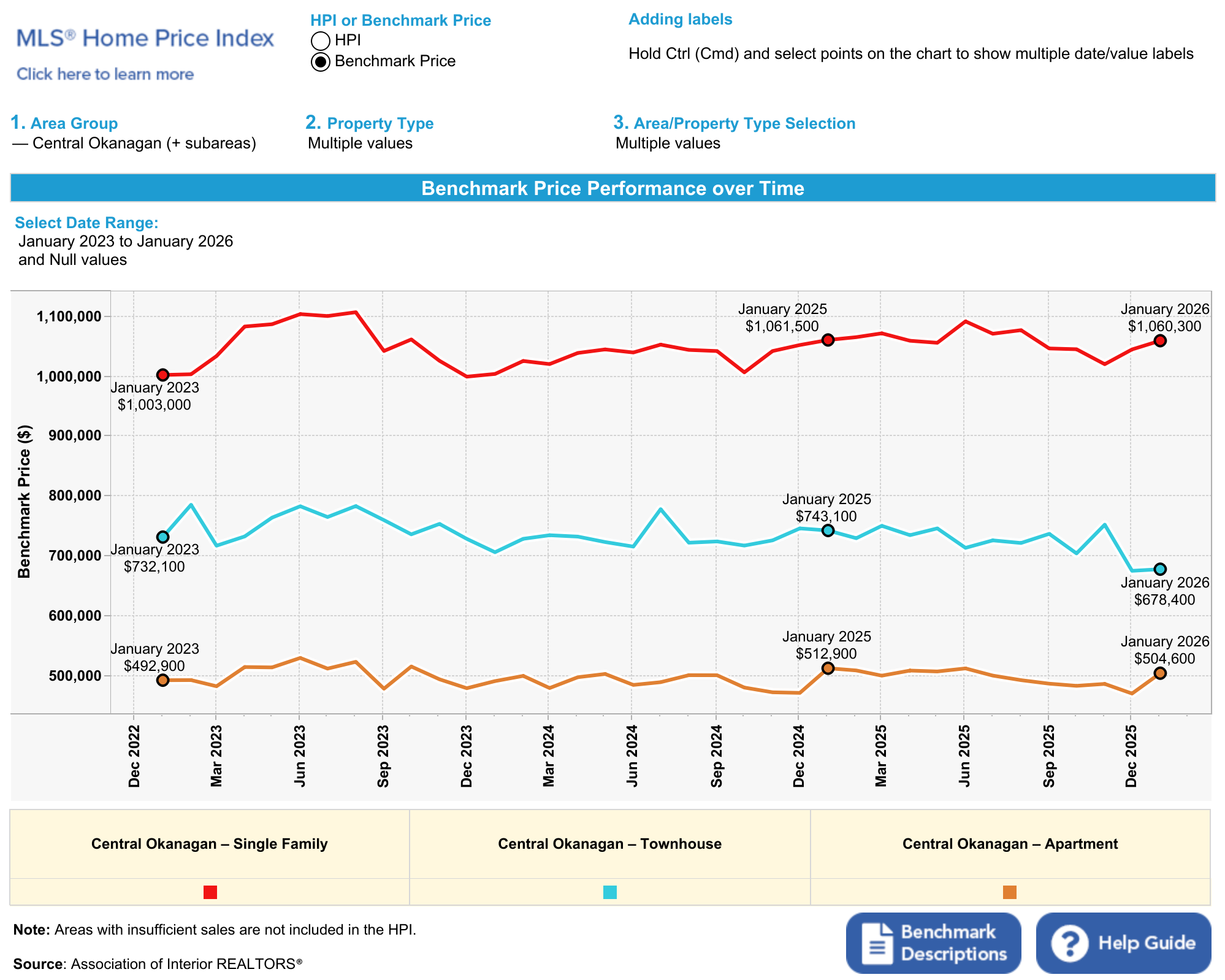
Chart showing benchmark prices in Kelowna and the Central Okanagan for January 2026

Market at a Glance (Residential Only)

  • Residential sales: 226 homes (down 16.9% year-over-year)
  • Residential sales volume: $184.5M (down 12.7% year-over-year)
  • New residential listings: Data not provided
  • Active residential listings: 3,109
  • Average days on market: 92 (up from previous period)
  • List-to-sell ratio: 90.4%

January brought fewer sales and slower turnover. But prices held. The average property now takes 92 days to sell. Sellers achieve about 90% of asking. This creates room for negotiation. Buyers have time to evaluate. Sellers need realistic pricing strategies from day one.

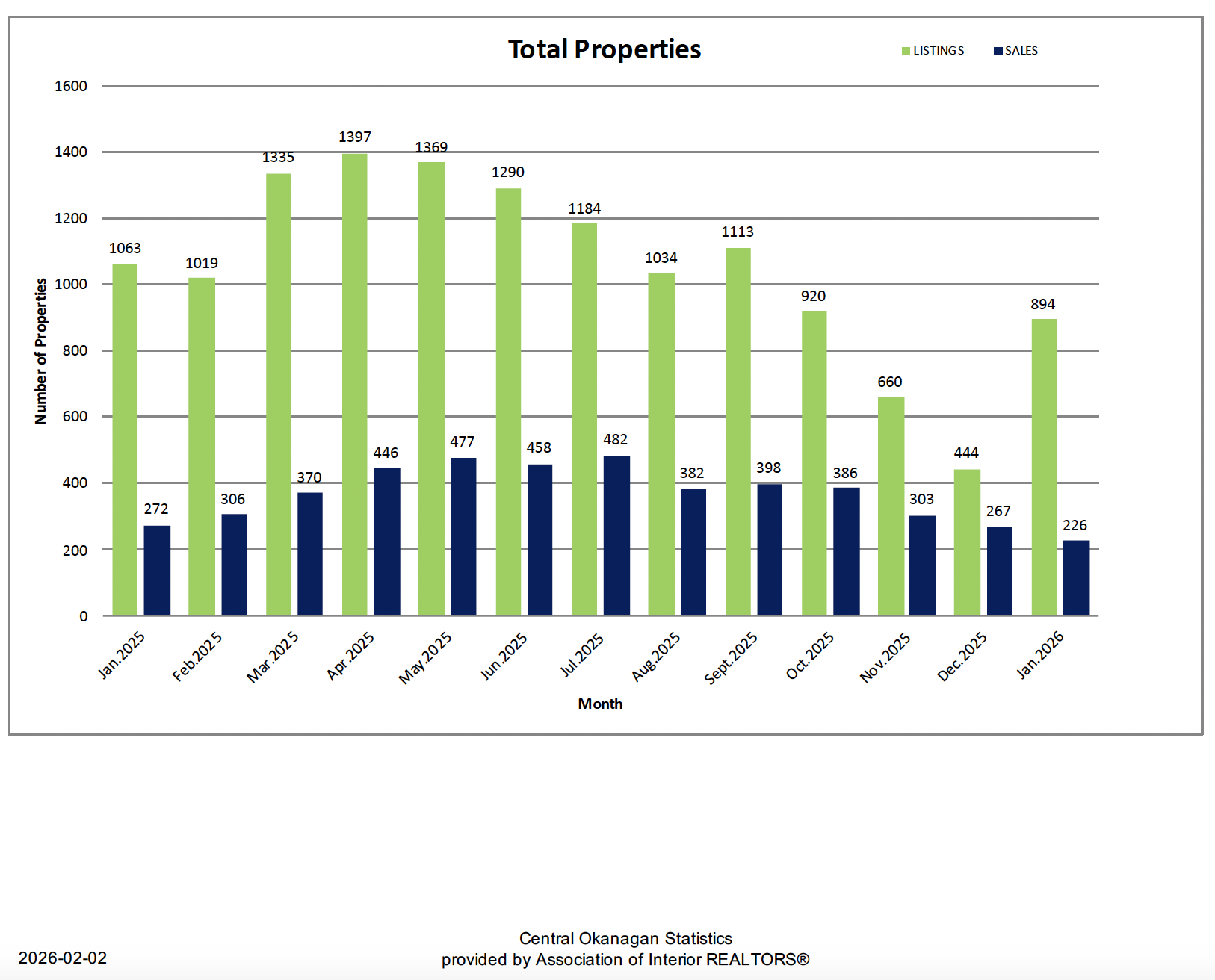
Chart showing overall real estate market activity in Kelowna and the Central Okanagan for January 2026

Property Type Breakdown

Single Family Homes (Excluding Lakefront & Acreage)

  • Sales: 91 (down from 110 last year)
  • Average price: $1,036,503 (up 0.8%)
  • Median price: $945,000 (down 1.3%)
  • Days on market: 81 (up from 75)
  • Inventory: 940 homes
  • Sell-to-inventory ratio: 9.7%

Insight: Single family homes remain the largest segment. Prices stayed remarkably stable despite slower sales. The million-dollar benchmark remains the norm for detached homes in this market. Days on market increased slightly but stayed within normal winter range. The spread between average and median shows the market serves both entry-level and upper-tier buyers. Buyers looking for space and privacy continue to choose Kelowna despite higher costs compared to Vernon.

Townhomes & Duplex-Style Properties

  • Sales: 36 (down 5.3% from 38 last year)
  • Average price: $730,581 (down 4.3%)
  • Median price: $661,250 (down 4.5%)
  • Days on market: 91 (up from 85)
  • Inventory: 314 homes
  • Sell-to-inventory ratio: 11.5%

Insight: Townhouses showed the strongest relative performance. Sales declined only 5.3% compared to steeper drops in other segments. The 11.5% sales-to-inventory ratio indicates healthy demand. Townhouses offer a middle ground between condo affordability and single family space. Slight price declines make this segment more accessible than it was a year ago.

Condos & Apartments

  • Sales: 55 (down from 63 last year)
  • Average price: $501,550 (up 7.0%)
  • Median price: $410,000 (down 7.1%)
  • Days on market: 83 (up from 77)
  • Inventory: 685 units
  • Sell-to-inventory ratio: 8.0%

Insight: The condo segment tells an interesting story. The split between average and median prices suggests higher-end units drove much of the activity. Entry-level condos under $410,000 offer opportunities for first-time buyers. Days on market increased but remain competitive. Inventory sits healthy at 685 units. Buyers targeting this segment have options and negotiating room.

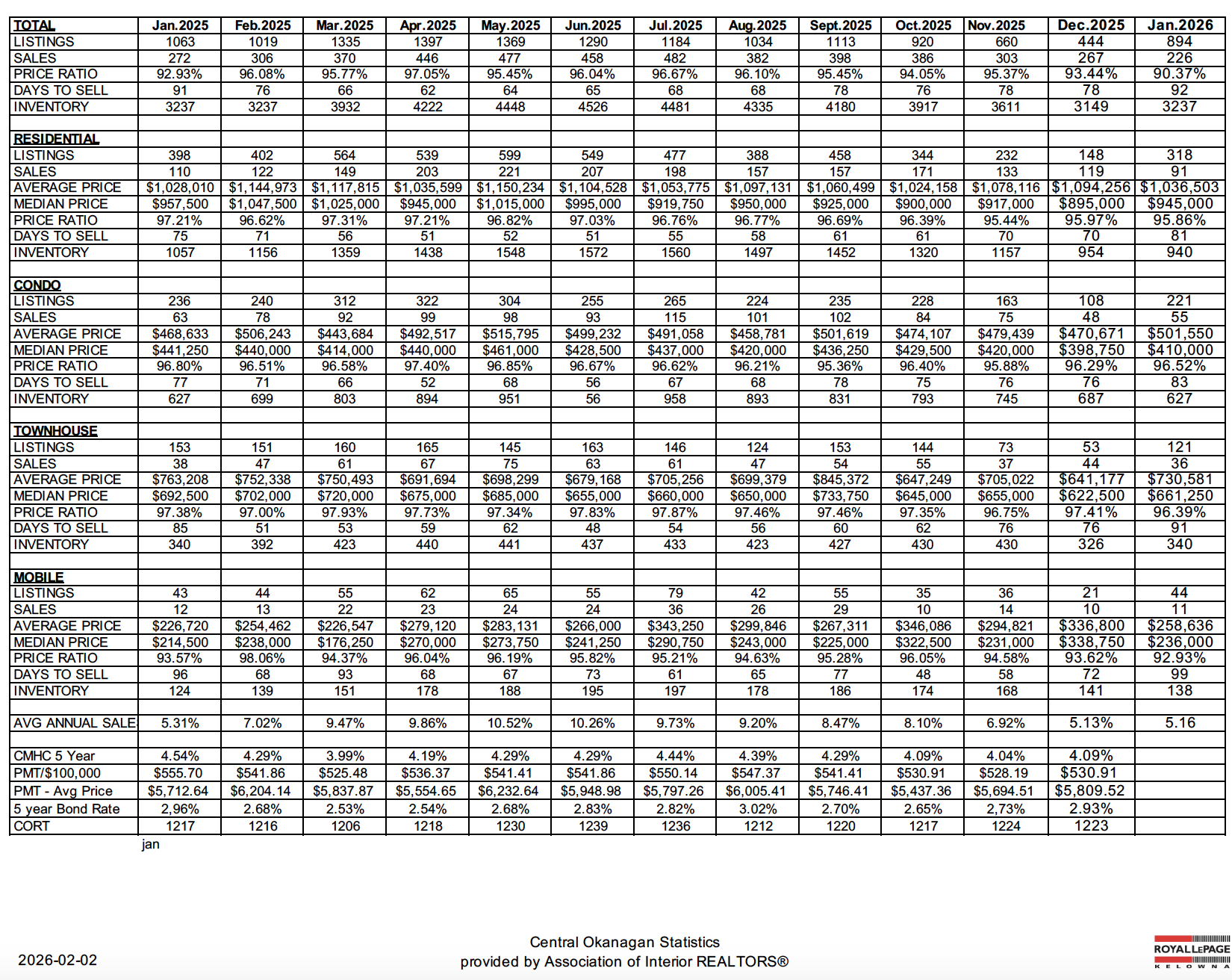
Chart showing total real estate market metrics in Kelowna for January 2026

Where Buyers Are Spending

The $900,000 to $999,999 price range saw the most activity with 17 sales. The $700,000 to $899,999 range captured 30 sales combined.

Luxury sales above $2 million slowed. Only 3 properties sold in that range compared to 6 last January.

This distribution shows middle-market strength. Buyers focus on homes priced between $700,000 and $1 million. The luxury segment waits for motivated buyers and realistic pricing.

Bank of Canada Rate Update: The next announcement is March 12, 2026 (view here). The policy rate sits at 3.25%. CMHC 5-year rates trade near 4.09%. Monthly payments on an average single family home run approximately $5,530 per $100,000 borrowed. Stable rates through early 2026 provide borrowing certainty. Buyers have clarity on carrying costs. This stability supports continued market activity.

Market Takeaway

January confirmed a shift.

The Central Okanagan market is not frozen. It is selective. Buyers have time and negotiating power. Sellers who price realistically find buyers. Overpriced listings sit.

The 90.4% list-to-sale ratio creates room for negotiation. This represents a meaningful advantage for buyers compared to previous years. Factor this into your strategy whether buying or selling.

Spring typically brings increased activity. Watch February and March numbers for early signals of seasonal trends. The question for early 2026 is straightforward: Does continued rate stability and improved affordability bring more buyers off the sidelines? January suggests a measured yes.

Need a hyper-local read?
Reach out for a custom report for your street or strata.

This blog post is for general informational purposes only and should not be taken as professional advice. Always consult a licensed REALTOR® for real estate matters, a qualified tax professional for tax matters, and a lawyer or notary public for legal matters before making decisions.


Feb. 4, 2026

Vernon & North Okanagan Real Estate Market Update — February 2026

Michael A. Jones - PREC* | Royal LePage Kelowna

Vernon and the North Okanagan delivered a solid start to 2026. Sales volume increased despite fewer transactions. Prices held steady. The market shows healthy fundamentals.

This was not a breakout month. But the numbers reveal stability. Buyers purchased higher-value properties. Sellers achieved near-asking prices. Days on market improved across most segments.

For context, you can revisit last month's report here:
Vernon & North Okanagan Market Update — January 2026

The North Okanagan includes Vernon, Coldstream, Armstrong, Enderby, and surrounding areas.

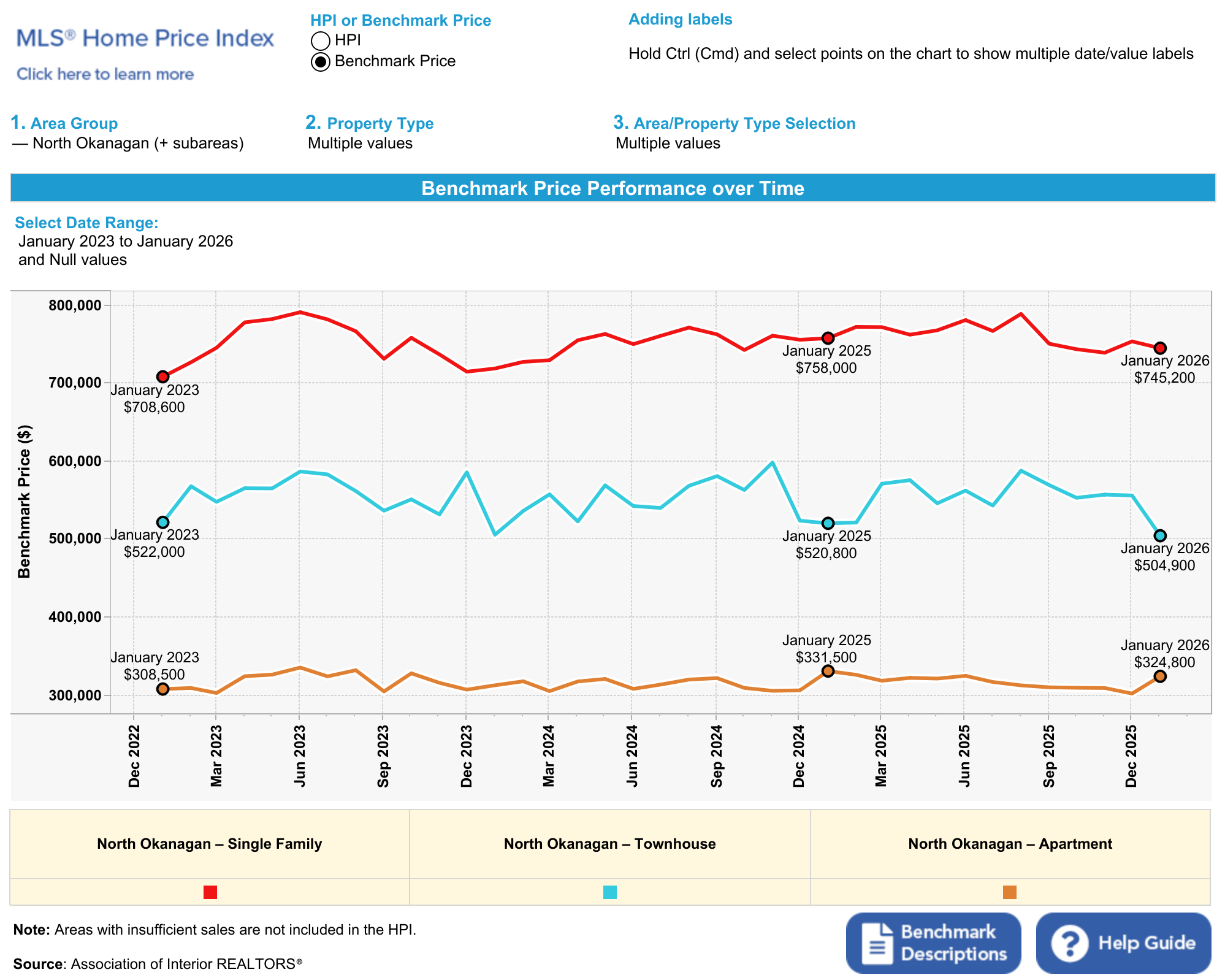
Chart showing benchmark prices in Vernon and the North Okanagan for January 2026

Market at a Glance (Residential Only)

  • Residential sales: 83 homes (down 7.8% year-over-year)
  • Residential sales volume: $56.6M (up 0.4% year-over-year)
  • New residential listings: 176 (down 15% year-over-year)
  • Active residential listings: 1,078
  • Average days on market: 85 (down from 89 last year)
  • List-to-sell ratio: 95.6%

January showed fewer sales but higher total volume. Buyers purchased more expensive properties. The market absorbed inventory without pressure. Days on market improved. Sellers captured close to asking price. These metrics point to balanced conditions heading into spring.

Chart showing home sales in Vernon and the North Okanagan for January 2026

Property Type Breakdown

Single Family Homes (Excluding Lakefront & Acreage)

  • Sales: 35 (down from 44 last year)
  • Average price: $737,580 (flat year-over-year)
  • Median price: $730,000 (up 6.2%)
  • Days on market: 81 (up from 69)
  • Inventory: 264 homes
  • Sell-to-inventory ratio: 13.3%

Insight: Single family homes remain the market's foundation. The rising median price with stable averages suggests entry-level homes attracted more buyers. This signals healthy first-time buyer activity. Days on market increased slightly but stayed within normal winter range. The $730,000 median offers a detached home entry point many BC markets no longer provide.

Townhomes & Duplex-Style Properties

  • Sales: 9 (up 125% from 4 last year)
  • Average price: $485,000 (down 19.2%)
  • Median price: $527,000 (down 14.0%)
  • Days on market: 86 (up from 47)
  • Inventory: 100 homes
  • Sell-to-inventory ratio: 9.0%

Insight: Townhouses posted the strongest sales growth. Lower prices drove higher volume. Buyers responded to improved affordability in this segment. Townhouses bridge the gap between condo affordability and single family space. Days on market increased but sales more than doubled. This segment rewards realistic pricing.

Condos & Apartments

  • Sales: 11 (down from 14 last year)
  • Average price: $301,491 (up 6.3%)
  • Median price: $307,000 (up 3.2%)
  • Days on market: 62 (down from 109)
  • Inventory: 78 units
  • Sell-to-inventory ratio: 14.1%

Insight: Condos showed impressive performance. Days on market dropped 43%. That shift indicates strengthening demand for affordable entry points. The 14.1% sales-to-inventory ratio leads all property types. Prices rose modestly while turnover accelerated. If you target this segment, be prepared to act. The 62-day average masks some properties selling much faster.

Chart showing new listings in Vernon and the North Okanagan for January 2026

How North Okanagan Compares

The price gap with the Central Okanagan remains substantial.

Single family homes: $737,580 here versus $1,036,503 in Kelowna. That is a $299,000 difference.

Condos: $301,491 here versus $501,550 in Kelowna. You save $200,000 for comparable unit types.

Townhouses: $485,000 here versus $730,581 in Kelowna. Nearly $250,000 in savings.

This value proposition continues to attract buyers willing to trade proximity for affordability. The North Okanagan offers accessible pricing while maintaining quality of life and outdoor recreation access.

Bank of Canada Rate Update: The next announcement is March 12, 2026 (view here). The policy rate sits at 3.25%. Canada's 5-year bond yield trades near 2.90%. Stable rates through early 2026 provide borrowing certainty. Buyers have clarity on carrying costs. This stability supports continued market activity.

Market Takeaway

January confirmed balanced conditions.

The North Okanagan market absorbs inventory without stress. Sales volume increased despite fewer transactions. Buyers purchased higher-value properties. Prices held steady across all segments.

The 95.6% list-to-sale ratio means less room for negotiation than the Central Okanagan (90.4%). Price your offers accordingly. Sellers achieve near-asking when properties meet market expectations.

Spring will bring increased activity. Current fundamentals support both buyers seeking value and sellers with realistic expectations. The question for March and April is straightforward: Does continued rate stability bring more buyers off the sidelines? January data suggests yes.

Need a hyper-local read?
Reach out for a custom report for your street or strata.

This blog post is for general informational purposes only and should not be taken as professional advice. Always consult a licensed REALTOR® for real estate matters, a qualified tax professional for tax matters, and a lawyer or notary public for legal matters before making decisions.


Jan. 4, 2026

Vernon & North Okanagan Real Estate Market Update — January 2026

Michael A. Jones - PREC* | Royal LePage Kelowna

December closed the year on a firmer note for the North Okanagan. Sales rose. Inventory tightened slightly. Prices held.

This was not a breakout month. But it was not weak either. Buyers showed up when pricing made sense. Sellers who met the market were rewarded with faster closings and stronger negotiations.

For context, you can revisit last month's report here:
Vernon & North Okanagan Market Update — November 2025

The North Okanagan includes Vernon, Coldstream, Armstrong, Enderby, and surrounding areas.

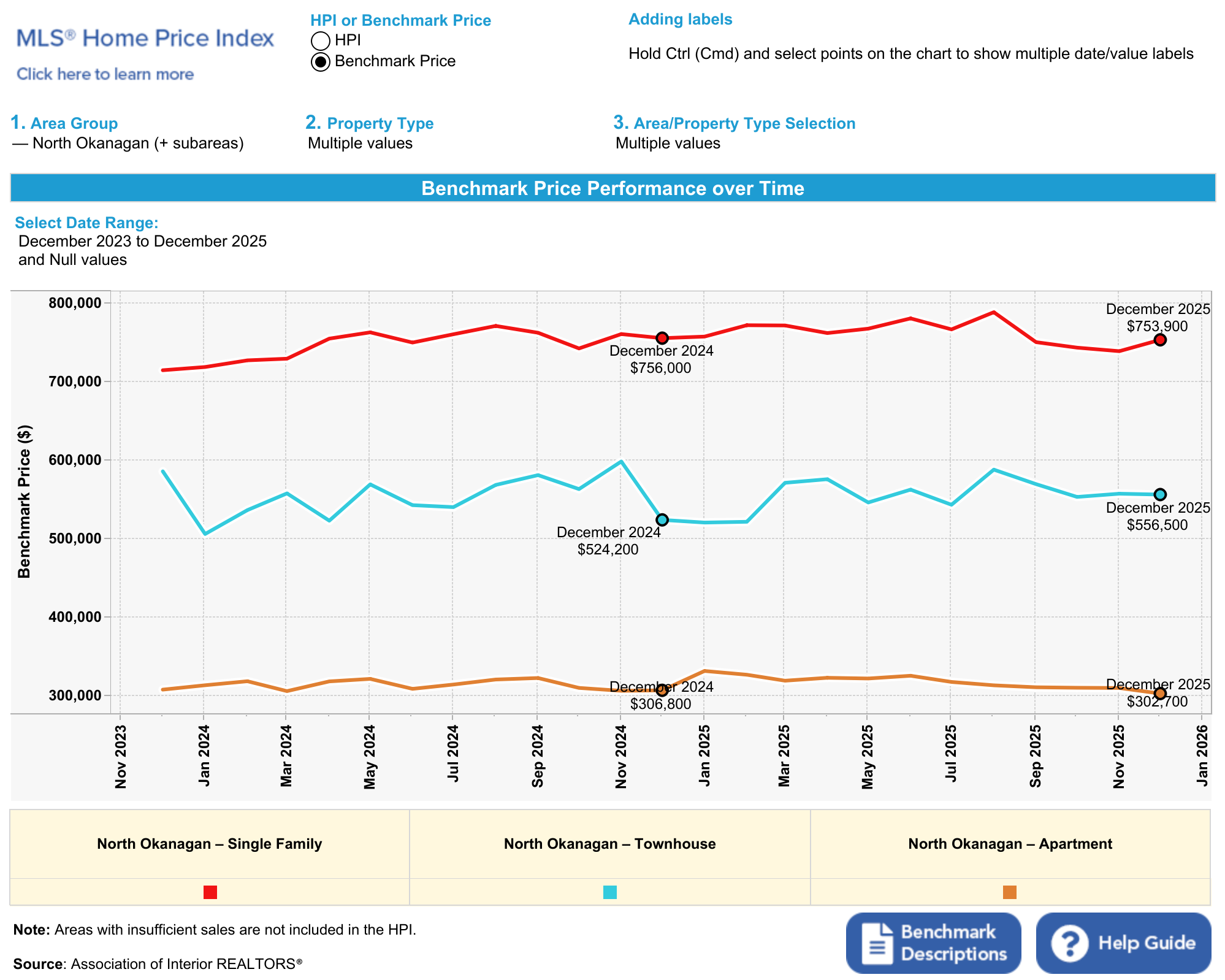
Chart showing benchmark prices in Vernon and the North Okanagan for December 2025

Market at a Glance (Residential Only)

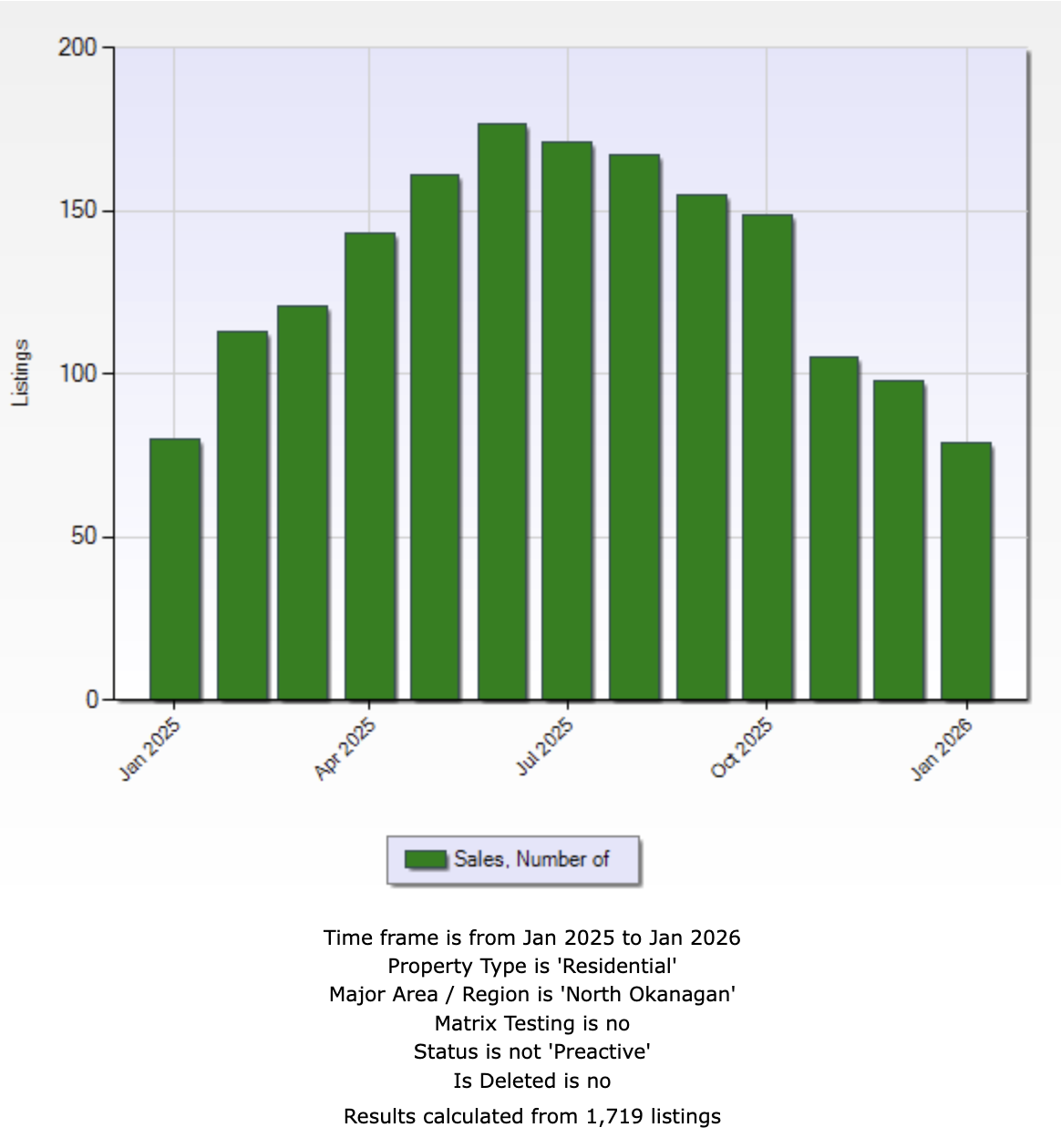
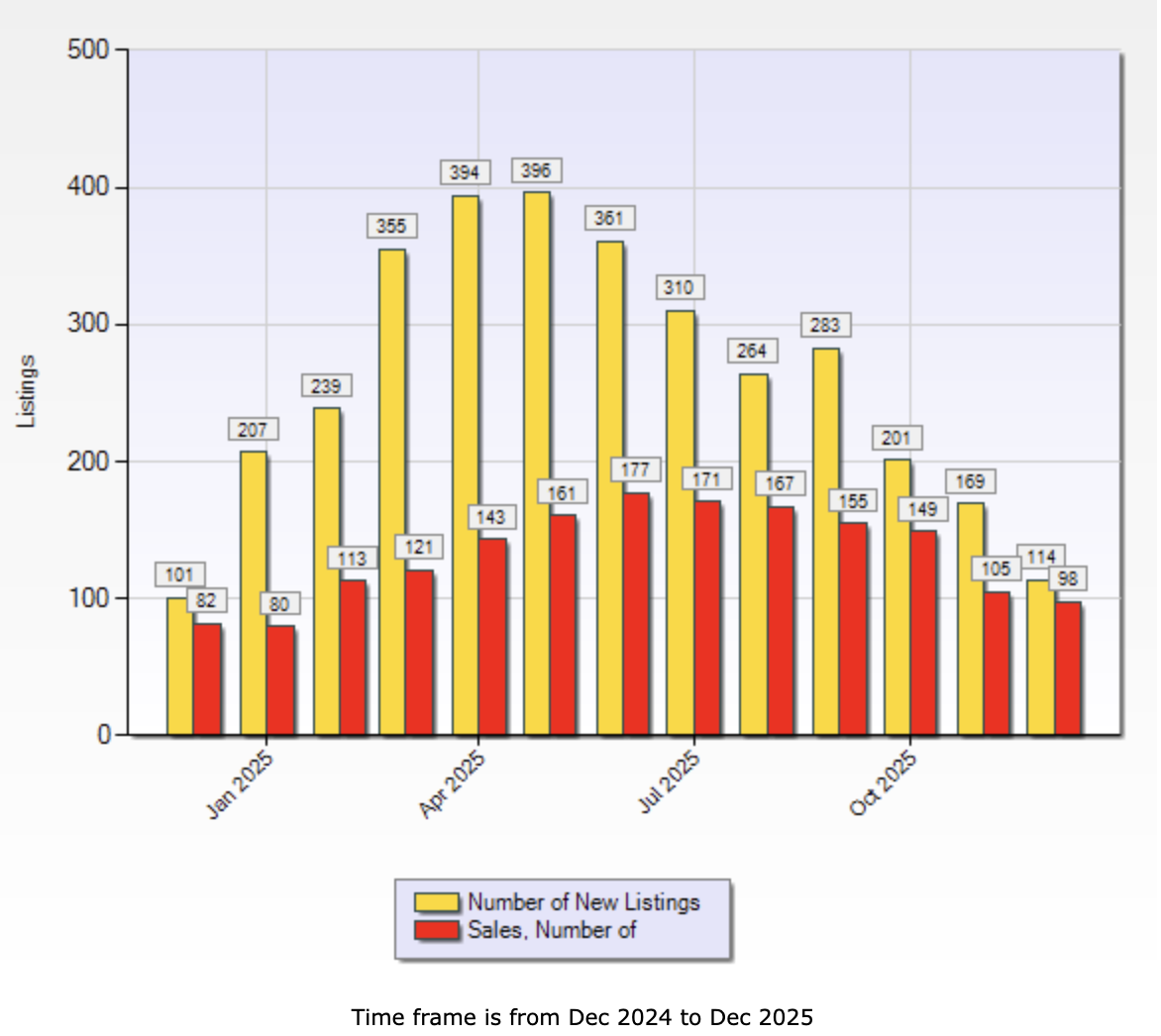
  • Residential sales: 98 homes (up 19.5% year-over-year)
  • Residential sales volume: $74.75M (up 26.8% year-over-year)
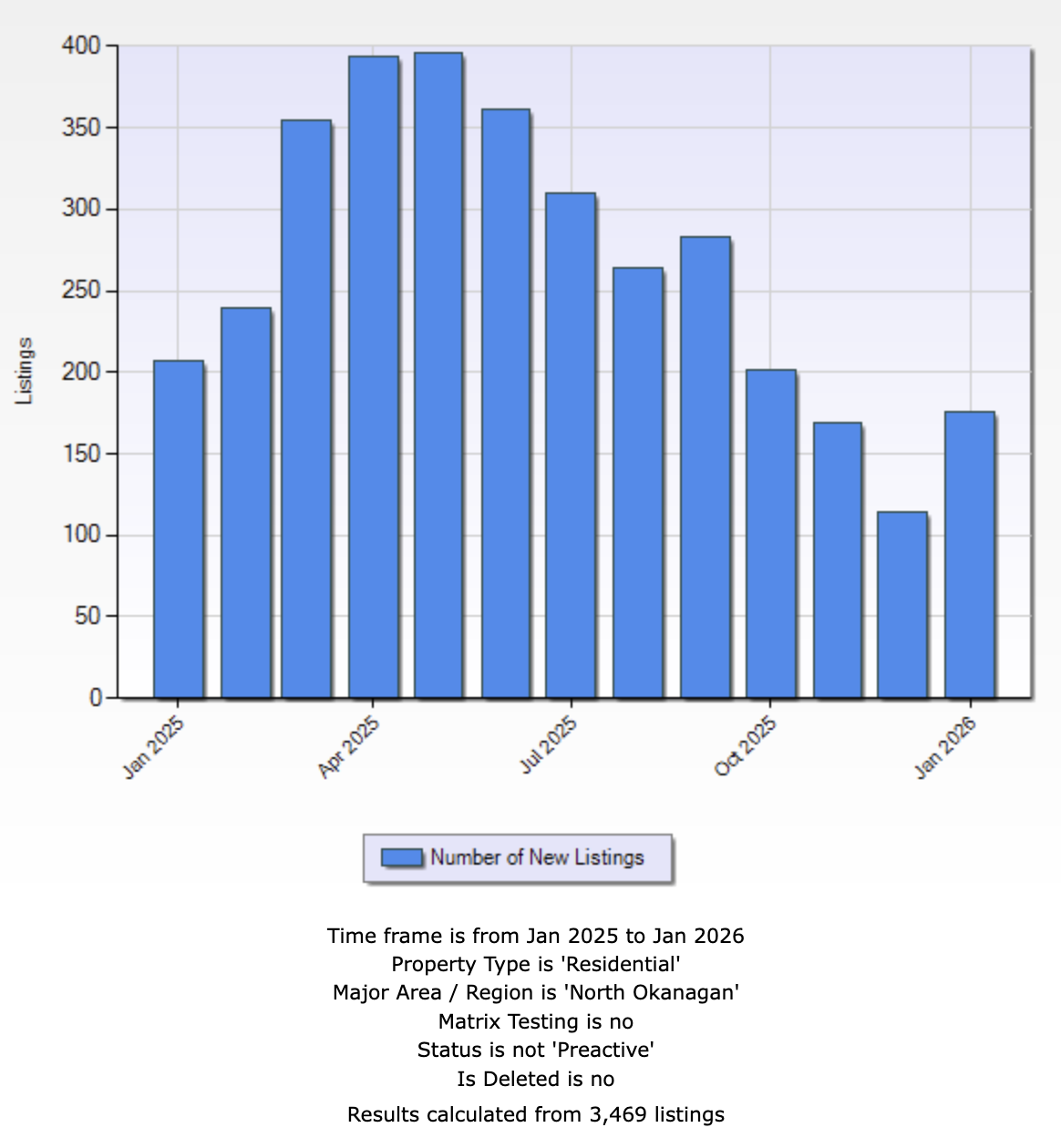
  • New residential listings: 114
  • Active residential listings: 695 (up 11.0% year-over-year)
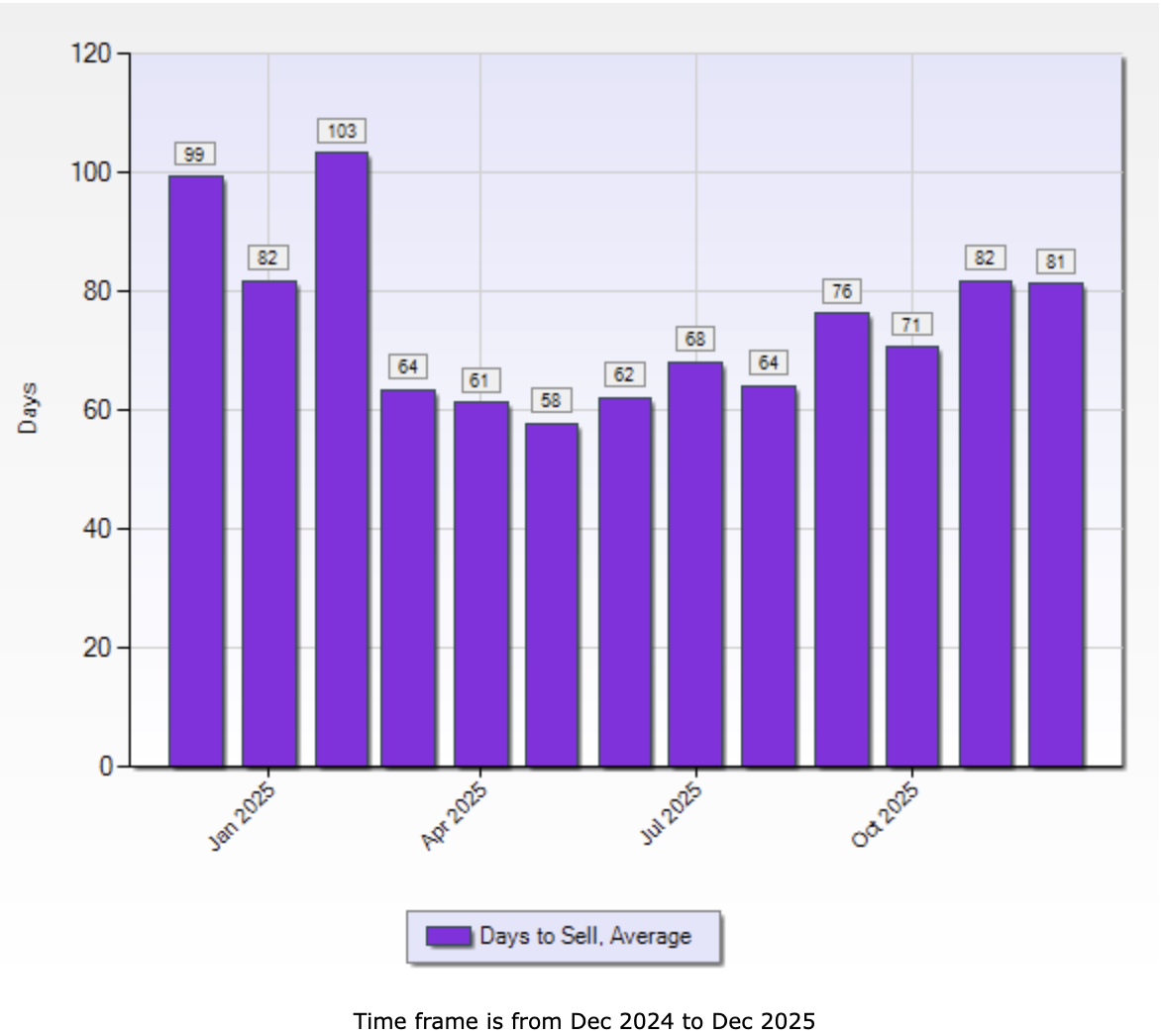
  • Average days on market: 81 (down from 99 last year)
  • List-to-sell ratio: 94.2%

The market finished the year more active than December 2024. Buyers showed up. Sellers who priced well moved their properties faster and closer to asking. The gap between average and median days on market narrowed, suggesting more consistency across price points.

Chart showing total listings and sales in Vernon and the North Okanagan for December 2025

Property Type Breakdown

Single Family Homes (Excluding Lakefront & Acreage)

  • Sales: 44
  • Average price: $858,036
  • Median price: $730,000
  • Days on market: 86
  • Inventory: 279 homes
  • Sell-to-inventory ratio: 15.8%

Insight: Detached homes remain the backbone of the market. Prices stayed firm even as inventory levels crept up from the fall. The spread between average and median price shows upper-tier properties traded alongside more affordable stock. Days on market came in near the 12-week mark, which is healthy for winter. Buyers looking for space and privacy continue to favor Vernon over higher-priced Kelowna alternatives.

Townhomes & Duplex-Style Properties

  • Sales: 16
  • Average price: $486,469
  • Median price: $437,500
  • Days on market: 74
  • Inventory: 100 homes
  • Sell-to-inventory ratio: 16.0%

Insight: Townhomes continued to move efficiently. This segment benefits most from affordability pressure pushing buyers out of detached homes and down from Kelowna. At 74 days on market, well-priced townhomes turned faster than single-family. The median price sitting nearly $50,000 below the average suggests strong activity at entry-level pricing.

Condos & Apartments

  • Sales: 8
  • Average price: $341,219
  • Median price: $307,375
  • Days on market: 55
  • Inventory: 78 units
  • Sell-to-inventory ratio: 10.3%

Insight: Condos remain the softest segment. Sales were thin in December, but days on market dropped to just 55, the fastest of all property types. This suggests motivated sellers found motivated buyers when pricing aligned. Inventory sits modest at 78 units. Buyers have leverage here. Pricing matters more than timing. Expect this segment to stay selective through early 2026.

Chart showing average days to sell in Vernon and the North Okanagan for December 2025

Year-End Perspective

For all of 2025:

  • Total residential sales: 1,640
  • Total residential volume: $1.15B
  • Average residential price: $700,317
  • Median residential price: $630,500
  • Average days on market: 71

Year-over-year sales rose over 12%. Volume rose at the same pace. Prices were stable, not speculative. The North Okanagan finished 2025 as one of the more consistent markets in BC. No crashes. No bubbles. Just steady absorption driven by affordability and lifestyle appeal.

Bank of Canada Rate Update: The next announcement is January 29, 2026 (view here). The policy rate sits at 3.25%. Canada's 5-year bond yield trades near 2.90%. Rate stability through late 2025 created a more predictable borrowing environment. Prices held because buyers had clarity on carrying costs.

Market Takeaway

December confirmed a simple truth.

The North Okanagan market is not frozen. It is selective.

Well-priced homes sell. Overpriced listings wait. The gap between asking and selling narrowed for properties that met the market. Buyers showed up when value aligned with affordability.

The question for early 2026 is straightforward: Does improving affordability bring more buyers off the sidelines? December suggests yes. But spring will tell the full story.

Need a hyper-local read?
Reach out for a custom report for your street or strata.

This blog post is for general informational purposes only and should not be taken as professional advice. Always consult a licensed REALTOR® for real estate matters, a qualified tax professional for tax matters, and a lawyer or notary public for legal matters before making decisions.


Dec. 25, 2025

Are Closing Costs Tax Deductible When Buying a Home in Kelowna BC?

Michael A. Jones - PREC* | Royal LePage Kelowna

Clients ask me all kinds of questions. One that comes up: are closing costs tax deductible when buying a home in Kelowna?

My first response to any tax question is always: "I'm not a tax expert. You need a tax professional for certainty."

Why? The CREA REALTOR code requires me to provide service within my competency. My competency is real estate, not taxation.

That said, I've been doing this work for years. That means I know enough to point you in the right direction. But please don't treat this as an ironclad fact. Hire a tax expert. Do your own research. If you need a Kelowna tax professional? Let me know.

The answer to the tax deductibility question: NO. Usually.

Let me break down that cryptic answer. First, I'll list typical closing costs in BC. (For an in-depth look at closing costs, have a look at this post). Then I'll explain why they're typically not deductible. Finally, I'll clarify why I said "usually."

Are closing costs tax deductible when buying a home in Kelowna BC explaining property transfer tax and exemptions

What Are Typical Closing Costs in BC?

I covered this in detail in another post. Here are the standard closing costs for buying a home in BC:

  • Property transfer tax (PTT)
  • Home inspection fees
  • Appraisal fees
  • Mortgage related fees
  • Home and fire insurance
  • GST (on new builds)
  • Legal/notary fees
  • Property tax/utility adjustments
  • Title registration fees
  • Title insurance

For more detail, check out my complete guide to closing costs.

Why Aren't These Costs Tax Deductible?

Simple: you're buying this home for personal use. The Canada Revenue Agency (CRA) doesn't allow personal home purchase expenses on your income tax return.

Should they be deductible? Different conversation. Right now, they're not.

The Exceptions

Some situations allow closing cost deductions. This is experiential sharing, not tax advice. Consult a tax professional.

Investment Properties

If you buy a property for rental income (and don't live in the property), some costs become deductible. These include:

  • Mortgage finance fees
  • Home and fire insurance premiums
  • Mortgage default insurance
  • Property tax adjustments

First Time Home Buyers

First time buyers qualify for several tax benefits:

Federal Home Buyer's Tax Credit (HBTC)
You get a non-refundable tax credit up to $1,500. Learn more about the home buyer's credit.

GST/HST New Housing Rebate
Buy a new home under $450,000? You qualify for a rebate up to $6,300. Details on the GST rebate.

Enhanced GST Rebate (2025)
First time buyers purchasing newly built homes get a 100% GST rebate (up to $50,000) on homes up to $1M. Take advantage if you qualify.

BC Property Transfer Tax Exemption
First time buyers in BC get full or partial PTT exemption on homes under $860,000. The money gets deducted at purchase. Not technically an income tax deduction, but a huge savings. The rules are complex, so research the exemption details yourself and talk to a tax professional.

The Bottom Line

Closing cost tax deductibility in Kelowna depends on your situation.

Buying for personal use? No deductions.

Buying an investment property? Some costs become deductible.

First time buyer purchasing a new home? You have options.

The best answer comes from a tax professional before you start the process.

Need more information or ready to look at homes? Reach out.

All for now,
Michael

This blog post is for general informational purposes only and should not be taken as professional advice. Always consult a licensed REALTOR® for real estate matters, a qualified tax professional for tax matters, and a lawyer or notary public for legal matters before making decisions.