Michael A. Jones - PREC* | Royal LePage Kelowna
What to know:
- • Kelowna proper has about 144,000 residents; the Central Okanagan Regional District — Kelowna, West Kelowna, Lake Country, and Peachland — has more than 220,000 (Statistics Canada). It is one of the fastest-growing regions in BC.
- • Climate runs four real seasons. Summers are hot and dry with wildfire-smoke risk in August and September. Winters are mild by Canadian standards. The lake moderates the extremes you would feel in Calgary or Edmonton.
- • The economy mixes healthcare, technology, agriculture, tourism, education, and government. Diverse for a city this size, but the corporate professional market is narrower than Toronto or Vancouver.
- • The four sub-markets — Kelowna, West Kelowna, Lake Country, Peachland — each have a distinct character. Most relocators land in Kelowna proper and figure out the right fit once they have spent time here.
- • The trade-offs are real: car-dependent, summer crowds, occasional smoke, smaller corporate job market. What most relocators find worth the move is the lake, the rhythm of the seasons, and the human scale.
Most of the people I work with ask the same question before they ask any of the others. Not "what does it cost" — that comes later. Not "where should I live" — that comes after they have arrived. The first question is the honest one: what is it actually like to live there?
This post is my best answer to that question. Not a brochure. Not a pitch. The actual texture of the place, from the inside, written for someone weighing the move.
The Rhythm of the Place
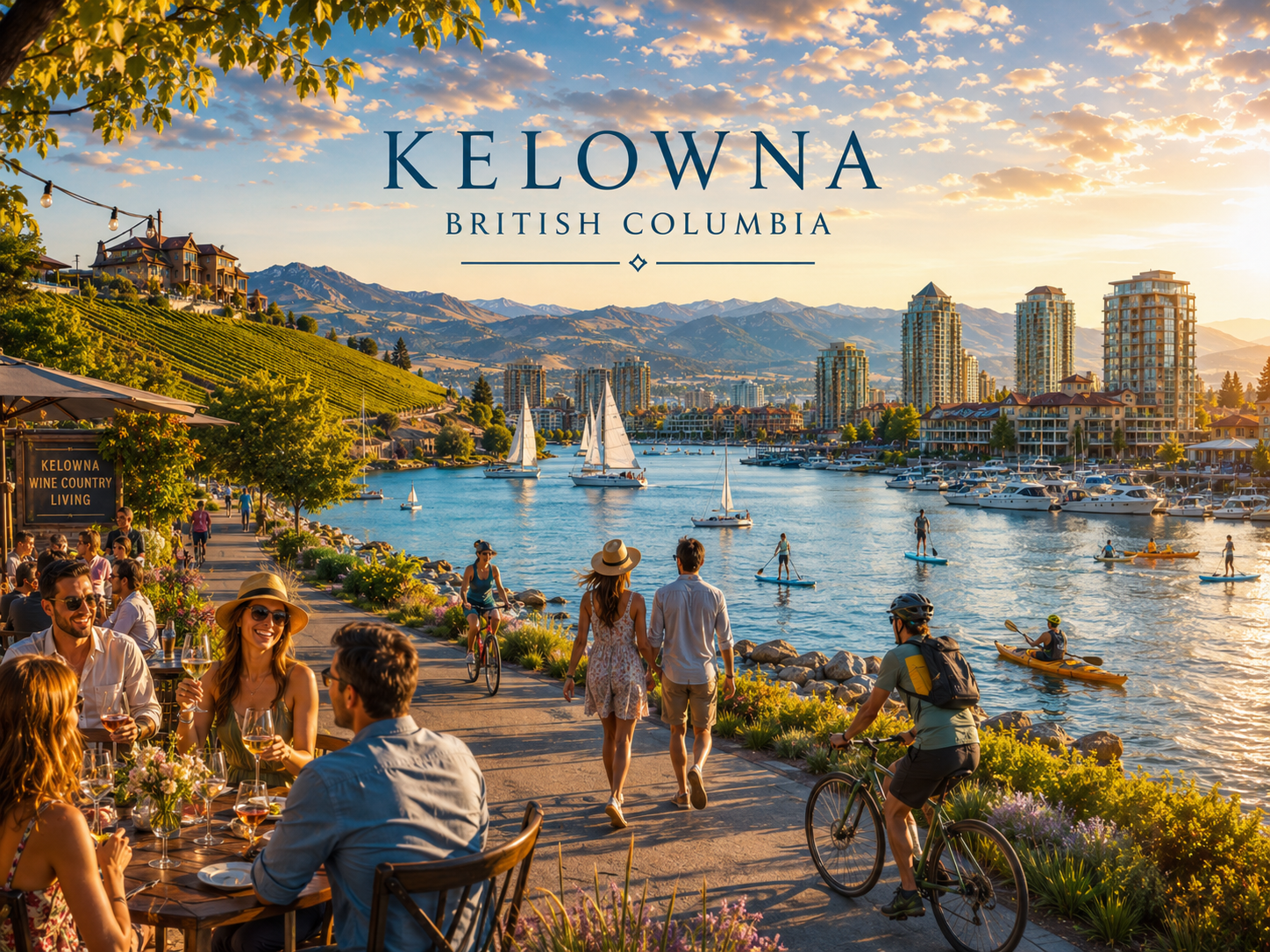
Kelowna sits on the east shore of Okanagan Lake in BC's Central Okanagan, about an hour's flight east of Vancouver or an hour west of Calgary. The lake is the defining feature. Most of the city orients itself either toward the water or away from it; both work, and the choice shapes what daily life looks like.
The seasons here are real and distinct. Summers are hot and dry — daytime highs run from the high 20s into the mid 30s Celsius, the lake warms enough to swim from June through September, and the city absorbs a significant tourism wave between July and Labour Day. Late summer brings wildfire-smoke risk; some years the air stays clear, others bring two or three weeks of degraded air quality. This is interior BC and the smoke is part of the calendar.
Fall is the underrated season. September and October bring crisp mornings, warm afternoons, vineyard harvest, and a noticeable drop in tourism. Winters are mild by any Canadian standard — temperatures hover near freezing, snowfall is moderate, and the lake moderates the extremes that hit Calgary, Edmonton, or even Vancouver Island. Spring arrives early. By late March most years, the orchards are blossoming and people are back on patios.
If you have lived anywhere east of the Rockies, the Kelowna winter will surprise you in a good way. If you have lived on the BC coast, the summer dryness and the seasonal smoke will take adjustment.
Who Actually Lives in Kelowna
The City of Kelowna has approximately 144,000 residents. The wider Central Okanagan Regional District — which includes Kelowna, West Kelowna, Lake Country, Peachland, and surrounding electoral areas — has more than 220,000 (Statistics Canada). The region has been one of the fastest-growing in BC for a decade, with growth rates regularly outpacing the national average.
The newcomer mix changes the place every year. Interprovincial migration drives most of the growth, with Alberta, Ontario, and the BC Lower Mainland as the largest origin markets. Retirees and pre-retirees remain a strong demographic, but the under-40 newcomer cohort has grown materially since 2020, fuelled by remote-work flexibility and the lifestyle pull. The city has a meaningful Indigenous community — the syilx Okanagan Nation are the traditional stewards of this territory, and Westbank First Nation is a significant economic and governance presence on the west side of the lake.
Compared to the Lower Mainland or the GTA, Kelowna is less ethnically diverse, though that is shifting. Compared to Calgary, the political and cultural orientation runs slightly more centrist with a stronger environmental sensibility. The local university (UBC Okanagan) brings about 12,000 students into the mix during the school year, which keeps a youth presence in the city core.
Where People Live: The Sub-Market Overview
Most relocators arrive thinking of "Kelowna" as a single place. It is functionally four communities that share a regional district and a lake.
Kelowna proper is the regional centre and the biggest of the four. Downtown anchors the cultural and professional life of the city. The Mission neighbourhoods (Lower Mission, Upper Mission) sit south of downtown along the lake and carry the highest residential price points. Glenmore and Wilden sit north and bring a family-and-professional character with strong school catchments. Rutland is the most affordable major neighbourhood and the fastest-changing — it has gone from working-class to mixed in the last fifteen years. The full breakdown lives in our Best Neighbourhoods to Buy in Kelowna piece.
West Kelowna sits across the William R. Bennett Bridge on the west side of the lake. The character is slightly more suburban and the access to wineries, beaches, and boating is direct. West Kelowna includes Westbank, Lakeview Heights, Glenrosa, and Shannon Lake. Bridge traffic during peak summer can be a real consideration if you commute into Kelowna daily for work.
Lake Country sits north of Kelowna along the lake corridor toward Vernon. More rural, more acreage, more orchard-and-vineyard land. Families looking for space and people relocating from Alberta land here often. Internet coverage is more variable here than in Kelowna proper; confirm before committing to a specific property.
Peachland sits south of West Kelowna, hugging the lake. Smaller, quieter, with a higher proportion of retirees and a relaxed pace. People who land here generally know why — they want lake access without the activity of Kelowna or West Kelowna.
For a deeper area-by-area breakdown including population, schools, recreation, and home types, the Kelowna Area Guide covers all four communities in detail.
Daily Life: What Actually Happens in a Week
Kelowna is car-dependent. Public transit exists and works for the university and the major corridors, but most people drive, and most lives are organized around fifteen-minute drive radii. From Lower Mission to Glenmore is roughly fifteen minutes outside of peak. From downtown Kelowna to West Kelowna across the bridge is fifteen to twenty-five depending on the season. From Kelowna to Lake Country runs twenty to thirty.
The rhythm of a typical week leans outdoor. Summer evenings are lake evenings — paddleboards, boats, beaches, vineyards within thirty minutes of most neighbourhoods. Winters bring skiing at Big White (45 minutes from downtown) and quieter trails. Spring and fall are the trail seasons — Knox Mountain, Myra Canyon, the Mission Creek Greenway, and dozens of viewpoints within a short drive.
Restaurant and bar density is strong downtown and in Pandosy Village. The local dining scene punches above its weight for a city this size, helped by the wine region. Live music, theatre, and arts are present but smaller-scale than what you would find in Toronto, Vancouver, or Calgary; visiting acts come through regularly, but the depth is not what it is in a major metro.
Healthcare runs through Kelowna General Hospital, the largest hospital between Vancouver and Calgary. Family doctor wait-lists are a real issue in BC and the Okanagan is no exception. If primary care access matters for your situation, get on the BC Provincial Health Connect Registry as soon as you have a BC address.
Work, Economy, and Connectivity
The Central Okanagan economy is more diversified than most cities its size. Healthcare, technology (notably software and digital media in the Innovation Centre cluster), agriculture and wine, tourism, education, and government all contribute meaningfully. That said, the absolute scale of the corporate professional market is smaller than what is available in Vancouver, Calgary, or Toronto.
What this means practically: if you are a remote worker whose employer is elsewhere, Kelowna gives you most of the lifestyle without the commute or the cost-of-living of a major metro. If you plan to find local employment after you arrive, research your specific sector before you sell your home in another province. The job market exists, but the depth in any specialized field is narrower.
Kelowna International Airport handles flights to and from Vancouver, Calgary, Edmonton, Toronto, Seattle, and seasonally further. Connectivity is meaningful for a city this size. The flight to Vancouver is under an hour; to Calgary, about an hour and ten minutes. The drive to Vancouver is four to five hours through the mountains and shifts considerably with seasonal road conditions.
What Changes When You Arrive From...
Vancouver. The pace slows. The pace of weather slows even more — you will notice four distinct seasons in a way that Vancouver does not deliver. Cost of housing becomes more reasonable. The professional network is smaller, the ethnic and cultural diversity is more modest, and the rain pattern of the Lower Mainland gets replaced by a dry-summer / mild-winter rhythm. People who move from Vancouver and stay tend to do so because the seasons and the scale make life feel more navigable.
Calgary. The winter shifts dramatically — you will feel like you have moved to a different climate, because you have. The Okanagan is roughly four climate zones removed from the prairie. Real estate runs more expensive than what you may have paid in Calgary, but the equity transfer often closes that gap (we cover the math in What Your Alberta Equity Buys in 2026). The lake culture and the wine country lifestyle replace the rodeo-and-foothills cultural texture; whether that swap works depends on your specific tastes.
Toronto. The scale change is the biggest adjustment. Kelowna's downtown core is walkable for what it is, but it is not a metropolitan downtown. Restaurant and arts depth runs strong for a city this size but does not match what you had access to in the GTA. The lake replaces the lake (Ontario to Okanagan), but the geography is more dramatic — mountains on both sides, dry interior climate, distinct seasons. Most Toronto transplants come for the slower pace and the equity transfer; we run the actual numbers in What Your Toronto Equity Buys in Kelowna.
What Kelowna Is Not
Kelowna is not a major metro. The corporate professional market is narrower than what you will find in Vancouver, Calgary, or Toronto. If you depend on a specialized professional network, weigh this carefully.
Kelowna is not affordable in the way the Prairies are affordable. Housing prices have risen significantly over the last fifteen years and continue to run above the national average. The equity-transfer math works for many relocators, but the absolute price points are real.
Kelowna is not a quiet small town. The summer months bring substantial tourism, traffic, and noise. The city handles it, but the rhythm of July and August is different from the rhythm of February and March.
Kelowna is not a transit-first city. If car-free urban life is important to you, this is a hard adjustment from Vancouver or Toronto. The downtown core has improved, but most of the city is organized for driving.
Kelowna is not immune to wildfire smoke. Late summer can be hard. Some years are clear, others are not. Anyone with a respiratory sensitivity should weigh this honestly before committing to the move.
Should You Make the Move
That question is yours to answer, not mine. What I can offer is the honest picture — the rhythm, the trade-offs, the real shape of the place — so you have the information to decide for yourself.
If you are at the stage of running numbers, working through the sub-market question, or trying to understand what your equity actually buys here, get in touch. I work with relocating buyers regularly and the first conversation is always about getting the full picture in front of you, not selling you on a city.
Frequently Asked Questions
What is it like to live in Kelowna, BC?
Kelowna is a lake-anchored city in BC's Central Okanagan with about 144,000 residents in the city proper and more than 220,000 across the regional district. The lifestyle is outdoor-leaning, car-dependent, four-season, and built around Okanagan Lake. Summers are hot, dry, and busy with tourism and wildfire-smoke risk in August and September. Winters are mild by Canadian standards. The economy mixes healthcare, technology, agriculture, tourism, education, and government. The pace is slower than Vancouver or Toronto and the scale is smaller than Calgary, but the city has a regional hospital, university, international airport, and full professional services.
How big is Kelowna's population in 2026?
The City of Kelowna has approximately 144,000 residents. The Central Okanagan Regional District — which includes Kelowna, West Kelowna, Lake Country, Peachland, and surrounding electoral areas — has more than 220,000 residents and is one of the fastest-growing regions in BC (Statistics Canada). The metro area continues to grow at a rate well above the national average, driven primarily by interprovincial migration.
What is Kelowna's climate like year-round?
Kelowna averages more than 2,000 hours of sunshine per year (Environment and Climate Change Canada), among the highest in Canada. Summers are hot and dry, with July and August temperatures routinely in the high 20s to mid 30s Celsius. Winters are mild by Canadian standards — temperatures hover near freezing, snowfall is moderate, and lake-effect moderation keeps extremes lower than in Calgary or Edmonton. Spring and fall are the most pleasant months. Wildfire smoke from interior BC fires is a real seasonal risk in August and September; some years are clear, others see weeks of degraded air quality.
What is the difference between Kelowna, West Kelowna, Lake Country, and Peachland?
Kelowna is the largest city and the regional centre — hospital, university, airport, downtown, most professional services. West Kelowna sits across the bridge on the west side of the lake, with a slightly suburban character and quick access to wineries and boating. Lake Country is north of Kelowna along the lake corridor, more rural, popular with families and people who want acreage. Peachland is south of West Kelowna, a smaller community with a relaxed pace and significant retiree population. The regional district covers all four. Most relocators land in Kelowna proper or West Kelowna and discover which sub-market actually fits after they have spent time in the region.
Is Kelowna a good place for remote workers in 2026?
Yes, with caveats. High-speed internet is widely available across Kelowna and West Kelowna; rural Lake Country and Peachland are more variable, confirm coverage before committing to a specific property. Co-working spaces and cafés are well-established downtown and in Lower Mission. The local professional job market is narrower than in major metros, so workers who depend on Toronto or Vancouver employers find Kelowna more flexible than workers who plan to find local employment after they arrive. Remote workers report the lifestyle and seasonal climate as the strongest draws.
All for now,
Michael
This blog post is for general informational purposes only. It does not constitute professional advice in any field. Population data references Statistics Canada census information and post-census estimates, which may be updated. Climate data references Environment and Climate Change Canada. Healthcare access varies by individual circumstance and BC Provincial Health Connect Registry status. Internet coverage varies by specific address and provider. Real estate market conditions change; verify current pricing and inventory with a licensed REALTOR® before making decisions. Michael A. Jones is a licensed REALTOR® with Royal LePage Kelowna and a member of the Canadian Real Estate Association (CREA) and the Association of Interior REALTORS®. Always seek qualified professional advice in the relevant discipline before making relocation, financial, or real estate decisions.