Michael A. Jones - PREC* | Royal LePage Kelowna
Every headline right now is framing the Iran war and rising oil prices as bad news for real estate. Most of what you will find online agrees: uncertainty is bad, oil is bad, recession risk is bad, therefore housing is bad.
I want to argue the other side. Not because I am being contrarian for the sake of it, but because the structural data for Kelowna specifically points in a different direction than the headlines suggest. If you are a serious buyer who is already qualified and already motivated, this post is for you.
The Honest Caveat First
I am not going to tell you prices will definitely rise no matter what. That claim overstates the case and I would rather be straight with you than sell you a feeling.
The realistic risk is this: if the oil shock triggers a recession severe enough to spike unemployment, demand does not just soften, it collapses. A collapsed buyer pool means distressed sellers do not wait for structural floors. They sell. Prices drift down. That scenario is real and worth naming.
What I am arguing is more specific. The structural forces already in motion in Kelowna are stronger than the headlines. For a buyer who is ready to act, the case for moving forward is more defensible than the case for waiting. Here is why.
Higher Oil Raises the Cost of Building, Not Just Buying
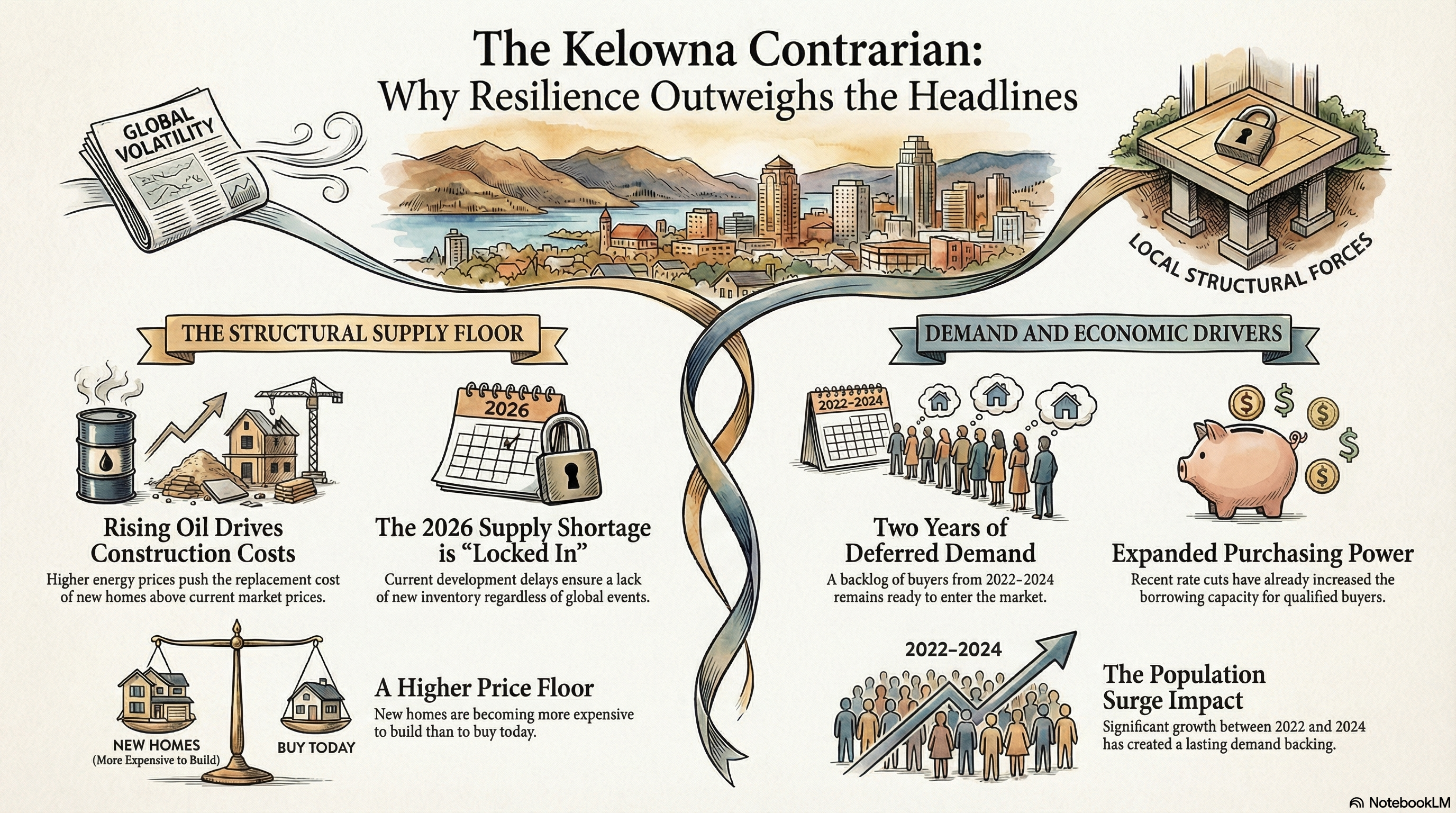
This is the argument most commentators miss. They see rising oil and conclude housing becomes less affordable. That is true for buyers. It is also true for builders, and the builder side of the equation matters more for prices in a supply-constrained market like Kelowna.
Construction in the Okanagan runs $300 to $425 per square foot before land in 2026. A 2,000 square foot home costs $600,000 to $850,000 to build before the lot, permits, and development cost charges. BC Energy Step Code compliance adds $15 to $40 per square foot on top of that. Construction costs rose 4% year-over-year in 2025, double the Bank of Canada's inflation target. Labour costs are up another 4% to 7% in 2026.
Brent crude surged from $73 per barrel on February 27 to above $113 by late March 2026 after the closure of the Strait of Hormuz. Oil feeds directly into construction through fuel surcharges on material transport, asphalt, petroleum-based building products, and equipment operation. Fertilizer disruptions raise food costs, which puts upward pressure on wages. Higher oil makes every construction input more expensive.
When resale prices fall below what it costs to build, builders stop building. Supply tightens. Prices recover. That mechanism does not care about global sentiment. It is arithmetic.
In most Kelowna family neighbourhoods, the all-in replacement cost of a new home sits at or above current resale prices. The gap between what you pay for a resale home and what it would cost to build a comparable one is narrow. Higher oil narrows it further.
The Supply Shortage for 2026 Was Already Locked In Before the War
Housing supply operates on a multi-year lag. The homes available in Kelowna in 2026 were started in 2023, 2024, and 2025. The war did not change that. You cannot reverse a construction decision already made.
CMHC projects housing starts in BC will slow through 2026, with a more significant decline in 2027 and 2028. Condominium presales in Vancouver collapsed. Developers cannot reach the presale thresholds required to secure financing. New project launches have stalled.
Nationally, Canada needs 430,000 to 480,000 new units per year to restore affordability. In 2025, the country built 259,028. That is a 40% to 46% shortfall. 60% of the national housing supply gap is concentrated in Ontario and British Columbia. The Okanagan is part of that picture.
The war did not create this shortage. It will not resolve it either. The pipeline is thinning regardless of what happens in the Middle East.
Two Years of Deferred Buyers Are Still Waiting
BC experienced more than two years of below-average sales activity. BCREA reports MLS residential sales fell 2.2% in 2025 to 72,840 units, well below the long-term average. That suppressed activity represents deferred demand. People who needed to buy waited. Most of them are still waiting.
BCREA forecasts a 12% increase in MLS residential sales for 2026. A Leger survey found 10% of Canadians plan to buy in the next 12 months, up from 7% in mid-2025. Coldwell Banker reports millennial purchase intent rose to 20% in early 2026.
Deferred demand does not require optimism to release. It requires only that the most urgent buyers, those with expired leases, growing families, job relocations, and mortgage renewals, stop deferring. Those circumstances do not wait for global clarity.
In Kelowna specifically, active listings are elevated and detached homes and townhomes remain undersupplied relative to the type of buyer entering the market. When deferred demand releases into mismatched inventory, prices rise on the segments people actually want.
The Bank of Canada Cannot Hike Into This
The Bank of Canada cut its overnight rate nine times between June 2024 and October 2025, dropping it from 5.0% to 2.25%. It held steady through three consecutive announcements in early 2026, including after oil surged past $100.
Variable mortgage rates sit near 3.35%. Fixed rates sit around 3.7% to 3.9%. The purchasing power those cuts created is already in buyer budgets.
Here is the constraint the Bank faces: oil-driven inflation is cost-push, not demand-pull. Hiking rates into cost-push inflation slows an already weak economy without addressing the source of rising prices. Canadian GDP growth is projected at 0.7% for 2026. Hiking aggressively into a supply-side shock at 0.7% GDP growth is a policy error the Bank has shown no willingness to make.
If rates hold flat, the purchasing power gains already in place continue to support prices. If rates fall further because the economy weakens, purchasing power expands and prices rise faster. The scenario that genuinely threatens Kelowna prices requires a significant rate increase combined with spiking unemployment. That combination is not the path the Bank is on.
What This Actually Means for a Kelowna Buyer Right Now
Kelowna is a buyer's market by the numbers today. Active listings are elevated. Days on market are longer than 2022 and 2023. The list-to-sale ratio gives you negotiating room that did not exist two years ago.
That window is structural, not permanent. Construction costs are rising. The supply pipeline is thinning. Deferred buyers are preparing to act. Purchasing power from rate cuts is in place. None of those conditions reverse because of what is happening in the Strait of Hormuz.
If you are moving from Calgary or coming from Ontario, the equity math still works in your favour. The gap between what your home sells for there and what you can buy here has not closed. You are still arriving with more purchasing power than a local buyer building from scratch.
The question is not whether conditions are perfect. They are not. The question is whether waiting 12 months improves your position. Based on what the structural data says, it does not.
If you want to run the numbers on a specific property or neighbourhood in Kelowna, call me. I will give you the data without the noise.
All for now,
Michael
This blog post is for general informational purposes only. It does not constitute financial advice, investment advice, or real estate advice specific to your circumstances. Market projections, construction cost estimates, interest rate commentary, and economic forecasts referenced in this post are sourced from third parties including BCREA, CMHC, the Bank of Canada, Leger, and Coldwell Banker; they represent forward-looking estimates and are subject to change. Past market conditions are not a guarantee of future performance. Real estate decisions involve significant financial risk and should be made in consultation with a licensed REALTOR®, mortgage professional, and financial advisor. Michael A. Jones is a licensed REALTOR® with Royal LePage Kelowna and is not a financial advisor, mortgage broker, or investment professional.