Michael A. Jones - PREC* | Royal LePage Kelowna
What to know:
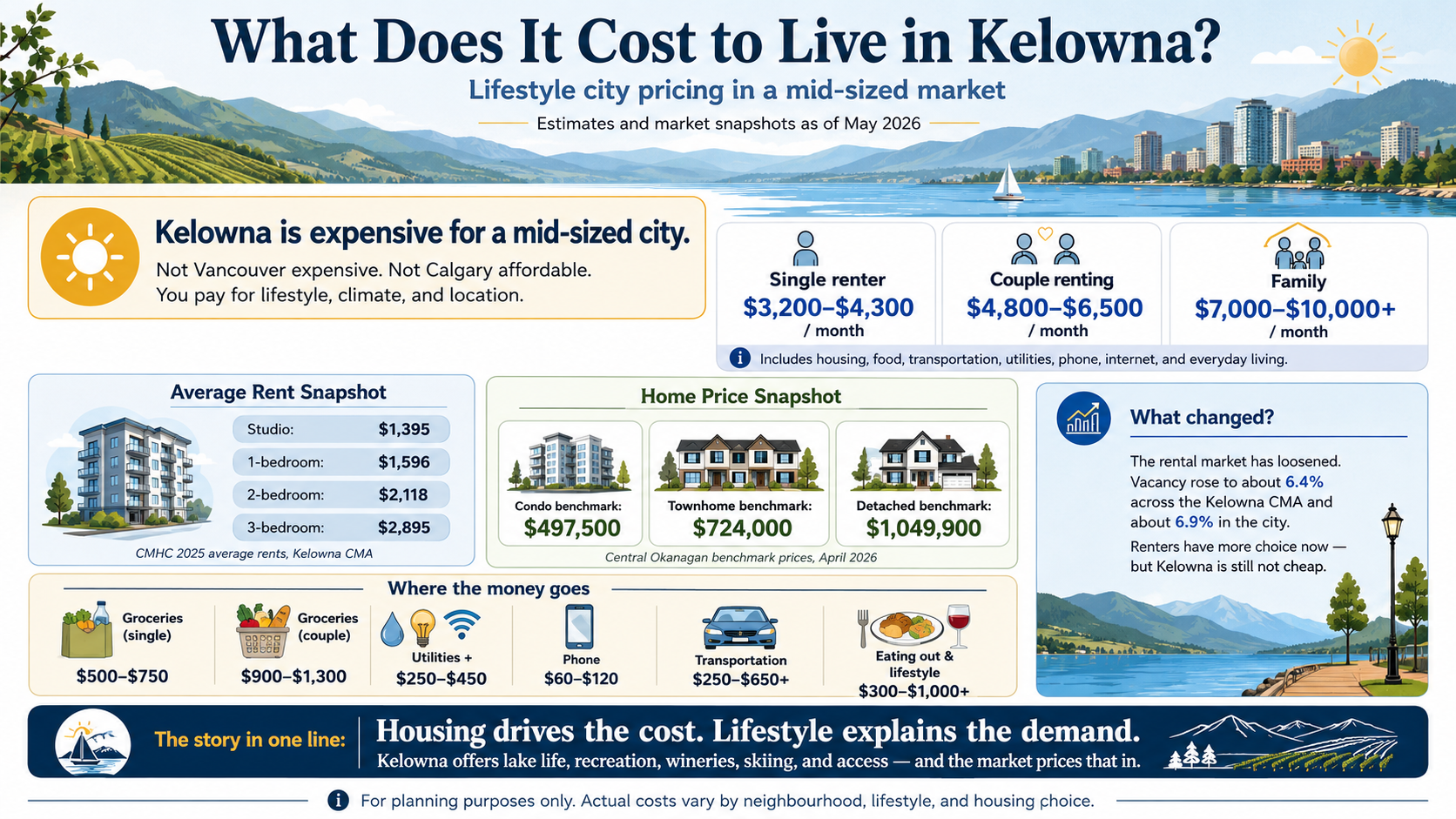
- • A single person renting a one-bedroom in Kelowna spends roughly $2,800 to $3,300 per month all-in. A couple in a two-bedroom: $4,300 to $5,000. A family of four owning an $850,000 home with one child in licensed care: $8,000 to $9,500.
- • The biggest line item is housing. The second is transportation. Kelowna is car-dependent, and ICBC plus fuel adds $400 to $700 per month for a typical two-car household (ICBC, BC Statistics fuel prices).
- • BC has no monthly MSP premium for individuals (eliminated January 1, 2020). Healthcare is effectively free at the point of access; extended benefits and family-doctor wait-lists are separate considerations.
- • Property tax in Kelowna runs about 0.45–0.55% of assessed value annually — meaningfully lower than Toronto, similar to or below Vancouver, higher than no-property-tax illusions Albertans sometimes hold (Alberta has property tax too; it just isn't structured the same way).
- • The hidden cost most newcomers miss: home insurance. Kelowna is wildfire country, and premiums run higher than what you paid in Calgary or Toronto. Get a quote on the specific property before you remove subjects.
Most relocators ask "what does a house cost in Kelowna" before they ask "what does it cost to live in Kelowna." Those are different questions, and the second one tends to surprise people more than the first.
This post is the second question. The recurring monthly numbers — what you actually spend, line by line, after you have moved in. I have covered the equity-transfer math for Alberta and Ontario buyers in the Calgary post and the Toronto post. This one is the budget that follows once the move is done.
Housing: Rent and Mortgage
Housing is the biggest single line in every household budget I have run with relocators. Rents and mortgage carrying costs both moved up significantly between 2020 and 2024, then steadied. The numbers below reflect early 2026 conditions.
Rentals. One-bedroom asking rents in the Central Okanagan have actually softened over the last year. The average asking rent for a one-bedroom in April 2026 was $1,530 — the lowest since May 2023, and the third decline in four months (Castanet Classifieds, drawn from 42 listings). Two-bedroom asking rent moved the other way in April, up $105 from March to $2,145 across 60 listings — but that two-bedroom average is still at least $100 below where it sat in each of the previous three Aprils. Three-bedroom houses run roughly $3,000 to $3,800 depending on neighbourhood and condition. Newer or waterfront-adjacent product carries a premium on top of these averages; older inventory and Rutland locations sit below.
Mortgage carrying cost. On a $750,000 purchase with 20 percent down ($600,000 mortgage), a five-year fixed mortgage at current rates produces a monthly payment of approximately $3,500. On an $850,000 purchase ($680,000 mortgage), about $4,000 monthly. On a $1,000,000 purchase ($800,000 mortgage), about $4,700 monthly. These figures assume a 25-year amortization and current Bank of Canada rate environment; your actual payment depends on the specific rate locked, term length, and amortization period chosen with your lender.
Property Tax and Strata Fees
Property tax in the City of Kelowna runs approximately 0.45 to 0.55 percent of assessed value annually for residential properties, combining the municipal, school, and regional district levies (City of Kelowna). On a $1,000,000 assessed home, the annual tax bill typically lands in the $4,500 to $5,500 range, or about $375 to $460 per month when reserved.
The Home Owner Grant reduces the bill on principal residences. The basic grant in 2026 is $570, with an additional $275 for properties in rural or northern areas. Eligibility and amounts adjust annually; verify current figures with the City of Kelowna or the Province before counting on the offset.
If you are buying a condominium or townhome, strata fees layer on top of property tax. Typical strata fees in Kelowna run $300 to $700 per month for standard apartment-style buildings, $200 to $500 for townhome complexes, and $700 to $1,500 or more for luxury waterfront or full-service buildings. Strata fees vary widely by building age, amenity load, and contingency reserve health. Review the strata documents before any purchase.
Utilities
Utilities are typically the most predictable monthly line item. A typical Kelowna single-family home runs the following ranges (BC Hydro, FortisBC, City of Kelowna utility schedules):
| Utility | Typical Monthly Cost | Source |
|---|---|---|
| Electricity (BC Hydro) | $100 – $150 | BC Hydro residential tiered rates |
| Natural gas (FortisBC) | $60 – $130 (seasonal) | FortisBC residential rate schedule |
| Water, sewer, garbage (City of Kelowna) | $70 – $110 | City of Kelowna utility rates |
| Internet (Rogers, Telus, others) | $80 – $120 | Published 2026 provider plans |
| Total utilities range | $310 – $510 | — |
Apartment and condo households generally fall on the lower end. Detached homes with electric heating or large square footage land higher, particularly in winter months when natural gas usage rises.
Home Insurance
Home insurance is the line item most relocators underestimate. Kelowna sits in wildfire country, and insurance premiums reflect that. A typical detached home in a low-to-moderate wildfire-risk neighbourhood runs $1,800 to $3,200 per year for full replacement coverage ($150 to $267 per month). Properties in higher-risk zones, particularly those flagged in the Kelowna Wildfire Resiliency Plan or in interface neighbourhoods like Wilden, Upper Mission, parts of West Kelowna, or rural Lake Country, can run materially higher or face limited coverage availability.
If you are coming from Calgary or Toronto, expect insurance to run 30 to 60 percent higher than what you paid there for an equivalent home. Get a quote on the specific property before you remove subjects on the purchase. I will say this more than once in this post because it catches people consistently.
Vehicle Costs
Kelowna is car-dependent. Public transit covers the major corridors and the university, but most lives are organized around a personal vehicle.
ICBC insurance. Basic Autoplan coverage is mandatory in BC and runs through ICBC as a provincial monopoly. For a driver with a clean record on a common passenger vehicle, basic coverage runs approximately $1,400 to $2,000 annually. Adding collision and comprehensive coverage brings the total to roughly $1,800 to $3,000 annually, or $150 to $250 per month per vehicle (ICBC published rate schedules).
Fuel. BC gasoline prices include provincial fuel tax, carbon tax, and (in the Lower Mainland) the TransLink levy. Kelowna fuel prices in 2026 typically run $1.80 to $2.10 per litre depending on global oil pricing and seasonal demand (BC Statistics fuel price tracking). A typical household with two vehicles burning 100 litres each per month spends $360 to $420 on fuel.
Parking. Most residential parking is free or included with housing. Downtown Kelowna parking for workers ranges from $80 to $180 per month at parkades. Beach parking in summer requires forethought; the city operates pay parking at major beach access points.
Healthcare
British Columbia eliminated MSP premiums for individuals on January 1, 2020. Residents pay no monthly premium for basic medical coverage under the Medical Services Plan once enrolled (Government of British Columbia). Funding shifted to the Employer Health Tax, paid by employers with annual payroll above $500,000.
Extended health and dental benefits are separate. If your employer covers them, budget zero. If not, family extended health coverage runs $100 to $200 per month through private insurers, depending on plan structure and dependents.
Family doctor wait-lists are a real issue in BC and the Okanagan reflects that. The BC Provincial Health Connect Registry is the central waitlist for unattached patients. Add yourself as soon as you have a BC address. Walk-in clinics, virtual care services, and Kelowna General Hospital handle acute issues in the meantime.
Groceries and Dining
Grocery prices in Kelowna align closely with the BC provincial average, which sits slightly above the Canadian average per Statistics Canada food CPI. A typical family of four spends $1,200 to $1,600 monthly on groceries; a couple spends $700 to $900; a single person typically spends $400 to $600.
Dining out is where Kelowna's tourism economy shows up. The local restaurant scene is strong for a city this size but pricing reflects a tourist market in summer. Expect Vancouver-equivalent pricing at the better restaurants, particularly downtown and in Lower Mission. Wine pairings with dinner add up quickly given the local wine country premium.
Childcare
British Columbia operates the $10 A Day Child Care BC program, which subsidizes participating licensed childcare providers down to a $10-per-day fee for eligible families. The program has expanded significantly since 2018 but spots are limited and wait-lists are common, particularly in Kelowna. Full-time enrolment under the program runs approximately $200 per month per child.
Outside the $10-a-day program, market-rate licensed childcare in Kelowna runs $1,200 to $1,800 per month per child for full-time care. Home-based daycare options sit at the lower end; centre-based and infant care sit at the higher end. The BC Affordable Child Care Benefit reduces costs further for eligible families based on income.
If you are moving with young children, get on Kelowna childcare wait-lists as soon as you know your move date. The supply gap is real.
Sample Monthly Budgets
Three realistic profiles. Numbers are illustrative ranges; your actual budget will vary.
| Line | Single renter | Couple, two-bed | Family of 4, owned home |
|---|---|---|---|
| Housing | $1,530 | $2,145 | $4,000 (mortgage) |
| Property tax (reserved) | — | — | $400 |
| Home insurance | $25 (tenant) | $35 (tenant) | $220 |
| Utilities | $200 | $330 | $450 |
| Phone | $70 | $140 | $220 |
| ICBC + fuel | $250 (1 car) | $500 (2 cars) | $550 (2 cars) |
| Groceries | $500 | $800 | $1,400 |
| Dining, personal | $350 | $500 | $500 |
| Childcare | — | — | $300–$1,500 |
| Extended health | $50 | $100 | $180 |
| Approx. total | $2,975 | $4,550 | $8,220 – $9,420 |
These budgets do not include discretionary spending on travel, recreation, gym or sports memberships, hobbies, or savings contributions. Add what your actual life requires.
What Costs More Here Than Calgary, Toronto, or Vancouver
Home insurance vs Calgary or Toronto. Wildfire risk pricing adds 30 to 60 percent for an equivalent home compared to a prairie or central-Ontario equivalent. Get the quote before you remove subjects.
Fuel vs Calgary. BC has provincial fuel tax and carbon tax that Alberta does not impose at the same level. Expect to pay $0.30 to $0.50 more per litre than in Alberta, which works out to roughly $60 to $120 more per month for a typical two-car household.
Restaurant pricing vs Calgary. Kelowna's tourism economy supports a higher restaurant price point than Calgary, particularly during the summer months. The gap narrows in winter.
Wine and recreation. If you actually engage with the wine country lifestyle, the consumption pattern adds up faster than it would in Calgary or Edmonton. Local wines run from $20 entry to $80-plus for premium product, and tasting fees at wineries are now standard.
What Costs Less Than Vancouver or Toronto
Housing carrying cost vs Vancouver. A comparable family home in Kelowna's mid-tier neighbourhoods carries for $1,000 to $2,000 less per month than the Greater Vancouver equivalent, depending on the specific neighbourhood comparison. The gap has narrowed since 2020 but is still meaningful.
Property tax vs Toronto. The City of Toronto adds municipal land transfer tax on purchases (one-time) and runs a property tax mill rate broadly comparable to Kelowna's, but Toronto's MLTT plus higher provincial LTT on entry costs significantly more upfront than BC's PTT. On the ongoing annual property tax line, the two markets are closer than most relocators expect.
Transit-related costs (because there aren't many). Kelowna's car-dependent layout means no transit pass costs build into a budget. Whether that nets out as a saving or a cost depends on how you compare it to subway/streetcar passes in Toronto or SkyTrain passes in Vancouver versus the cost of running a second vehicle here.
Hidden Costs Newcomers Miss
The two-vehicle creep. Couples who arrived as one-vehicle households in Toronto or Vancouver often become two-vehicle households here within twelve months. The car-dependent geography makes a single shared vehicle hard to sustain once both partners have local commitments. Build a second vehicle into your one-year forecast even if you do not buy one immediately.
Smoke-season indoor adjustments. If wildfire smoke is bad in a given summer, indoor air filtration becomes a quality-of-life expense. Decent HEPA filters run $200 to $500 each; HVAC upgrades for higher-grade filtration can run $1,500 to $3,500 one-time. Not every year, but enough years to plan for.
Seasonal travel back home. Many Kelowna relocators fly back to Vancouver, Calgary, or Toronto more often than they expected — for family, work, healthcare specialists, or specific events. Flights from YLW run $300 to $500 return to Vancouver, $400 to $700 to Calgary, $700 to $1,200 to Toronto. Two or three trips a year per family member adds up.
Outdoor recreation gear. The lake-life lifestyle requires gear if you actually plan to live it. Paddleboards, bikes, ski passes, boat moorage, vineyard memberships — none of these are required, but most relocators end up with a meaningful share of them within the first two years. Budget honestly for what you will actually do.
The Real Test
The way I run a real cost-of-living conversation with relocator clients is to take their current household budget and walk through it line by line, swapping in Kelowna numbers and naming the things that change. That exercise tends to reveal the actual financial shift faster than a generic comparison ever does.
If you are running the numbers seriously and want to do that exercise together, get in touch. The first conversation is always about the real picture, not the brochure.
Frequently Asked Questions
How much does it cost to live in Kelowna per month for a single person in 2026?
A single person renting a one-bedroom apartment in Kelowna typically spends $2,800 to $3,300 per month covering rent, utilities, transportation, groceries, phone, and basic discretionary spending. The average asking rent for a one-bedroom in the Central Okanagan in April 2026 was $1,530 — the lowest since May 2023 (Castanet Classifieds, drawn from 42 listings). Utilities, insurance, and ICBC vehicle coverage layer on top. Downtown waterfront and active-lifestyle budgets can land closer to $3,500 to $4,000.
How much does a family of four spend monthly in Kelowna?
A family of four owning an $850,000 home, with two vehicles and one child in licensed daycare, typically spends $8,000 to $9,500 per month covering mortgage, property tax, home insurance, utilities, two ICBC policies, fuel, groceries, childcare, activities, and basic extended health coverage. The largest single line is the mortgage (about $4,000 monthly at current rates on a 20% down purchase). Childcare ranges widely depending on access to the BC $10-a-day program versus market rates.
Is Kelowna more expensive than Calgary, Toronto, or Vancouver?
Kelowna runs less expensive than Vancouver and Toronto on housing and most carrying costs, and more expensive than Calgary on housing but comparable on most other monthly expenses. Property tax is meaningfully lower than Toronto. Home insurance is meaningfully higher than Calgary or Toronto due to wildfire risk pricing. Fuel and provincial taxes are higher than Calgary. Compared to Vancouver, Kelowna comes in lower on housing carrying cost, property tax, and most utilities, but the cost gap has narrowed substantially since 2020.
What is the property tax rate in Kelowna in 2026?
The combined property tax rate for a residential property in the City of Kelowna in 2026 runs approximately 0.45 to 0.55 percent of assessed value annually, depending on the specific tax classes and area levies that apply (City of Kelowna). On a $1,000,000 assessed home, the annual property tax bill typically lands in the $4,500 to $5,500 range. Add school tax and regional district levies to the municipal portion to arrive at the full annual amount. The Home Owner Grant offsets a portion for principal residences.
Does BC have monthly MSP premiums for residents?
No. British Columbia eliminated MSP premiums for individuals on January 1, 2020. Residents pay no monthly premium for basic medical coverage under the Medical Services Plan once enrolled (Government of British Columbia). Funding shifted to the Employer Health Tax, which is paid by employers with annual payroll above $500,000. Extended health and dental coverage is separate and either employer-provided or privately purchased; budget $100 to $200 per month for a family if you do not have employer coverage.
All for now,
Michael
This blog post is for general informational purposes only. It does not constitute financial, tax, mortgage, or legal advice. Cost figures referenced are illustrative ranges based on publicly available 2026 source data from BC Hydro, FortisBC, the City of Kelowna, ICBC, the Government of British Columbia, the Association of Interior REALTORS, Castanet Classifieds rental tracking, and Statistics Canada, and will vary by specific household, property, and consumption pattern. Mortgage qualification and rates depend on individual circumstances and must be assessed by a licensed mortgage professional. Property tax rates, utility tariffs, ICBC premiums, and provincial program eligibility (including the $10 A Day Child Care BC program and the BC Affordable Child Care Benefit) are subject to change; verify current figures with the relevant authority before relying on them. Michael A. Jones is a licensed REALTOR® with Royal LePage Kelowna and a member of the Canadian Real Estate Association (CREA) and the Association of Interior REALTORS®. He is not a lawyer, tax advisor, mortgage broker, or financial planner. Always seek qualified professional advice in the relevant discipline before making relocation or financial decisions.