Michael A. Jones - PREC* | Royal LePage Kelowna
If you have already decided to move to Kelowna, the month you buy matters almost as much as the price you pay. Kelowna's real estate market runs on a seasonal cycle, and it does not line up with the one you know from Calgary or Toronto. Competition and prices firm through late spring and hold into summer, then supply and leverage swing back toward the buyer through late fall and winter. The best time to buy a home in Kelowna on price and negotiating room falls between November and January, when listings thin out and the sellers still on the market have a reason to deal. The catch: that window sits opposite the season most relocators would otherwise pick for the move.
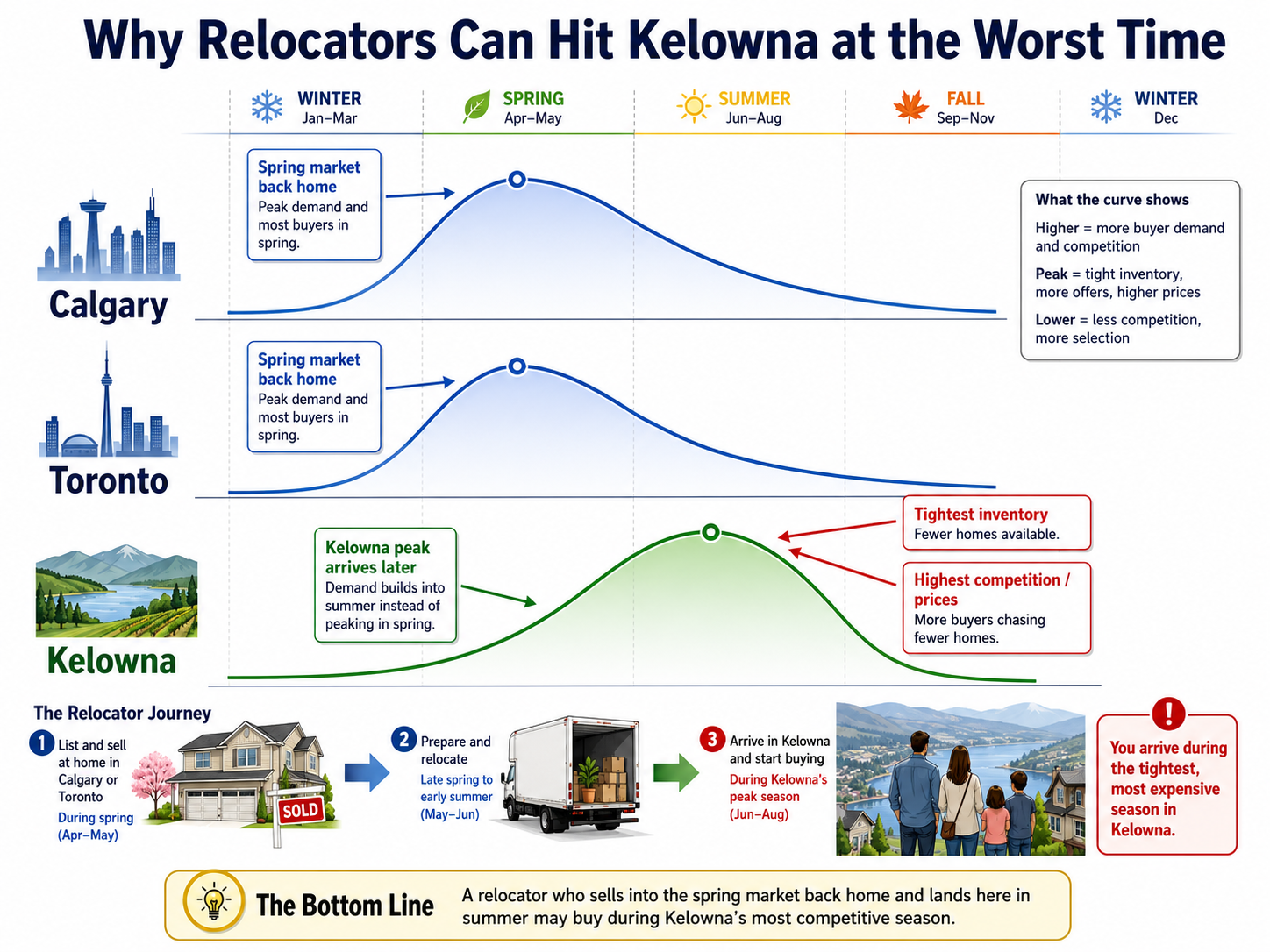
Kelowna's buying competition peaks a few weeks later than Calgary's or Toronto's, so a relocator who sells into the spring market back home and lands here in summer buys into Kelowna's tightest, most expensive season.
What to know:
- • Kelowna sales climb from a January floor to a June and July peak, then fade through fall to a December bottom, per the Association of Interior REALTORS 13-month record.
- • Central Okanagan homes took 92 days to sell in January 2026, the slowest month of the year, against 51 to 52 days the prior spring (Author's analysis of Association of Interior REALTORS MLS data).
- • Toronto home prices historically peak in May, with a 62.5% chance May marks the spring high, per Toronto Realty Blog's read of TRREB data.
- • Calgary follows the same spring-uplift, winter-slowdown arc, with sales sliding to 1,553 by December 2025, per the Calgary Real Estate Board.
- • Kelowna's summer runs hotter and longer than the big metros because recreational and lifestyle demand extends the season past the spring peak.
- • List your home before you shop, not after. A Kelowna seller takes a buyer with a listed or sold home far more seriously, and an offer conditional on selling a home that is not yet listed almost always gets declined.
How does Kelowna's real estate calendar move through the year?
Kelowna's market builds in spring, peaks around midsummer, and empties out by winter. Sales rose from 306 in February 2025 to a July peak of 482, then slid to 226 by January 2026, per the Association of Interior REALTORS 13-month comparison. Active inventory traced the same arc, cresting near 4,500 listings in June and thinning to roughly 3,150 by December.
Read those two lines together and the seasons sort themselves into buyer weather and seller weather. Spring is when the choice arrives. New listings flood in, and by May a buyer has the widest field of homes to walk through all year. Summer is when the competition shows up to meet that choice, and prices firm. Then fall thins the field, and winter clears it. By January, homes took 92 days to sell across the Central Okanagan, the slowest month in the record, against 51 to 52 days the previous spring. A house that has sat for 92 days has a seller who has watched three months pass, and that patience running out is where a buyer finds room to negotiate.
The relocator's mistake is reading "most listings" as "best time to buy." The widest selection and the best price rarely share a month. Spring hands you the most doors to knock on and the most company knocking beside you. Winter hands you fewer doors and no company at all.
When is the best time to buy a home in Kelowna?
The short answer: for selection, buy in spring, when new listings peak and you can compare the most homes side by side. For price and negotiating leverage, buy from late fall through January, when inventory bottoms, days-on-market stretch past 80, and the remaining sellers have a reason to deal. Most relocators cannot split the difference, so the honest answer turns on whether choice or leverage matters more to your move.
If you are after a specific kind of home in short supply, a single-level rancher, a lake-view condo, a walkable Lower Mission property, spring and early summer give you the only real selection, and paying near the top of the season buys you the home you actually want. If you are flexible on the property and firm on the budget, winter is your season. In a thin market, one motivated seller and no competing offer beats twenty listings you have to bid against.
How is Kelowna's cycle different from Calgary's and Toronto's?
All three markets share the same seasonal skeleton, a spring build, a summer plateau, a fall fade, and a winter trough, but the peaks land in different months. Toronto's average price historically tops out in May. Calgary's activity crests in spring and slides through the back half of the year. Kelowna's peak runs later, into June and July, because recreational and lifestyle demand keeps buyers active through the summer after the big metros have already turned down.
That lag is the whole story for a relocator. When you sell in Calgary or Toronto, you sell into a market that peaks in spring. When you buy in Kelowna, you often arrive in summer, right as Kelowna hits its own peak. You catch both markets near their most expensive, selling high only to turn around and buy high.
| Toronto (GTA) | Calgary | Kelowna / Central Okanagan | |
|---|---|---|---|
| Activity / price peak | May (price) | Spring | June and July (sales) |
| Slowest month | December and January | December | January |
| What drives the summer | Fades after May | Fades after spring | Recreational and lifestyle demand holds it up |
| Best buyer-leverage window | Late fall and winter | Late fall and winter | November to January |
| Widest selection | Spring | Spring | May and June |

If I am selling in Calgary or Toronto and buying in Kelowna, how do I time both?
The clean play and the convenient play point in opposite directions. To sell high, list back home into the spring market, February through May, when buyer demand and prices peak in Calgary and Toronto. To buy with leverage in Kelowna, purchase in the late-fall-to-winter window. Those two windows sit roughly six months apart, and that gap is the coordination problem no one warns you about.
You have three honest ways through it. Sell in spring and rent locally or in Kelowna until winter, trading a few months of carrying cost for a stronger buy. Sell and buy in the same season, accepting that you trade near the top on both ends, which stays simplest and is often what family timing forces anyway. Or stretch the move across a full year, listing back home in spring and buying in Kelowna the following winter, if your life allows the bridge. None of these comes free. The point is to choose the tradeoff on purpose rather than discover it after you have committed to both sides.
One rule matters more than the season, and buyers get it backwards more than any other. List your home before you shop for the next one, not after. Most people want to find the Kelowna place first and list back home once they have it. That order works against you. Sellers here want qualified buyers, and qualification runs in tiers. A buyer whose home is already listed is qualified. A buyer whose home has already sold is the strongest kind of all. A buyer who has not listed is a promise, and a thin one. Write an offer subject to selling a home that is not yet on the market, and a Kelowna listing agent will almost always decline it, or at best attach a short time clause, commonly 24 to 72 hours. That clause keeps the seller's home on the market and lets them take a stronger offer the moment one lands, which bumps you to the back of the line.
I will say it plainly, because it is how I work. I would never let a seller of mine tie up their home for a buyer who has not even listed their own, and I would want to know why we let an unqualified buyer through the door at all. So list first, and shop second. Once your home is on the market, you can still protect yourself. Accept an offer on it subject to you finding a suitable property to buy, and you keep your footing on both sides. You sell from strength, and you shop as the only kind of buyer a Kelowna seller takes seriously.
Why is summer the hardest time to buy in Kelowna?
Summer feels like the natural time to move. School is out, the lake is warm, and the calendar opens up, so it draws the most relocating buyers all at once. That same pull makes it the toughest season to buy well. Kelowna's out-of-province and second-home demand concentrates in the summer months, stacking lifestyle buyers on top of the local market and holding prices at their seasonal high.
This is the trap built into a relocation. The season that is easiest to move in carries the most competition and the least negotiating room. It does not mean you should rule out a summer move; sometimes the job or the school year decides for you. It means you should walk in knowing you are buying into the peak, budget for it, and resist the feeling that a fast, competitive market forces you to overpay to win.
Does the yearly trend override the seasonal pattern?
Yes. When the broader market is moving, the annual trend sits on top of the seasonal one, and you have to read both. The seasonal cycle tells you the best month within a normal year. The market trend tells you whether this year is normal. In June 2026, Kelowna posted its strongest sales month in a year on falling inventory, and Toronto and Vancouver turned up the same month, per board data. When the big markets firm, a winter that would normally hand buyers leverage can stay tighter than the calendar suggests.
So use the season to fine-tune, not to gamble. In a flat or softening market, the winter leverage window is real and worth the wait. In a firming market, the seasonal discount shrinks, and holding out for winter can cost you more in rising prices than it saves in negotiating room. Your job as a relocator is to know which kind of year you are buying into, and that is a conversation worth having before you settle on a moving date.
All for now,
Michael
Michael A. Jones - PREC* is a REALTOR® with Royal LePage Kelowna, licensed in British Columbia. He writes about Central Okanagan housing, Kelowna, West Kelowna, Lake Country, and Vernon, under the byline The Real Estate Novelist. Member of the Association of Interior REALTORS® and the Canadian Real Estate Association (CREA). Reach him at 250-258-4663 or yourkelownahomes.com.
General market information for the Central Okanagan. Not personalized financial, legal, or tax advice. Real estate market conditions and seasonal patterns vary by year, property type, and price band. Confirm specifics with a licensed REALTOR® or appropriate professional.