Michael A. Jones - PREC* | Royal LePage Kelowna
On March 13, 2026, Statistics Canada released the February Labour Force Survey. Canada lost 84,000 jobs. The unemployment rate climbed to 6.7%. Economists had expected a gain of 10,000 jobs. This was not a rounding error. It was one of the weakest monthly jobs reports in years outside of the pandemic.
BC lost 20,200 jobs in February. The provincial unemployment rate held at 6.1%, but only because people stopped looking for work altogether, not because conditions improved. Construction and finance, insurance, and real estate were among the hardest hit sectors in the province.
If you are watching the Kelowna real estate market, this report matters. Not because it crashes anything. It does not. But because it changes the calculation in specific, measurable ways.
Here is what you need to know.

Photo: Amernhel Pascua
What the Numbers Actually Say
The national headline is 84,000 jobs lost in February. Full-time employment dropped by 108,000 positions. Private sector jobs fell by 73,000. Youth unemployment jumped to 14.1%. The labour force itself shrank, which is what kept the official unemployment rate from rising even higher.
For BC specifically, the 20,200 job losses were the province's largest since the pandemic. The sectors that took the biggest hits included construction (-6,900 jobs), finance, insurance, and real estate (-5,400 jobs), and health care (-4,900 jobs). Some gains appeared in accommodation and food services (+7,200) and technology (+5,300), but they were not enough to offset the losses elsewhere.
BC's unemployment rate of 6.1% is the fourth lowest in Canada. That context matters. Ontario sits at 7.6%. Alberta is at 6.3%. The national rate is 6.7%. BC is not immune to what is happening, but it is not leading the decline either.
What This Means for the Bank of Canada
The Bank of Canada held its policy rate at 2.25% at its January 28 meeting. The next decision is Wednesday, March 18, 2026.
The February jobs report changes the tone heading into that announcement. A report this weak makes it harder for the Bank to maintain a neutral or hawkish stance. Most economists as of mid-March were predicting a hold, but several noted the data opens the door to a cut.
Here is why this matters for you as a buyer: fixed mortgage rates in Canada track the 5-year Government of Canada bond yield, not the overnight rate directly. As of early March 2026, the best 5-year fixed rates were sitting near 3.79%. Variable rates also remain available and competitive.
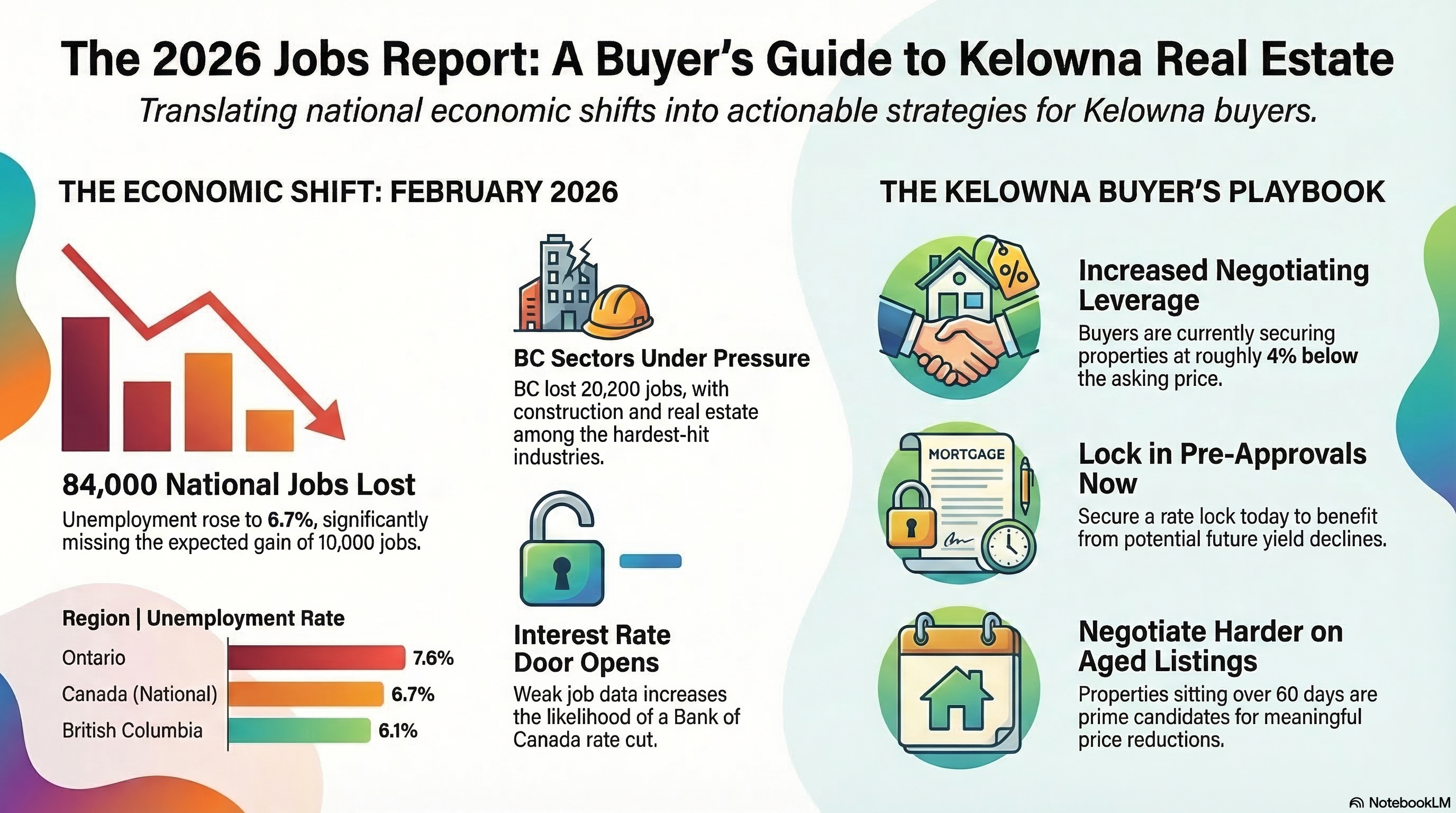
If the jobs data leads to a rate cut, or simply shifts market expectations toward future cuts, bond yields can decline and fixed mortgage rates can follow. That directly affects what you can afford.
What to watch: Check the Bank of Canada announcement on March 18 at bankofcanada.ca. Do not make rate assumptions based on what was true last month.
What This Means for the Kelowna Real Estate Market
Kelowna entered 2026 already in a buyer's market. Active inventory is elevated. Days on market have increased. The list-to-sale ratio sits near 96%, which means buyers routinely get properties for 4% below asking. February saw a 22.6% month-over-month increase in sales compared to January, and townhome sales rose 25% in the same period. The spring market was beginning to show some life.
A weak national jobs report introduces friction into that recovery. It does not reverse it. But it does some specific things worth noting:
- Buyer confidence slows. Households facing job uncertainty, or who know someone facing it, pull back on large financial commitments. This is rational. It extends the window during which buyers have negotiating room.
- Seller urgency can increase. Homeowners who are employed in affected sectors may become motivated sellers. Motivated sellers price to move. That creates opportunity for prepared buyers.
- New build risk rises. Kelowna already had pre-sale condo projects where appraisals came in below contract prices. Weaker employment conditions make lenders more conservative. If you are buying a new build or a pre-sale unit, understand your appraisal risk before you firm up.
- Relocation buyers may pause. Alberta's unemployment rate is 6.3%. Some of the equity buyers that Kelowna relies on as a feeder market are also watching their own job security before they pull the trigger on a relocation purchase.
What Smart Buyers Will Do Right Now
Economic uncertainty creates hesitation in the market. Hesitation is often misread as lack of opportunity. It is not. It means the people competing against you have paused. If your own employment is stable and your financing is in order, this is worth paying attention to.
Here is what the buyers who end up with good outcomes do in markets like this one:
- Get pre-approved now, not after rates move. Pre-approval locks your rate for a period. If rates drop between now and when you write an offer, you benefit. If they rise, you are protected. Waiting to see what happens is not a neutral position. It is a gamble.
- Focus on your household's income stability, not the headlines. Canada losing 84,000 jobs is significant. Whether those jobs are in your industry, your company, or your household is a separate question. Buy based on your actual financial position.
- Understand the difference between fixed and variable rate risk. Fixed mortgage rates track bond yields. Variable rates track the overnight rate. These move for different reasons at different times. Ask your mortgage professional to walk you through both scenarios with current numbers before you commit to either.
- Negotiate harder on properties that have been sitting. Kelowna's inventory is elevated across most property types. Properties over 60 days on market are candidates for meaningful price reductions. The February data gives buyers additional leverage to ask for it.
- Build in longer subjects. An uncertain economic backdrop is not the time to waive financing or inspection conditions to compete. You do not need to compete right now. There is enough inventory to be deliberate.
What to Watch Out For
There are also some traps in this environment worth naming directly.
Waiting indefinitely for the perfect conditions. If you are waiting for rates to drop further and the jobs market to stabilize and prices to fall and inventory to increase, you are stacking conditions that may not arrive simultaneously. Each of those factors moves on its own timeline. Buyers who waited through 2024 for a rate cut that came later than expected ended up paying for that delay in other ways.
New build appraisal gaps. Several Kelowna condo projects already have buyers facing appraisal shortfalls at completion. Weaker economic conditions can widen that gap. If you are considering a pre-sale unit, price the worst-case scenario: what happens if the appraisal comes in 10% below your contract price? Do you have the cash to bridge it?
Over-leveraging on the assumption that rates will drop significantly. The Bank of Canada is at 2.25%. Before the 2024 rate cutting cycle began, the rate was at 5%. Nine cuts brought it down. Most economists now expect the rate to hold at 2.25% through end-2026, with cuts only possible if economic conditions deteriorate further. Do not build your purchase plan on a rate that does not yet exist.
Confusing a slow market with a broken market. Kelowna is not broken. Prices on single-family homes are holding. The million-dollar benchmark for detached homes in the Central Okanagan remains intact. The market is slow and selective, not collapsing. Buyers who conflate those two things either overpay for fear of missing out or miss good properties while waiting for a crash that is not coming.
The Bigger Picture
Canada's economy has faced meaningful headwinds in early 2026. U.S. tariffs, trade uncertainty, and a labour market that has given back most of last fall's gains are real factors. BC has held up better than most provinces, but 20,200 job losses in a single month is not noise.
For Kelowna buyers, the practical reality is this: the market was already tilted in your favour before this report came out. The jobs data extends the window during which that remains true. It may also create downward pressure on fixed mortgage rates if the Bank of Canada moves or markets price in future cuts.
That combination, more inventory, more time, motivated sellers in certain segments, and potentially lower borrowing costs, is not a reason to panic. It is a reason to be prepared.
If you want to understand how the current data applies to your specific situation in Kelowna, call me. I will give you the numbers as they actually stand, not as they were six months ago.
All for now,
Michael
This blog post is for general informational purposes only. It does not constitute financial advice, mortgage advice, or investment advice. Labour market conditions, interest rates, and real estate market data change frequently and may have shifted after the date of publication. Bank of Canada rate decisions should be confirmed directly at bankofcanada.ca before making any financing decisions. Mortgage rate information should be verified with a licensed mortgage professional. Real estate market conditions vary by property type, neighbourhood, and individual transaction. Michael A. Jones is a licensed REALTOR® with Royal LePage Kelowna, registered with the BC Financial Services Authority (BCFSA) and a member of the Canadian Real Estate Association (CREA). He is not a mortgage professional, financial advisor, or economist. For financial planning and mortgage decisions, consult a licensed mortgage professional and a qualified financial advisor.