Michael A. Jones - PREC* | Royal LePage Kelowna
If you are an American looking at property in the Okanagan, you have probably heard about Canada's foreign buyer ban. You may have assumed that closes the door on you. It does not. The ban has a geographic exemption built into it, and parts of the Okanagan fall outside the boundary where the ban applies.
The opportunity is real. The costs are also real. This post lays out both so you can make an informed decision before you spend time or money on a search.

Photo: Expedia.com
How the Foreign Buyer Ban Actually Works
The Prohibition on the Purchase of Residential Property by Non-Canadians Act came into force in January 2023. It prohibits non-Canadians from purchasing residential property in Canada until January 1, 2027.
The key word is "where." The ban only applies to properties located within a Census Metropolitan Area (CMA) or Census Agglomeration (CA) as defined by Statistics Canada. A CMA requires a total population of at least 100,000 with 50,000 or more in the urban core. A CA requires a core population of at least 10,000. Properties outside those boundaries are legally exempt from the ban.
Kelowna is a CMA. The ban applies there. But not every Okanagan community sits inside a CMA or CA boundary.
Where the Exemption Applies in the Okanagan
Naramata is a confirmed example. It sits near the Penticton CA but falls outside its boundary. American buyers can legally purchase residential property in Naramata right now.
Naramata is not an obscure rural outpost. It sits on the east bench of Okanagan Lake, south of Kelowna. Vineyards, lake views, and a tight community. It is exactly the kind of place American buyers are looking at when they picture an Okanagan property.
Other rural and semi-rural Okanagan communities may also fall outside CMA and CA boundaries. Each property needs to be verified individually because boundaries do not always follow municipal lines.
CMHC provides an interactive map tool for this. You enter any property address and it tells you whether the ban applies. Use it before you get attached to a listing.
Check Any Okanagan Address on the CMHC Map Tool
Being Exempt from the Ban Is Not the Whole Picture
This is where American buyers need to slow down and read carefully. Clearing the federal foreign buyer ban is step one. There are additional costs that apply specifically to non-Canadian buyers in BC, and they are significant.
BC Additional Property Transfer Tax: 20%
BC imposes a separate Additional Property Transfer Tax of 20% of the property's fair market value on foreign nationals purchasing residential property in designated regions. The Regional District of Central Okanagan is one of those regions.
This tax applies regardless of whether the property is inside or outside a CMA or CA boundary. Being exempt from the federal ban does not exempt you from this provincial tax.
On a $1,000,000 purchase, you owe approximately $200,000 in Additional PTT on top of the standard BC Property Transfer Tax. On top of that, the standard PTT on a $1,000,000 purchase is $18,000 (1% on the first $200,000, 2% on the next $1,800,000).
That is $218,000 in transfer taxes on a $1,000,000 purchase. Factor this into your budget before you go any further.
Some limited exemptions to the Additional PTT exist, including for BC Provincial Nominees. Confirm applicability with a qualified BC real estate lawyer before you proceed.
BC Speculation and Vacancy Tax: 3% Annually
BC levies an annual Speculation and Vacancy Tax on residential properties in designated regions. For foreign owners, the rate is 3% of the property's assessed value annually beginning in 2026.
This applies even if the federal ban does not. A property exempt from the foreign buyer ban can still be subject to the SVT every year you own it.
On a $1,000,000 property assessed at market value, that is $30,000 per year. Properties rented for a sufficient portion of the year may qualify for an exemption. A BC tax professional can confirm eligibility for your specific situation.
Standard BC Property Transfer Tax
All buyers, including Canadians, pay the standard BC Property Transfer Tax at the time of purchase. The rates are:
- 1% on the first $200,000
- 2% on the portion from $200,000 to $2,000,000
- 3% on the portion from $2,000,000 to $3,000,000
- 5% on any portion above $3,000,000
On a $1,000,000 purchase, this amounts to $18,000. For a non-Canadian buyer in the Central Okanagan, both the standard PTT and the 20% Additional PTT are owed at closing.
GST on New Construction
If the property is newly constructed, federal GST of 5% applies to the purchase price. Resale properties are not subject to GST. Some rebates exist for properties below certain price thresholds used as a primary residence, but these have limited application for non-resident foreign buyers. Confirm GST treatment with your lawyer before you commit.
Rental Income and Canadian Tax Obligations
If you plan to rent the property, you are subject to Canadian income tax on that rental income. A 25% withholding tax applies to gross rental income by default. You can elect to be taxed on net income instead by filing a Canadian tax return, which allows you to deduct eligible expenses including mortgage interest, management fees, and repairs.
US citizens must also report rental income to the IRS. The Canada-US Tax Treaty may provide credits to reduce double taxation, but a cross-border tax professional should be involved before you start renting.
Capital Gains When You Sell
When a non-resident sells Canadian property, any capital gain is subject to Canadian tax. The buyer's lawyer is required to withhold a portion of the sale proceeds at closing until the non-resident seller obtains a Clearance Certificate from the Canada Revenue Agency confirming their tax obligations are settled.
US citizens must also report the gain to the IRS. Treaty credits generally apply. Plan this in advance with a cross-border tax professional, not after you accept an offer.
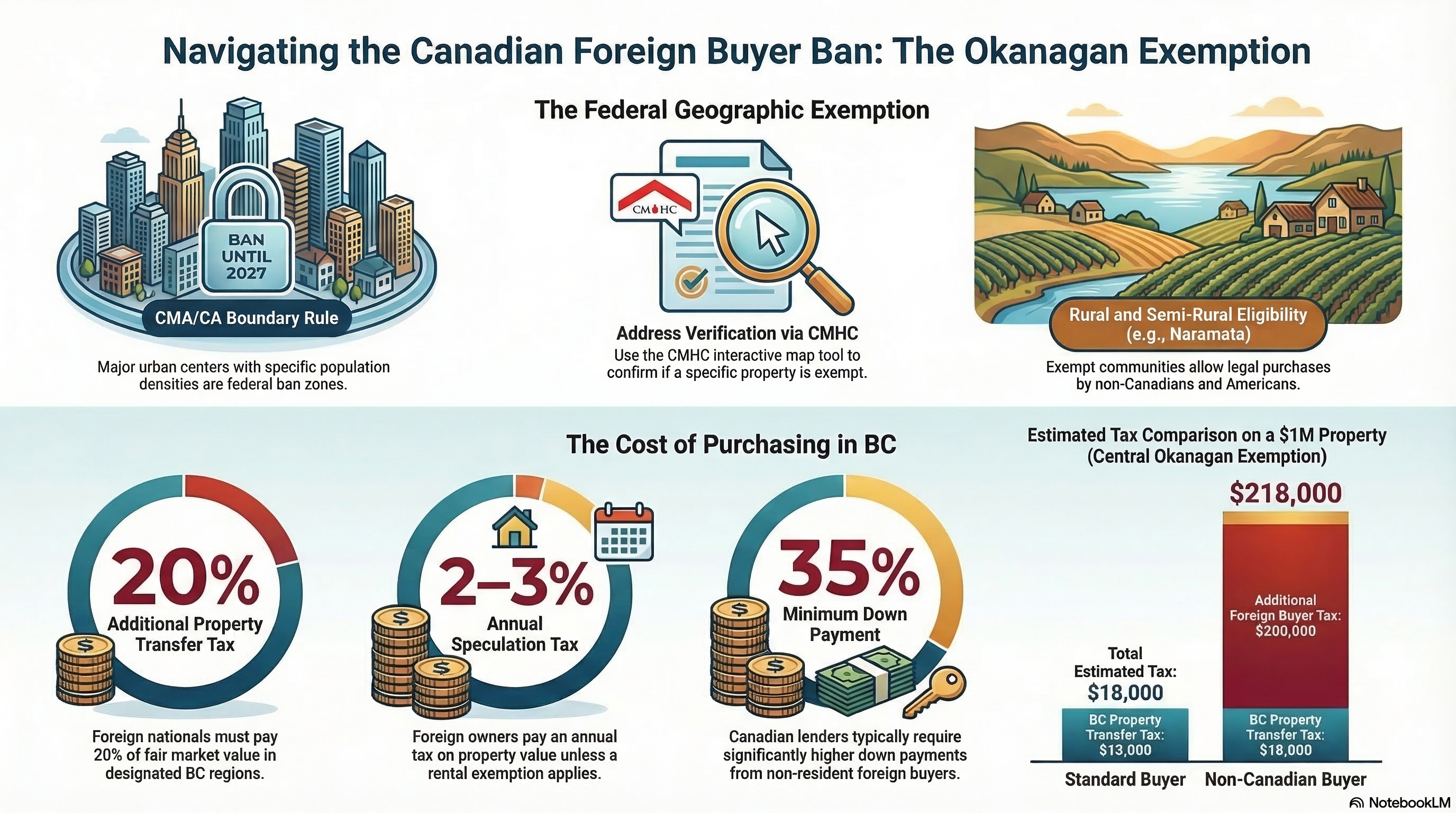
Photo: Expedia.com
Financing as an American Buyer
Getting a Canadian mortgage as a foreign national is possible. It is more restrictive than for Canadian residents. Most Canadian lenders require a down payment of 35% or more from non-residents, apply stricter income qualification criteria, and charge higher rates. US income can generally be used to qualify, but currency conversion and documentation requirements vary by lender.
Some buyers choose to purchase with cash or use US-based equity to avoid these complications. Either way, engage a Canadian mortgage broker experienced with non-resident buyers early in the process, before you make an offer.
Your Full Cost Checklist
Here is a summary of the costs that may apply to a non-Canadian buyer in the Okanagan. Not every item applies in every situation. Verify each one with legal and tax professionals before you proceed.
- At purchase: Standard BC Property Transfer Tax (applies to all buyers)
- At purchase: Additional BC Property Transfer Tax at 20% of fair market value (Central Okanagan, foreign nationals)
- At purchase, new construction only: GST at 5% of purchase price
- Annually: BC Speculation and Vacancy Tax at 3% of assessed value for foreign owners (unless exempt)
- Annually, if renting: Canadian income tax on rental income (25% withholding on gross, or net income election)
- On sale: Canadian capital gains tax; Clearance Certificate required from CRA before proceeds are released
What to Do Next
If you are an American buyer seriously looking at Okanagan property, the first step is to verify whether the specific properties you are interested in fall outside the CMA or CA boundary. Use the CMHC map tool linked above. Do that before anything else.
The second step is to get a BC real estate lawyer involved early. The provincial tax obligations for non-Canadian buyers are material. You need confirmed numbers, not estimates, before you write an offer.
If you want to talk through what is available in exempt areas of the Okanagan, I am happy to help. I work with buyers from the US regularly and I know where to look.
Contact me here and we can start with the basics.
All for now,
Michael
This blog post is for general informational purposes only. It does not constitute legal advice, tax advice, or financial advice. The Prohibition on the Purchase of Residential Property by Non-Canadians Act, its Regulations, and all referenced provincial tax legislation are subject to change. The foreign buyer ban is currently set to expire January 1, 2027. Geographic boundaries for CMA and CA designations should be verified using the CMHC interactive map tool for each specific property address. BC Additional Property Transfer Tax exemptions, Speculation and Vacancy Tax exemptions, and GST treatment must be confirmed with a qualified BC real estate lawyer and tax professional for your specific transaction. Canadian income tax obligations for non-residents, including withholding tax on rental income and capital gains tax on sale, should be reviewed with a Canadian accountant experienced in non-resident taxation. US citizens should also consult a cross-border tax professional regarding obligations to the IRS. Michael A. Jones is a licensed REALTOR® with Royal LePage Kelowna and is not a lawyer, tax advisor, or financial professional.