By Michael A. Jones - PREC* | Royal LePage Kelowna
Short answer: Yes, winter is a good time to buy in Kelowna, and it may be the best time to learn how a home really lives. You can see how steep the driveway is with snow on it, how fast the street gets plowed, and how much light the rooms get when the valley cloud sits low. The trade-off is that some things, like the roof, pool and irrigation, are hard to inspect under snow. Plan for that and you can buy with fewer surprises.
Moving here from another province or from the Coast? Start with our Moving to Kelowna and the Okanagan guide.
1. Drive the driveway and the hill
Many of Kelowna's view homes sit on hillsides. Upper Mission, Black Mountain and Wilden all have steep streets and steep driveways. In summer they are easy. After a snowfall, they can be a different story.
- Visit after a snowfall if you can, not only on a clear day.
- Look at which way the driveway faces. North-facing driveways stay icy longer.
- Ask if the driveway has heat cables or if the sellers pay for snow clearing, and what it costs.
- Check where the snow goes. A short, steep driveway with no room to pile snow is hard work.
- Think about the next 10 years. A slope that is fine at 58 may be harder at 70.
The City of Kelowna does not clear private driveways. It says there are about 39,000 driveways in the city, too many for its crews. (Source: City of Kelowna, Snow clearing and ice control)
2. Check the street's plow priority
Kelowna clears its streets in a four-tier order. Priority 1 roads, like Gordon Drive, Springfield Road and Lakeshore Road, are cleared and sanded within eight hours of snowfall ending. Priority 2 roads are cleared within 12 hours. These include collector roads with steep hills, school zones and transit routes, such as the Black Mountain area. Local and residential streets, Priority 3, are cleared within 48 hours. If more snow falls while crews are working, they go back to Priority 1 roads first. (Source: City of Kelowna)
That means a quiet cul-de-sac may wait up to two days after a storm. For most people that is fine. If you work shifts, care for someone, or need to get to medical visits, it matters.
The City also has snow route areas with parking bans during a snow advisory. These include Black Mountain, Clifton/Magic Estates/Wilden, Dilworth Mountain, Kirschner Mountain, McKinley Beach, Quail Ridge and parts of the South Mission. If you buy there, plan to park off the street when the City calls an advisory. You can look up any street on the City's snow removal priority map at maps.kelowna.ca.
One more thing. Highways 97 and 33 are run by the province, not the City.
3. See the rooms under winter cloud
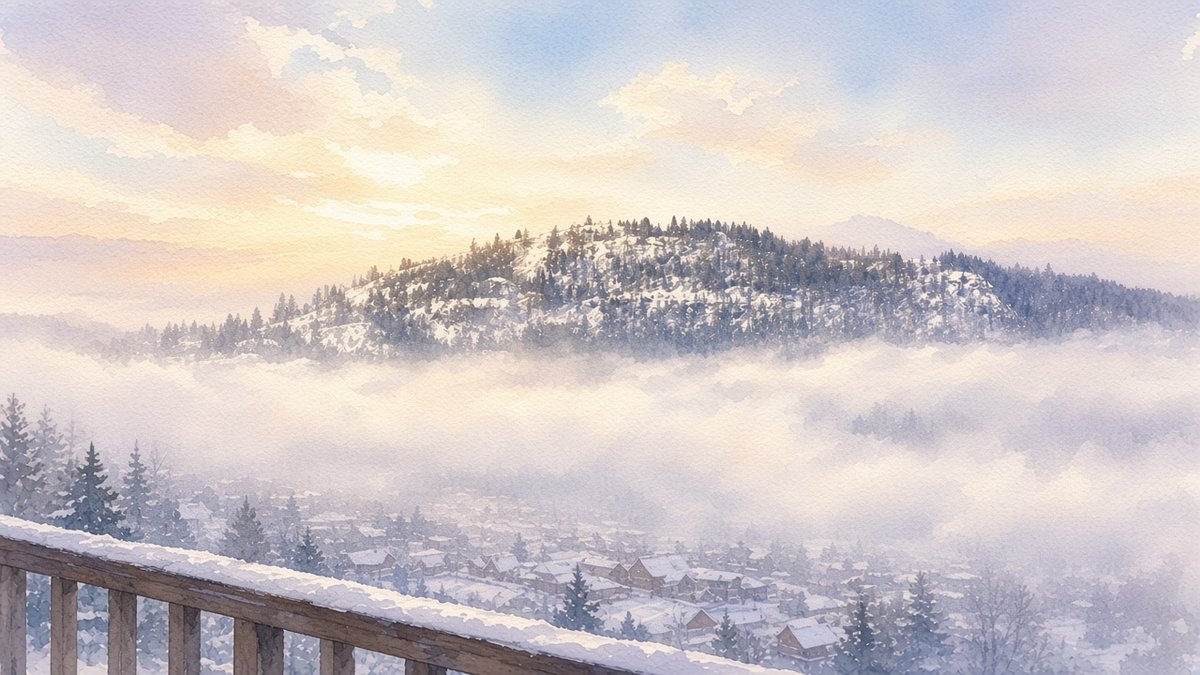
Kelowna is sunny in summer. Winter is another story. Environment Canada's 1981 to 2010 data shows Kelowna got only about 35 hours of bright sunshine in a typical December and about 40 in January. July got about 298. (Source: iNFOnews, citing Environment Canada)
The cause is a temperature inversion. Warm air sits on top of the valley like a lid, and moisture from Okanagan Lake forms a low cloud under it. An Environment Canada meteorologist told iNFOnews that this often leaves ski hills in sunshine while the valleys stay socked in.
A winter showing tells you a lot:
- Stand in the kitchen and living room on a grey day. Is it bright enough?
- Note which rooms face south. Low winter sun only reaches some windows.
- Ask about the heating bill for December and January.
- Some higher homes can sit above the cloud on some days. Do not assume it. Ask the sellers or neighbours what they see.
If winter light matters to your mood or health, take this seriously. Many newcomers say the grey months were the biggest surprise of their first year.
4. What an inspector cannot see under snow
A good home inspector can still check a lot in winter. The furnace, heat, windows and insulation are easier to judge when it is cold. But snow and frozen ground hide some things.
- Roofs. Snow covers shingles, flashing and vents. The inspector may only see the roof from the ground or the attic.
- Pools and hot tubs. Most are closed and covered for winter. The pump, heater and liner usually cannot be tested.
- Irrigation. Sprinkler systems are drained in the fall. No one can run them until spring.
- Drainage and grading. Snow hides how water moves around the house. Look for ice dams and icicles, which can point to heat loss.
- Decks and landscaping. Boards, stairs and retaining walls may be under snow.
Ways to protect yourself:
- Ask the inspector to write down what they could not check.
- Ask the sellers for receipts and dates for the roof, pool equipment and irrigation work.
- Ask for summer photos of the yard, pool and roof.
- Talk with your agent and lawyer or notary about terms that cover items that cannot be checked until spring.
- Budget a little extra for spring surprises.
Also look at the wildfire side of the property while the brush is bare. See our wildfire insurance guide.
5. Do winter sellers drop their price?
Not usually. Fewer people shop for homes in December and January, but that does not mean sellers will take less. Okanagan sellers tend to stay firm on price. They know what their home is worth.
What can differ is why someone is selling. A job move, a new build that is ready or an estate sale can shape what a seller cares about most. That might be the completion date, what stays with the house, or how inspection items are handled. These cues are often small and easy to miss. A good local agent knows how to spot them and how to shape an offer around them.
The best number to watch is the sale-to-list price ratio. It compares what homes actually sold for with what they were listed at. If a home listed at $1,000,000 sells for $960,000, the ratio is 96%. Look at this ratio for recent sales of similar homes in the same area. It shows how much room to negotiate there really is.
In September 2026, single-family homes in the Central Okanagan sold for 96.04% of list price on average. All residential sales came in at 95.88%. (Source: Association of Interior REALTORS, Central Okanagan Monthly Statistics, September 2026)
For how the market moves through the year, read our guide to the best time to buy a home in Kelowna.
6. If you are 55 or older
Winter is the honest test for a retirement home. Ask yourself:
- Can I get up this driveway and to my car safely on ice?
- Who will clear snow if I cannot? The City says residents must clear the sidewalk next to their home within 24 hours of snowfall ending.
- How far is it to groceries, a pharmacy and Kelowna General Hospital on a snowy day?
- Is there a level-entry home or a condo in a flatter area that fits better?
Many buyers in their 60s move from a hillside home to a flatter area like the Lower Mission or downtown for this reason. See our Okanagan retirement housing guide and our guide on whether to sell first or buy first when downsizing.
A short note for U.S. buyers
Most non-Canadians cannot buy homes in Canada until January 1, 2027, with some exceptions. Read our foreign buyer guide first.
My take
Sellers in the Okanagan generally remain firm. They know the value of the property they're selling. That said, hiring a good agent who can read between the lines and find the subtle cues indicating motivations is your best strategy. I have my secret tells, but they're my secrets.
Bottom line: your best guide is the sale-to-list price ratio on past sales.
Ready to look this winter?
If you are planning a move, our Moving to Kelowna and the Okanagan guide covers the rest of the steps. Want to talk through a home or a neighbourhood? Call me at 250-258-4663.
Sources checked Nov 3, 2026. This is general information, not legal, tax or financial advice. Rules and numbers change. Confirm details with the City of Kelowna, your home inspector and qualified professionals before you buy.