Market Intelligence | November 15, 2026
By Michael A. Jones - PREC* | Royal LePage Kelowna
More people are working in the Central Okanagan. Yet unemployment is higher. At first glance, those statements seem to pull in opposite directions. Together, they help explain why growth can feel encouraging on paper without making everyone confident enough to buy a home.
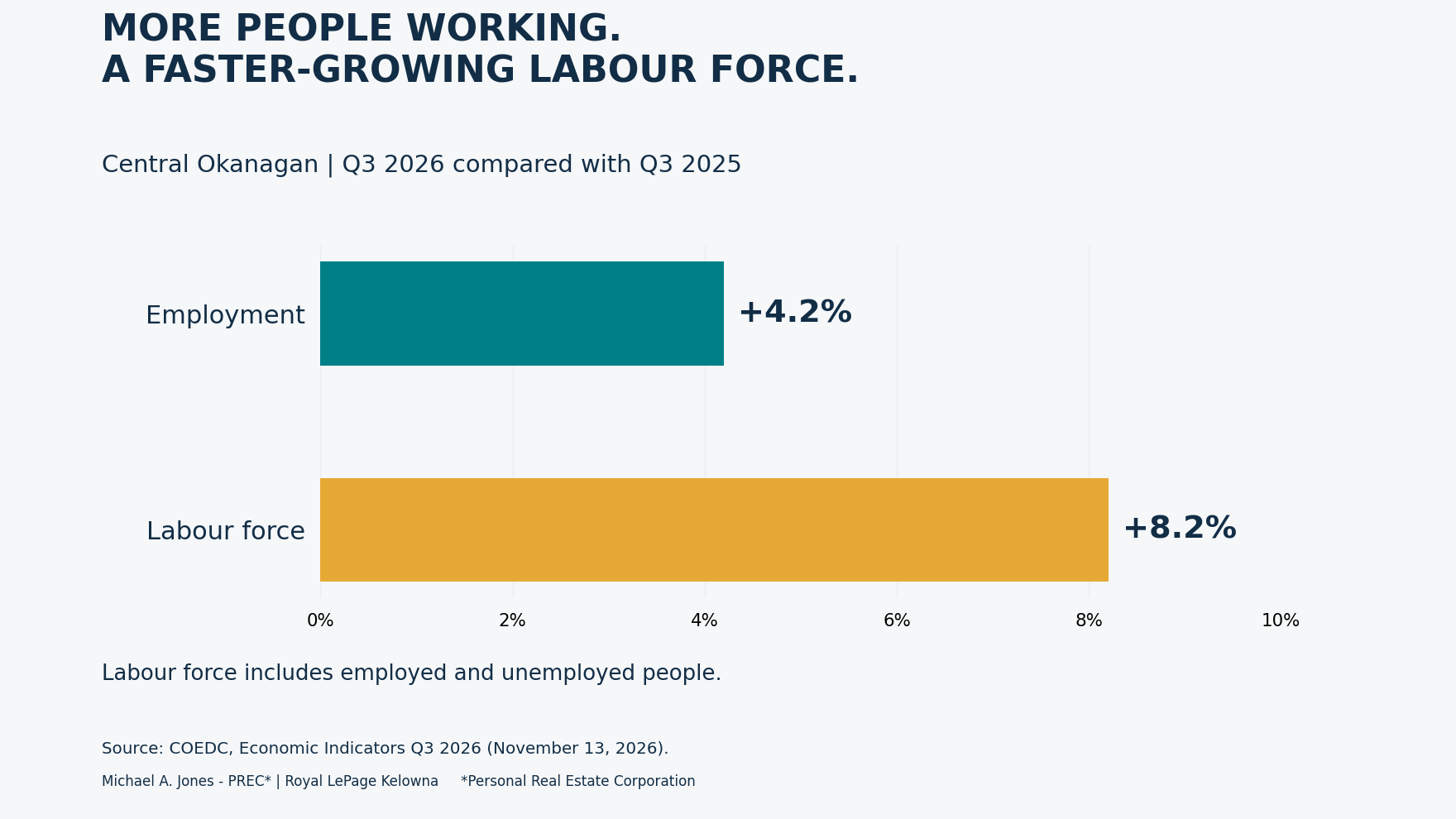
Employment grew. The labour force grew faster.
The Central Okanagan Economic Development Commission's Q3 report, released November 13, compares July through September 2026 with the same period in 2025. Employment increased 4.2%, while the labour force expanded 8.2%. The unemployment rate rose from 4.9% to 8.5%, a rise of 3.6 percentage points.
The report records an average of 133,500 employed residents within a labour force of 145,833. It also reports 7.9% fewer job postings than a year earlier, with stronger demand in some professional and technical fields.
The denominator matters
The unemployment rate measures unemployed people as a share of the labour force, not as a share of everyone who lives here. The labour force includes employed people and those classified as unemployed. Statistics Canada explains these definitions.
Here is a simplified example, not Kelowna data. Imagine a labour force of 100 people, with 95 working and five unemployed. The unemployment rate is 5%. Later, the labour force grows to 110 and employment to 100. Five more people are working, but ten are unemployed. The rate is now about 9.1%.
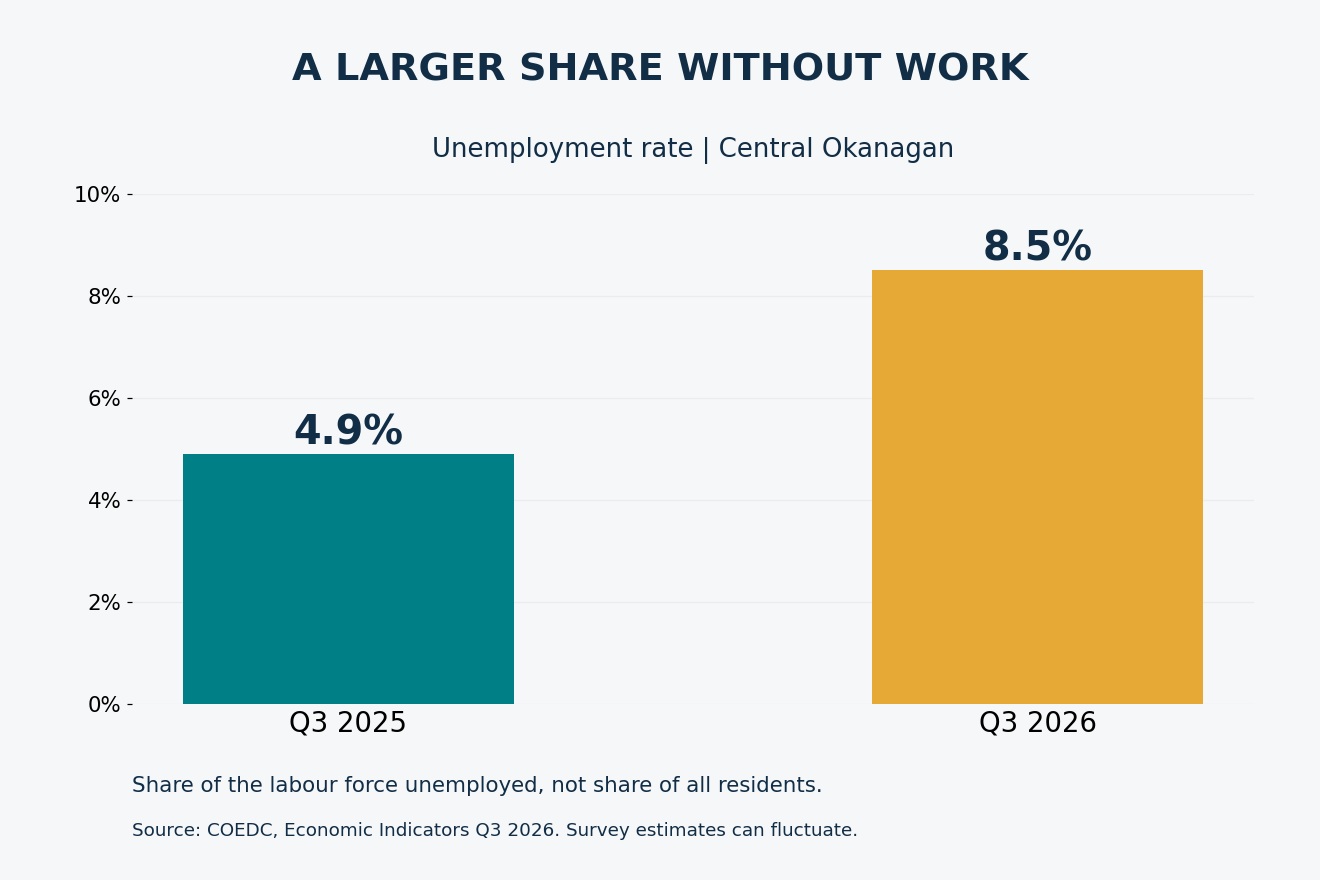
Both headlines can be true. Employment has increased, but it has not kept pace with the number participating in the labour market.
Housing need and buying power can move differently
My reading is that this is a useful caution against assuming a growing region automatically produces a stronger resale market.
A household can need somewhere to live without being ready to take on a mortgage. A job search, uncertain hours or concern about a partner's employment can affect its timing and budget. Even someone already working may choose to keep more cash available rather than stretch for a larger home.
These are possible channels through which employment conditions affect housing decisions. This report does not measure buyer confidence or establish how many sales have been delayed. It cannot tell us how much of the housing slowdown is caused by the labour market rather than rates, prices or other factors.
What I would take from this as a buyer or seller
For sellers, growth is background context, not a pricing strategy. The practical test remains what comparable buyers are choosing now: recent sales, competing homes, price reductions and feedback. A larger labour force does not automatically mean a larger pool of buyers able to pay your asking price.
For buyers, the regional headline should not decide the purchase for you. Your own income security, savings, financing and expected time in the home matter more. If a move depends on finding work locally, test that assumption before committing to a housing budget.
For rental owners, additional people seeking work may still need accommodation, but that does not guarantee higher rents. Some households may share housing or delay forming a separate household. Assess the property against current rental alternatives and actual leasing demand.
What the report cannot settle
COEDC warns that Labour Force Survey estimates for smaller regions can fluctuate. Its quarterly comparison is not a claim that unemployment suddenly jumped this month; the report says it has stayed elevated since late 2025.
Nor does labour-force growth tell us how much comes from people moving here versus existing residents entering or re-entering the workforce. We should not turn it into an immigration statistic. Job postings are also a different measure from employed people, and neither tells us everything about wages, hours or job security.
The point for housing
More employment is encouraging. But a housing recovery also depends on households having the means and confidence to act. That is the tension worth watching: the region can be adding workers and still leave a growing number of people waiting for an opportunity.
For a particular home, I would use this report as context, then return to the evidence in its own price range and neighbourhood. That keeps the decision grounded without either dismissing the risks or assuming the worst.
Related reading: BCREA's 2027 housing forecast and new-build competition for Kelowna sellers. Browse market statistics.
*Personal Real Estate Corporation.
General market commentary, not financial or employment advice. Survey estimates may be revised. Housing implications are analysis, not a forecast for an individual property.