Market Intelligence | Okanagan Housing Outlook
By Michael A. Jones - PREC* | Royal LePage Kelowna
BCREA expects home sales to pick up in 2027 after another difficult year. For anyone planning a move in Kelowna, the important detail is the scale of that recovery: more activity, alongside modest average-price growth and plenty of uncertainty.
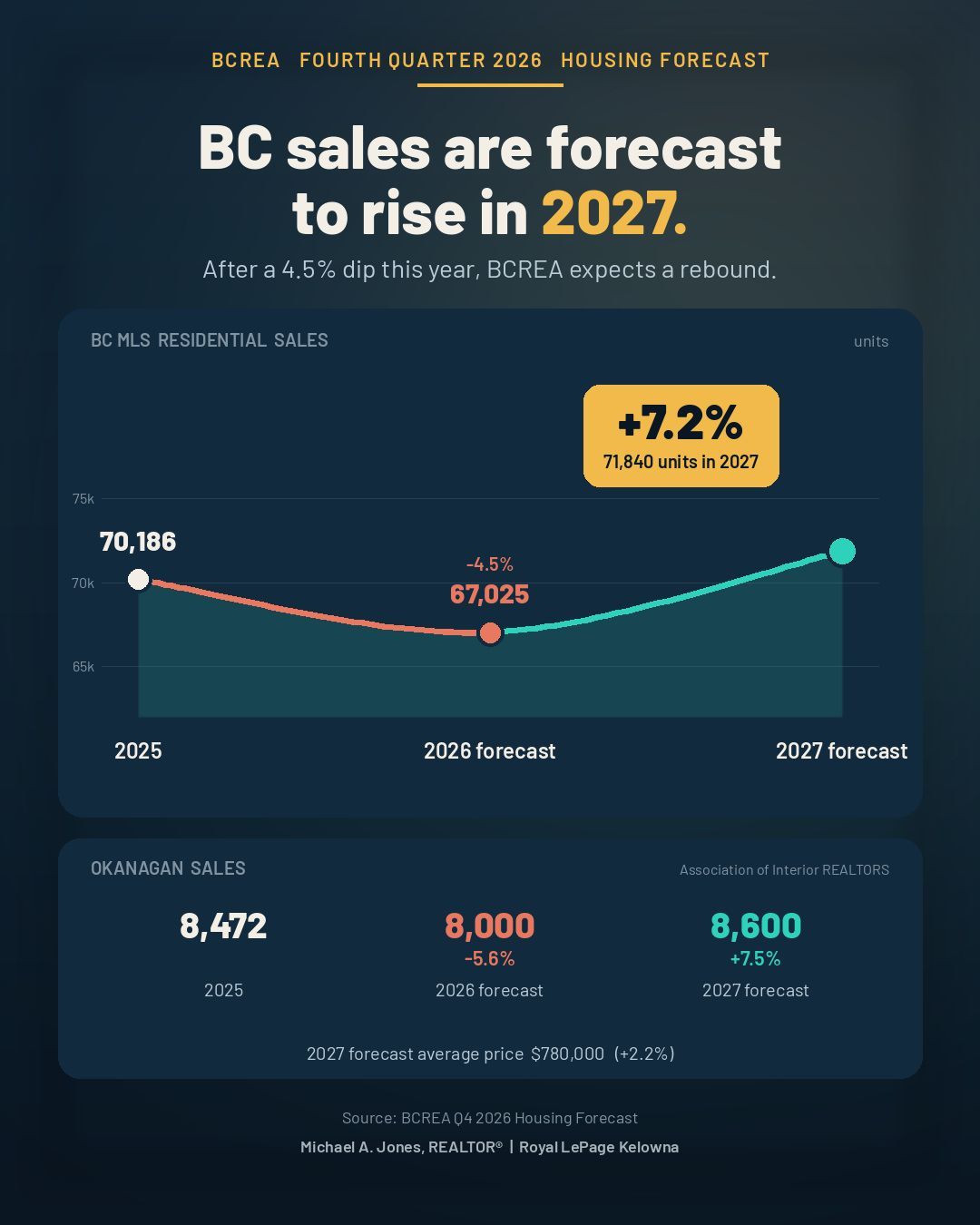
The association's fourth-quarter forecast, released November 10, projects a 7.5% increase in Okanagan residential sales next year, following an expected 5.6% decline in 2026. That would bring sales slightly above their 2025 level.
What BCREA is forecasting
Across British Columbia, BCREA forecasts 67,025 residential sales in 2026, down 4.5% from 70,186 in 2025. For 2027, it expects 71,840 sales, an increase of 7.2%.
The Okanagan forecast follows a similar path:
- 2025: 8,472 residential sales and an average MLS sale price of $766,183.
- 2026 forecast: 8,000 sales, down 5.6%, and an average price of $763,200, down 0.4%.
- 2027 forecast: 8,600 sales, up 7.5%, and an average price of $780,000, up 2.2%.
The Okanagan figures cover a broader region than Kelowna. They should not be presented as a forecast for Kelowna alone, the Central Okanagan alone, or a particular neighbourhood.
There is another useful comparison here. The projected 8,600 Okanagan sales in 2027 would be about 1.5% above the 8,472 recorded in 2025. The larger 7.5% headline increase reflects the recovery from a weaker expected 2026.
The recovery depends on conditions improving
In its full November housing forecast, BCREA describes a market held back by economic uncertainty, trade pressures and higher mortgage rates. Its provincial outlook depends on greater economic stability and a decline in Canadian fixed mortgage rates.
The Thompson-Okanagan discussion also points to stronger economic growth and easing oil prices and interest rates as assumptions behind the 2027 recovery. These are conditions to watch, rather than outcomes buyers and sellers can count on.
On supply, BCREA says regional inventories have begun falling from a near-decade high, although active listings remain elevated. It expects recovering demand and further reductions in supply to support modest price growth in 2027.
For a specific Kelowna property, the useful next question is how many comparable homes are available and how quickly they are selling. A regional forecast provides context; recent local evidence helps shape the actual decision.
More sales and higher prices are different measures
A 7.5% increase in sales means more completed transactions across the Okanagan. BCREA's projected increase in the average sale price is much smaller, at 2.2%.
Average prices also change with the mix of homes sold. If more expensive homes account for a larger share of transactions, the average can rise even when the value of an individual property has changed little.
BCREA's property-type forecasts show why the details matter. For 2027, it forecasts Okanagan average-price increases of 1.8% for single-detached homes, 2.4% for apartments and 3.6% for townhouses. These remain broad regional averages, not estimates of what a particular home will be worth.
If you are thinking of buying
Use the forecast to prepare, while keeping your own budget and timetable at the centre of the decision.
- Confirm financing using today's terms. Ask your lender or mortgage broker what is affordable now, and test whether your plan still works if rates do not decline as expected.
- Compare the homes you would actually buy. Look at recent sales, competing listings, condition, strata documents where applicable and the costs of ownership.
- Keep room for due diligence. A forecast of stronger demand next year is no reason to skip the work needed to understand a property today.
If you are thinking of selling
The prospect of more buyers in 2027 is encouraging, but it does not settle whether waiting is the better choice.
Start with the likely sale range for your home in its current condition, your carrying costs and what your next move will require. If you will also be buying, compare the price difference between the two homes rather than considering the sale price on its own.
Preparation and pricing still deserve attention. Elevated regional inventory gives buyers alternatives, and a stronger annual sales total would not make every listing equally competitive.
If your mortgage term is part of the timing decision, read what to check before selling your Kelowna home before your mortgage term ends.
A useful outlook for planning your next move
My takeaway is that BCREA sees a path to a more active Okanagan market in 2027, with a measured improvement in average prices. The forecast is useful because it gives us specific expectations to compare with the market as the next year unfolds.
For your move, I would bring that outlook back to three practical questions: what is happening in your price range, what will the whole move cost, and what timing fits your circumstances?
Contact Michael to discuss your Kelowna buying or selling plans. You can also browse more market reports and Okanagan real estate articles.
All for now,
Michael
Sources: BCREA Q4 2026 Housing Forecast news release and full November 2026 Housing Forecast, including the Thompson-Okanagan discussion and tables. Sources checked November 10, 2026. This article provides general real estate information, not financial, mortgage, investment, tax or legal advice. Forecasts are estimates and may change; actual results can differ. Regional average prices do not predict the value of an individual property. Confirm current local market conditions and obtain advice appropriate to your circumstances before making commitments. Prepared with AI assistance.
*Personal Real Estate Corporation