Market Intelligence
By Michael A. Jones - PREC* | Royal LePage Kelowna
Could letting foreign buyers purchase new homes help get more Okanagan housing built? Possibly. But the answer changes depending on where the property is, what qualifies as new, and whether the project works financially.
My view: the proposal could help individual developments, but it is unlikely on its own to transform Kelowna's market. I would be more cautious about dismissing its potential across the entire Okanagan. A major provincial tax barrier applies in the Central Okanagan but not in Vernon or Penticton.
AI-generated architectural illustration of new housing and construction in an Okanagan-inspired landscape. Not an actual development or a representation of eligible properties.
First, this is a proposal
Budget 2026 proposes exempting new residential properties from the federal foreign-buyer ban while extending the ban on existing residential properties to January 1, 2029. The government says legislation and a regulatory process will follow. This is not permission to buy today.
The detail that changes the local story
B.C.'s additional property transfer tax is separate from the federal purchase prohibition. Removing a federal restriction would not automatically remove the provincial surcharge.
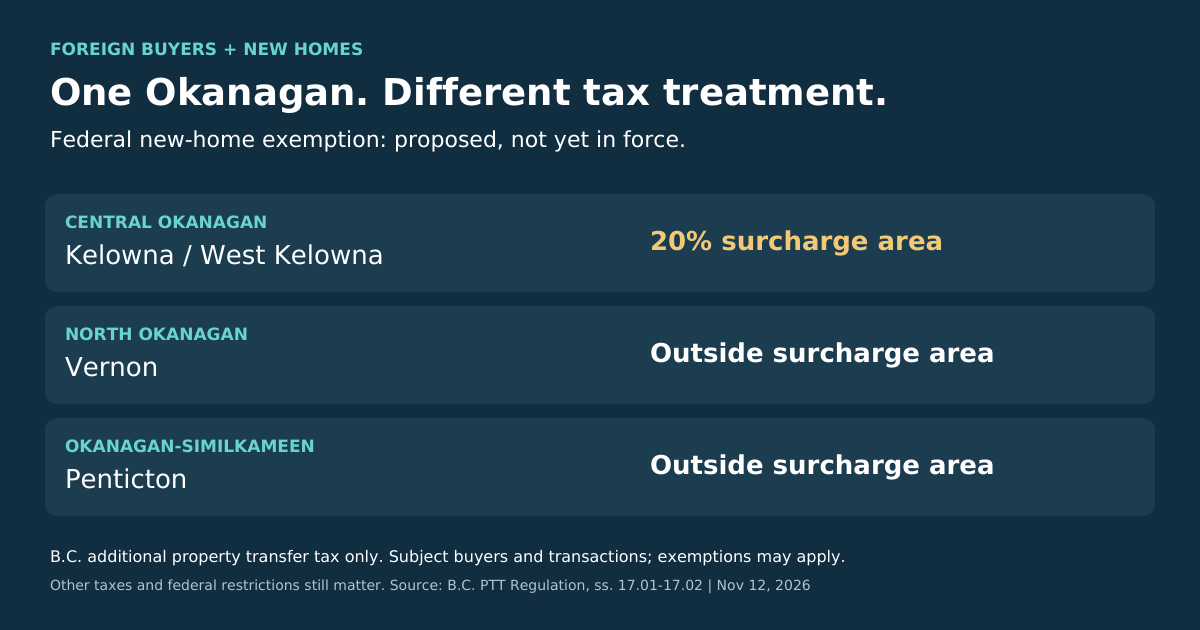
Provincial purchase-tax geography matters. This comparison does not determine federal eligibility or other taxes. Source: B.C. Property Transfer Tax Regulation, sections 17.01-17.02; checked November 12, 2026.
The provincial regulation includes the Central Okanagan among the specified regions. North Okanagan and Okanagan-Similkameen are not on that list. That is why Kelowna and West Kelowna need to be considered differently from Vernon and Penticton.
For an illustrative $800,000 residential purchase fully subject to the additional tax, the surcharge is $160,000. That is on top of ordinary property transfer tax and other applicable purchase costs. A federal exemption would leave that calculation intact unless B.C. changes its own rules.
This is a regional comparison, not a ruling on an individual purchase. Buyer status, ownership structure, exemptions and the specific property matter. A Canadian citizen living abroad is not automatically a foreign buyer.
What exactly counts as a new home?
That remains an important unanswered question. The budget does not define the final scope or announce a commencement date. Fasken's November 9 analysis notes the uncertainty over whether the exemption would cover presales alone or also completed, never-occupied homes. We cannot yet assume that every unsold new condo will qualify.
Helping a development is different from fixing affordability
The Vancouver Sun article by Nathan Griffiths and Stephanie Ip makes a useful point: expanding the buyer pool could help, but it would not resolve the cost of building housing. That caution belongs in an Okanagan discussion too.
There are two separate ways additional eligible buyers might help. Presales can support the financing needed to proceed with construction. Sales of already-completed homes can release capital tied up in inventory. The second may help a builder's finances, but it does not itself add another dwelling.
For a particular project, a few more sales could matter. That is a plausible financing effect, not evidence that this proposal will restart a named project or deliver a particular number of homes.
The buyer still needs an investment that makes sense. Purchase costs, financing, strata fees, achievable rent, vacancy risk and future resale prospects do not disappear when a rule changes. Developers still face land, labour, materials, approval and financing costs.
Why my conclusion differs slightly from Vancouver's
For Kelowna, I share much of the article's caution. Keeping a 20% surcharge while removing one federal restriction leaves a substantial barrier in place. There is not enough evidence to forecast a broad foreign-buyer revival or higher local prices.
For Vernon and Penticton, the absence of that particular surcharge makes the purchase-cost picture different. It is reasonable to see more potential there than a Vancouver-focused headline suggests. It would be a step too far to predict a stronger actual response without evidence of buyer demand, eligible inventory and final rules.
The distinction is about conditions, not a promise of results. A useful policy for selected projects can still have a modest effect on the wider housing market.
Some foreign investment is already treated differently
CMHC's current guidance describes exceptions and exclusions, including purchases for development, properties outside census metropolitan areas and census agglomerations, and whole buildings with four or more dwelling units. Individual condo purchases are treated differently. Some rural Okanagan properties may already fall outside the prohibition; do not assume the same policy change applies everywhere.
No surcharge does not mean no other taxes
B.C.'s speculation and vacancy tax has its own geography. The taxable-area list includes Vernon and Penticton as well as Kelowna and West Kelowna. Being outside the additional property-transfer-tax area does not remove the annual tax question.
For the 2026 use year, the SVT rate for foreign owners and untaxed worldwide earners is 3%, with declarations and payments in 2027, subject to exemptions and credits. Qualifying rentals can be exempt, but tenancy requirements matter. Foreign owners should not assume simply occupying the property gives them a principal-residence exemption.
What this means if you are buying or selling
Buying a new home: do not rush because a policy proposal sounds like a coming wave of competition. Compare the property, total costs, contract terms and developer track record. Additional buyers could increase competition for eligible new homes before any longer-term supply benefit appears.
Selling an existing home: this proposal would not directly reopen your listing to foreign buyers who remain prohibited. Any benefit through improved confidence or activity would be indirect and uncertain. Price against current comparable sales, not a hoped-for policy effect.
Considering an investment or development: separate three questions: can this buyer legally purchase this property, what taxes apply, and does the project work after all costs? Get legal and tax advice before making a commitment.
My takeaway
I would welcome a clearer route for investment that helps viable new housing get built. But the strongest local conclusion is narrower than either "this changes everything" or "this will do nothing." The proposal could help selected projects, and its effect may differ across the Okanagan. The final rules and the economics of each project will decide how much.
For the broader outlook, read BCREA Forecasts a 2027 Housing Recovery: What It Means for Kelowna. Browse more Okanagan real estate articles and market reports.
All for now,
Michael
General real estate information, not legal, tax or investment advice. Federal changes discussed are proposals as of November 12, 2026. Rules, exemptions and eligibility depend on the buyer and property; verify them with qualified advisers before committing. No forecast of prices or foreign-buyer demand is implied. Prepared with AI assistance.
*Personal Real Estate Corporation