Connecting the dots between risk and opportunity across the Okanagan.
October 19-25, 2026
By Michael A. Jones - PREC* | Royal LePage Kelowna
Happy Monday Morning! Hope you had a great weekend. It's getting colder out there, so let's warm things up with the latest in real estate from last week. There are definitely some opportunities worth a closer look.
Summary
- Economists disagree on when Canada needs another rate hike
- Buyers can negotiate more than price on new homes
- Housing and affordability make great political points
- Disney For Drinkers Coming To Kelowna
- Canada's Home Prices Can Be Attributed To 3 Key Factors
- Real Estate Investment Suffers From The Same Risks As Any Investment
- AI-Powered Underwriting Heats Up Canada's Mortgage Market
Market Watch
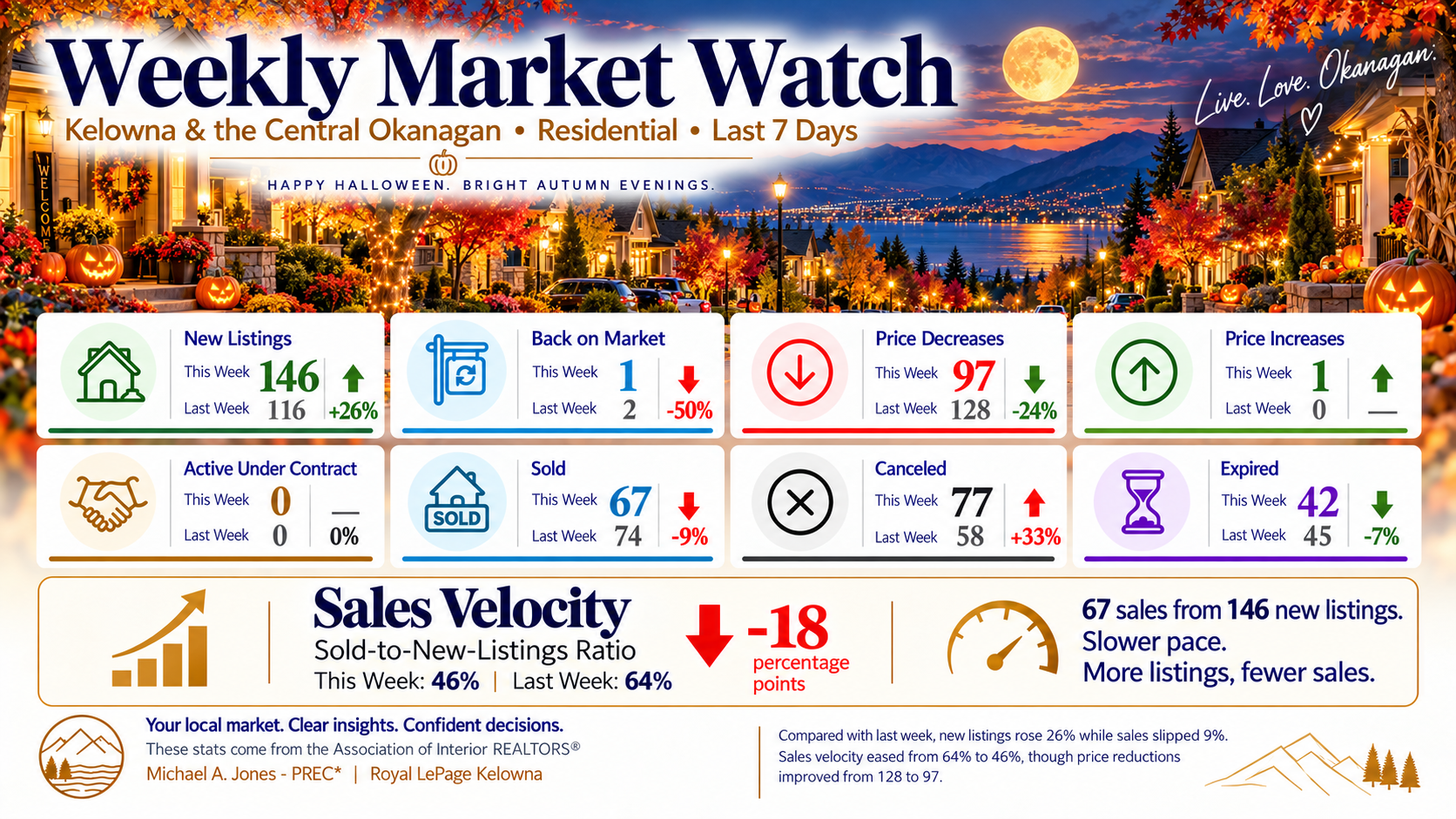
For the seven-day snapshot ending October 25, new listings rose from 116 to 146, up approximately 26%, while sales fell from 74 to 67, down approximately 9%. The sold-to-new-listings ratio eased from 64% to 46%, a drop of about 18 percentage points. These weekly counts describe activity, not the likelihood that an individual listing will sell.
To Hike Or Not To Hike, That's The Question
Ahead of the Bank of Canada's October 28 decision, economists remain divided. BMO, RBC Dominion Securities and Desjardins moved toward a rate increase, anticipating a quarter-point rise to 2.5%. Scotiabank and Manulife also expect a hike. Their concern goes beyond expensive gasoline: those costs could spread, while businesses and consumers increasingly expect inflation to persist.
But TD still expects rates to hold through year-end, citing limited evidence that higher energy costs are spreading broadly. Its reasoning makes sense to me. Trade uncertainty and a soft job market deserve consideration before making borrowing more expensive. Desjardins notes that Canada lost almost 110,000 jobs across two months, even as it makes the case for a hike. Meanwhile, Statistics Canada's latest retail report shows sales rose 1.2% in August.
There's resilience here, alongside a weakening labour market.
For buyers and sellers, competing forecasts can make everything feel unstable. But a closer look reveals more than the eye-catching headlines suggest. We have risks, strengths and economists interpreting both differently. These are forecasts, not an announced October 28 decision. We also have homes to buy and lives to get on with. Do your homework. If the home fits and the numbers work, it may be a good time for you to buy.
If You're Shopping For New, Now's The Time To Ask For More
A new home with a $100,000 BMW thrown in? The Globe and Mail reports that Metro Vancouver developers are getting creative, offering cars, cash, financing subsidies, e-bikes and outfitted garages. Wesgroup even offers weekends in show homes, complete with stocked fridges and local gift cards. Behind the perks sits a practical need: turn unsold homes into cash. Sales release capital, reduce carrying costs and help developers move forward.
For buyers, that creates room to negotiate beyond price. A developer holding firm might still cover strata fees, install blinds or include extra parking. Here in the Okanagan, I'm not seeing incentives this extravagant. But if you're shopping for new, ask what's possible. Compare the full deal, including any price reduction, against competing homes. A perk only helps when the home itself makes sense. Still, I'd happily consider a $40,000 Hyundai!
New Governments Face The Same Housing Affordability Test
Well, that changes things. BC's preliminary election results point to a Conservative majority, with the party leading in 63 of 93 ridings in the initial count. Final counting is still to come. This follows Kelowna electing five new councillors a week earlier. Housing affordability now sits on both agendas. The Conservatives' platform promises lower construction taxes and charges, faster approvals and greater local direction over density.
Here in Kelowna, Brady Rogers, Les Bellamy and Laura Thurnheer identify affordability as a priority. Bellamy proposes spreading infrastructure costs over a project's lifetime. That could reduce upfront building costs, but someone still needs to pay the bill. Council can also allow more homes through zoning, accelerate approvals and offer targeted incentives. These tools matter when they turn proposed housing into homes people can buy.
But affordability also has an income side. Governments can help attract investment and support businesses creating better-paying jobs. National Bank economist Stéfane Marion makes that connection, arguing stronger investment and incomes offer a path toward improved affordability. We should pay attention. Growing paycheques can help close the gap between local earnings and housing costs. More jobs also attract more residents, making additional housing essential.
For young people hoping to stay, the goal is straightforward: careers worth building and homes within reach. We have fresh leadership and plenty of commitments. Can our incoming provincial government and new councillors help deliver both? We shall see.
A Disneyland For Wine Lovers Takes Another Step Forward
I keep coming back to this: amenities give people reasons to visit, spend and stay. And that benefits Okanagan homeowners. Following recent stories about downtown investment and Kelowna's tourism ambitions, we have another idea worth watching. Detailed plans for Kelowna Wine Village have reached city hall.
Proposed for McKinley Landing, its first phase includes 11 tasting suites, wine-production spaces and barrel storage. Picture Mediterranean-style buildings, wandering pathways and a central square for events. We could be getting our own Disneyland, the kind wine enthusiasts prefer. Very exciting. These businesses would make wine here, too, giving smaller producers a place to produce, sell and build a following. The potential benefits extend beyond the tasting counter: jobs, purchases from local suppliers, and customers for nearby restaurants, hotels and shops. Tourism Kelowna's 2022-23 survey estimated $2.4 billion in tourism-related economic output for Kelowna and the Central Okanagan.
This village could strengthen that economy while giving people another reason to explore northern Kelowna. Council still needs to approve the development permit. But alongside the planned lake swimming venue, it shows people continue imagining and investing in this city's future. As I said last week, there's a bull market in Kelowna's ambitions despite bear-market headlines. It's a good idea to buy where people want to be, and where people keep creating reasons to come.
Don't get so caught up waiting that you overlook what's taking shape. Future amenities and property values are not guaranteed, so keep the decision grounded in the home and your budget.
We're Going To Need A Bigger Boat...Filled With Homes
CMHC turned its investigative eyes toward peer countries, asking why Canadian home prices have climbed so much faster. Its findings confirm a familiar problem. Between 2005 and 2025, our home prices roughly doubled after inflation, despite declines since 2022. We weathered the financial crisis relatively well, then continued climbing.
Three forces helped drive that growth. First, a growing population needed places to live. Second, construction failed to keep pace with demand. In 2023 and 2024, Canada added nearly five residents per completed home. That creates pressure. The ratio fell to approximately 1.5 in 2025, easing that additional pressure without necessarily clearing the accumulated shortage. Third, rising incomes and low borrowing costs increased purchasing power, particularly during the second half of the 2010s. More people, more buying power, and too few homes.
The challenge is changing that equation. Building more homes is essential. Politically, however, there's a balancing act. Homeowners counting on equity for retirement have plenty riding on property values. A sharp price decline improves access for some while reducing wealth for others. Incomes growing faster than prices offer another route toward affordability. Meanwhile, Immigration Minister Lena Diab signals immigration levels could rise again, with details still to come.
If you're considering buying, think in probabilities. Over the next five years, will construction deliver enough homes where you want to live, or will demand keep outpacing supply? National shortages don't prevent local price declines. But today's softer market doesn't mean the underlying problem is solved. Choose your course accordingly.
Before You Count The Returns, Ask Who Gets Paid First
When an investment's promised returns spark that twinge of excitement, pause. Is the opportunity sound, or is hope outrunning scrutiny? A failed Big White development offers a sobering reminder. Realtor Michelle Perreault says she was offered a 32% annual return, plus exclusive rights to sell the completed units. Construction never got off the ground. The property is now listed through a court-ordered sale. Despite securing a $752,000 judgment, Perreault says 12 other creditors stand ahead of her and her fellow investor.
She doesn't expect to recover their funds. We all like to think this couldn't happen to us. Experience, however, doesn't make anyone immune to a compelling pitch. Real estate can provide solid returns, but the downside deserves every bit as much attention. What happens if construction stalls, financing disappears or sales disappoint? What secures your investment, who gets paid before you, and what might remain? A court judgment means little comfort if there's insufficient money left. Before imagining what you'll earn, understand what you could lose.
Real Estate In the Intelligence Economy
AI Could Open More Mortgage Doors For The Self-Employed

Last week, I wrote about TD bringing AI into mortgages. Now, Northguard Financial plans to bring AI-powered lending to BC in the second quarter of 2027. This is exciting. Northguard says company testing produced initial underwriting responses in about nine seconds. That isn't final approval, but it could significantly shorten the back-and-forth.
Its Make My Deal feature suggests changes that could help an application qualify, such as adjusting the down payment or adding a guarantor. Think of brokers finding financing solutions they might otherwise miss. Northguard starts with insured mortgages, then plans to expand into alternative and private lending. That could particularly benefit self-employed borrowers whose income doesn't fit traditional lending models. These folks often have it rough. The aim is faster, more consistent underwriting, with human underwriters available for exceptions and review.
The bigger opportunity concerns competition. Northguard eventually plans to offer its technology to other lenders. If smaller businesses can process mortgages efficiently, more could compete for your business. Lower operating costs could translate into better rates if competition pushes lenders to share those savings. Meanwhile, Morgan Stanley's US research explores the borrower's side: AI agents monitoring rates, comparing lenders and preparing paperwork when refinancing makes financial sense.
Imagine having that working for you. Faster answers, more financing options, and more businesses competing to earn your mortgage. There's plenty here worth watching.
Related reading: AI and mortgages for self-employed buyers and What could change next door before you buy.
Explore more Market Intelligence, Okanagan news and mortgage insights.
Final Thoughts
We're all looking to save a buck, make a buck, and improve our position. There's nothing wrong with that. This week's stories approach it from several angles: negotiating more from developers, finding better financing, and recognizing where investment could create future value.
The challenge is that we never get perfect certainty. There's always another report coming, another rate announcement, another reason to wait. We make decisions using the information available and the tools at our disposal. The aim is to understand enough to make a sound choice.
We also need to watch that familiar twinge of excitement. Fear of missing out can pull us into trouble. Fear of making a mistake can leave us standing still. Both deserve a little scrutiny. Look beneath the headline or the promised return. Follow the government policies, jobs, incomes, construction and investment. Learn to connect the dots that reveal what's actually happening.
Then, at some point, take a breath and make your move. Sound principles help: understand what you're buying, know what could go wrong, and leave yourself room to adapt. We won't always get everything right. But we give ourselves a better chance of ending up somewhere good.
If you or someone you know needs help connecting the dots on a real estate decision, let's grab coffee. We can discuss your options and work through the questions. I'm always happy to help. Reach out anytime.
Have a great week in the meantime.
All for now, Michael
This weekly commentary is for general information and personal opinion, not financial, investment, mortgage, legal or tax advice. It reflects the October 19-25, 2026 news cycle, with selected source checks on October 26. Forecasts, preliminary election results, proposals and company plans may change; they are not confirmed future outcomes. Weekly market figures are from the supplied Market Watch records and are not a forecast for any individual property. Confirm Bank of Canada decisions at bankofcanada.ca, financing with a licensed mortgage professional, and investment or legal decisions with an appropriately qualified adviser. Development proposals and future amenities do not guarantee property-value increases. Michael A. Jones is a REALTOR® with Royal LePage Kelowna, not a mortgage professional, financial adviser or economist. This article was prepared with AI assistance.
*Personal Real Estate Corporation