By Michael A. Jones - PREC* | Royal LePage Kelowna
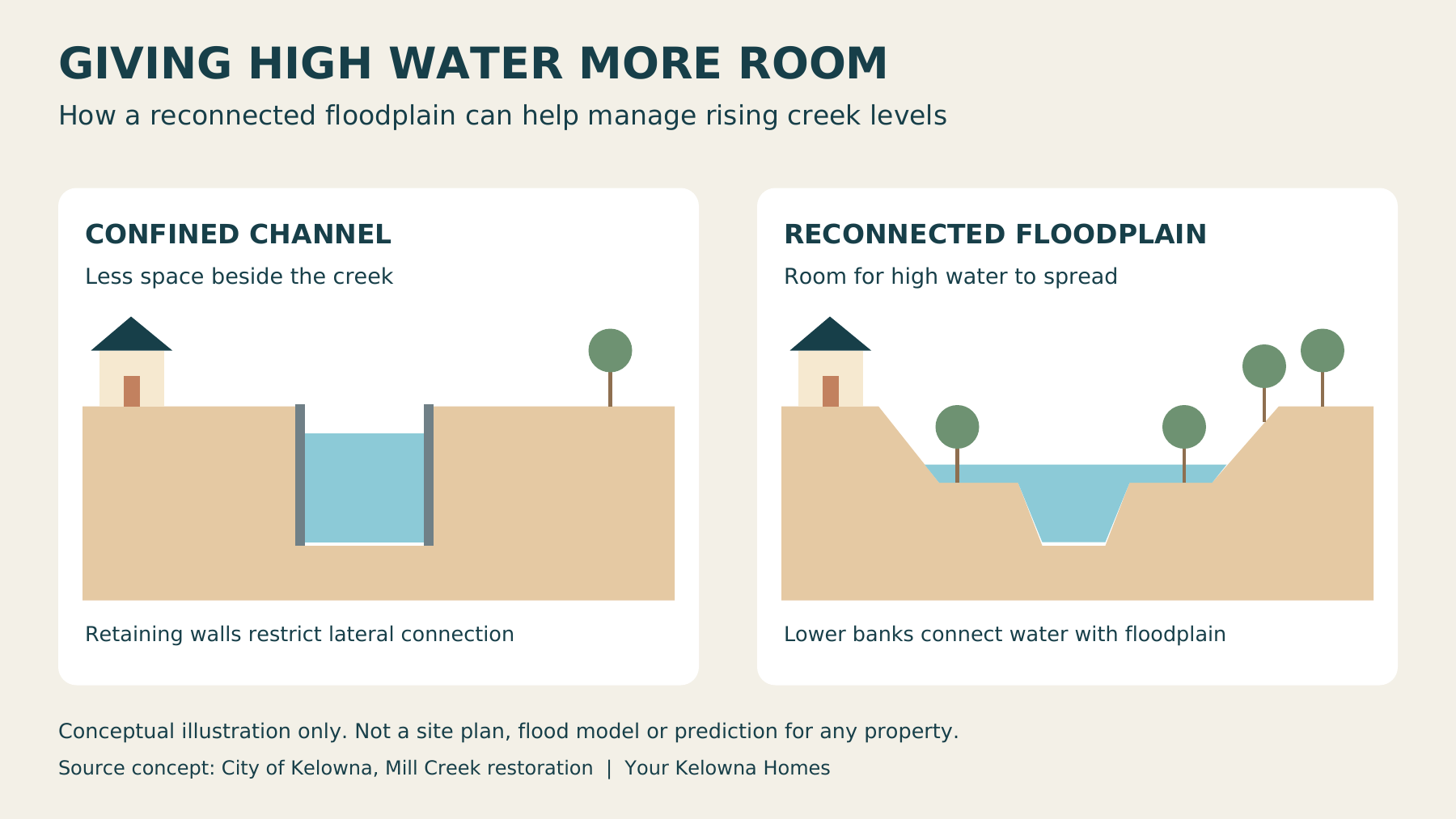
A creek running through a park can look like a pleasant neighbourhood feature. During high water, the space around it has another job. Kelowna's latest work on Mill Creek is a useful example of how a landscape can help protect the community around it.
On November 6, the City announced that construction and planting were complete along 650 metres of Mill Creek through Parkinson Recreation Park. Crews removed retaining walls and reconnected the floodplain to help the creek handle high flows. The restored area will remain closed until 2027 while vegetation establishes. Read the City announcement.
More room for the creek
The basic idea is straightforward. When water rises, a creek connected to a wider floodplain has more space to spread. The City describes the restored channel, banks and vegetation as working together to slow, store and move water through the corridor. That gives part of the park a practical role in managing floods. See the restoration project.
The work also supports fish and wildlife habitat. Native planting is intended to help stabilize banks and provide shade as it matures. The project was developed in collaboration with Westbank First Nation and the Okanagan Nation Alliance, including guidance on native plants and a gathering area. Flood protection and ecological restoration are being pursued together.
A better neighbourhood still needs a property-level check
For someone moving to Kelowna, this is the kind of local investment worth understanding. A listing might mention a nearby park or creek without explaining the infrastructure around it. Learning how that system works adds useful context to a home search.
Still, I wouldn't take the completion of this project as evidence that a particular home is flood-free. The announcement doesn't establish a new floodplain boundary, a change in insurance terms or a rise in nearby property values. Those are separate questions that need their own evidence.
Start with the map, then ask about the address
Kelowna's Mill Creek Flood Plain Bylaw page provides mapping and explains the flood construction levels used for development and redevelopment. In plain language, a flood construction level sets a minimum elevation for the lowest habitable floor of a building under construction. Ask City planning staff which current requirements apply to the property and any proposed addition or redevelopment.
For an existing home, I'd use that information to guide further questions. Has the property experienced flooding or water entry? What repairs or drainage work were completed, and are there supporting records? Have your inspector assess visible conditions and explain when a qualified drainage or flood professional is needed. A normal home inspection isn't a property-specific flood study.
Check the coverage before you commit
The Government of Canada explains that flood coverage typically isn't included in a standard home policy. Overland flooding, sewer backup and other kinds of water damage may be treated differently. Availability also depends on the insurer's assessment of the risk.
Give your insurance representative the exact address and ask what coverage is available, what it excludes, and what limits and deductibles apply. Do this while you still have time to investigate under the terms of your offer. An assumption about insurance is a poor substitute for a written answer.
My take
I like this project because it makes a familiar part of the city more useful in several ways. It also gives buyers a reason to look beyond the lot line. Understanding a neighbourhood includes understanding its water, its public infrastructure and the work being done to improve it.
If you're relocating, make those questions part of your shortlist rather than leaving them until closing. For more on checking a home from a distance, read Buying a Kelowna Home Before You Ever Visit.
Explore Buyers, Kelowna and Relocation.
Sources checked November 16, 2026. General information only, not engineering, legal or insurance advice. Flood risk, development requirements and coverage are property-specific and can change. Confirm current requirements with the City, coverage with your insurer, and property concerns with qualified professionals. The illustration explains a general concept; it is not a site plan, flood model or assurance of protection. *Personal Real Estate Corporation