Michael A. Jones - PREC* | Royal LePage Kelowna
Canada’s housing market is beginning to show signs of real momentum again. CREA reports four straight months of rising sales, fewer listings, and faster turnover. That has many, including CREA’s Senior Economist Shaun Cathcart, contemplating whether a seller’s market is around the corner.
The key question for buyers and sellers in Kelowna and the Okanagan is whether local conditions are following Canada’s national trend. To answer it, we’ll use the same approach CREA applies nationally—looking at sales growth, new listings, sales-to-listings ratios, and months of inventory. First we’ll review the Canadian data, then narrow in on Kelowna, then the wider Okanagan, before asking whether these numbers suggest the region is truly moving toward a seller’s market.

Canada’s Market Signals
The Canadian Real Estate Association (CREA) recently announced that national home sales climbed 3.8% in July from June, marking the fourth consecutive month of gains. Since March, sales are up 11.2% across the country. Listings have also been shrinking for two straight quarters, creating tighter conditions.
Back in May, the ratio of sales to new listings was just 47.4%, which signaled a buyer’s market. By July, it had climbed to 52%, the level often considered balanced. Months of inventory fell from five to four. These shifts suggest sellers are beginning to regain some ground.
“The ratio is falling, so we’re moving very rapidly to the direction of a sellers’ market again,” Cathcart says. “If we keep this up, and I’m not saying we will, we will officially be in a national sellers’ market by January.”
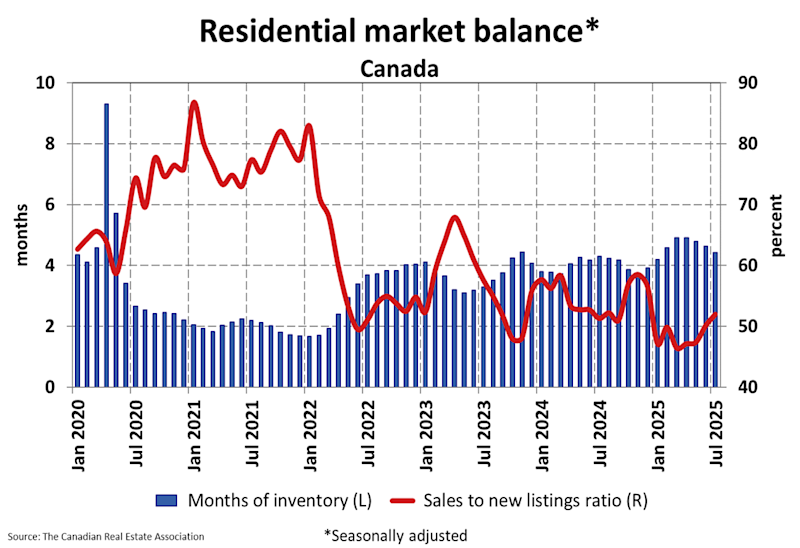
Another factor is interest rates. Economists expect several cuts in the coming months. Cheaper borrowing could fuel demand just as listings remain scarce. That combination often sets the stage for sellers to reclaim leverage.
Kelowna: Volatile but Still Buyer-Friendly
But while the national picture shows momentum, Kelowna tells a different story. Since May, new listings have dropped 11.6%, which mimic the national pattern. Yet sales in the same period are up 28.3%. Though since May, they’ve fallen 1.7%.
That has left Kelowna with about eight months of inventory, double the national average. By definition, this is still a buyer’s market. The sales-to-new-listings ratio is inching upward but not enough to tip the balance.
For sellers, this means patience. Homes priced too high above market will sit. For buyers, this remains a market with room to negotiate, especially when properties have been listed for a while.
Wider Okanagan: Catching Up to the National Trend
The broader Okanagan, stretching from Osoyoos to Salmon Valley, shows slightly more strength. New listings since March are down 13.5%, and since May are down 17.3%. At the same time, sales have risen 33.8%.
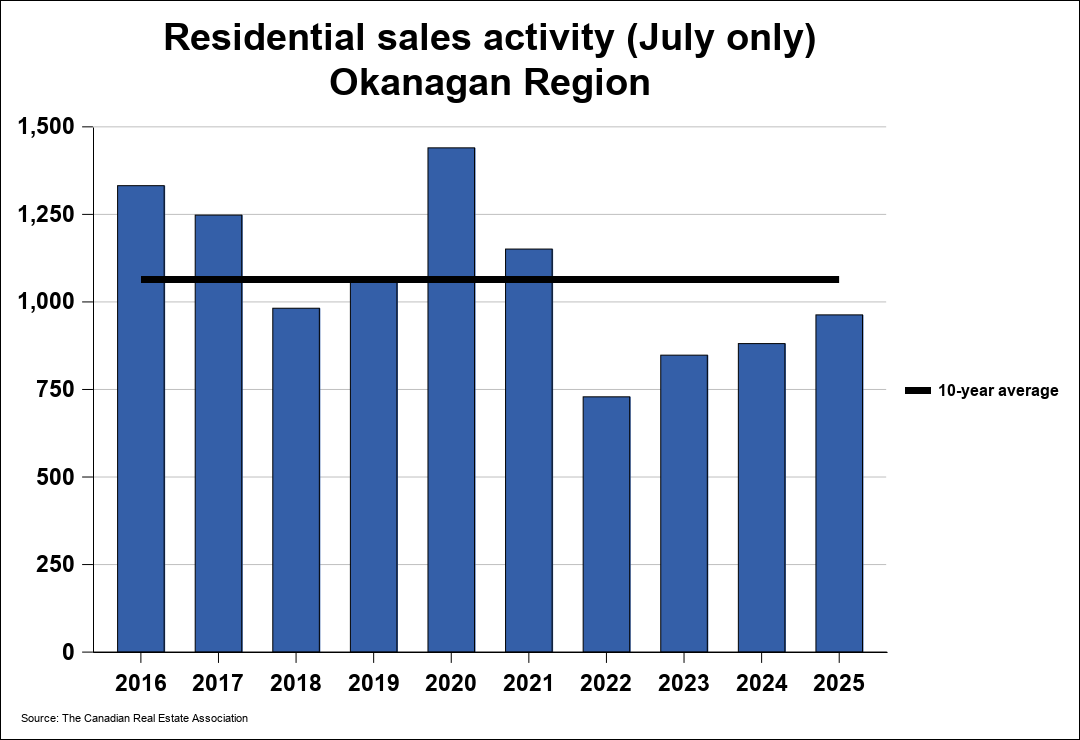
That combination pushed the sales-to-new-listings ratio up by 54% since March, moving the region from a strong buyers market into balanced territory. Even so, months of inventory remain at eight. This means buyers still have choice, and competition is limited.
The Interest Rate Wildcard
The key wildcard is interest rates. CREA does not mention this, but just this week, U.S. Federal Reserve Chair Jerome Powell signaled a likely rate-cutting cycle. If the US Fed lowers rates, the Bank of Canada often follows.
Lower borrowing costs would make housing more attractive again. During COVID, ultra-low rates fueled a buying rush that sent home prices soaring. If similar conditions return, Kelowna and the Okanagan could tighten quickly.
But conditions today are not identical to 2020. Many investors are now allocating more capital to gold and cryptocurrency. These alternative assets absorb money that in the past might have flowed entirely into housing. That could mean a more moderate response, even if rates fall.
Bottom Line for Buyers and Sellers
Kelowna remains a buyer’s market with eight months of inventory, but the sharp 28% sales surge earlier this year shows that demand exists and can resurface quickly. Even though sales dipped slightly after May, the potential for renewed energy is clear if conditions shift. For now, buyers hold the advantage, but Kelowna’s numbers suggest volatility rather than stagnation.
When we step back and look at the wider Okanagan—communities stretching from Osoyoos through Vernon and into Salmon Valley—the picture looks stronger. Sales are up more than 30% since spring, new listings are down, and the sales-to-listings ratio has improved sharply. While inventory remains elevated, these are early signs of balance, with some markets outside Kelowna moving faster toward national trends.
In short, Canada is tilting toward sellers, Kelowna is lagging but showing bursts of demand, and the broader Okanagan is catching up more quickly. For buyers, this means opportunity still exists but may not last. For sellers, the market is improving, though strategy and pricing remain critical. The next few months—especially with possible rate cuts—will decide whether 2025 tips the scales toward a true seller’s market in the Okanagan.
This blog post is for general informational purposes only and should not be taken as legal, financial, or real estate advice. Always seek the advice of a licensed REALTOR® for real estate matters and a qualified lawyer or notary public for legal matters before making decisions.