By Michael A. Jones - PREC* | Royal LePage Kelowna
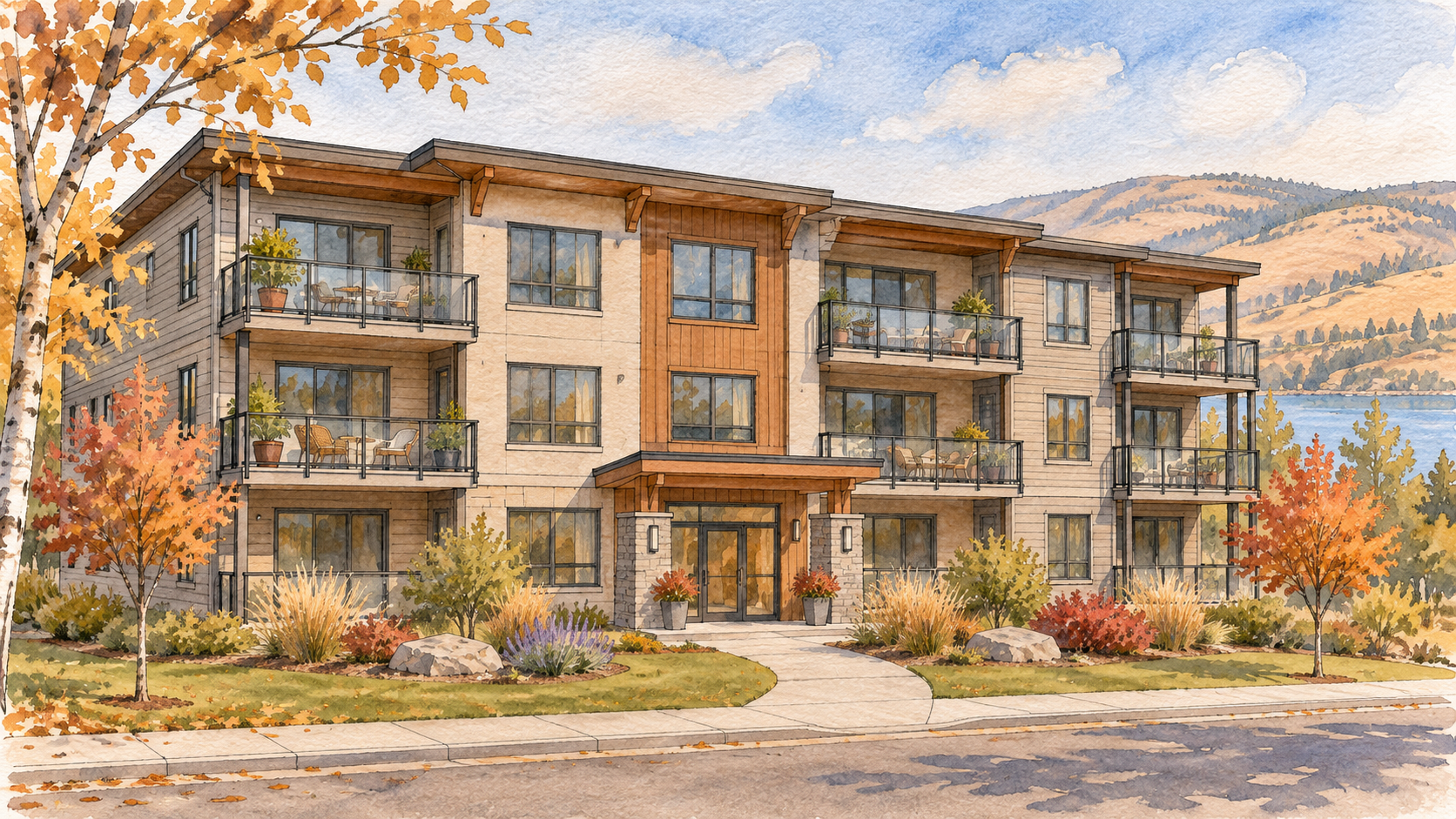
If you own a small apartment building, are considering buying one, or have a site that could accommodate several homes, Ottawa's latest mortgage insurance announcement deserves a closer look.
Budget 2026 opens the door for private mortgage insurers to offer insurance on residential properties with five to fifty units. For Okanagan owners and builders, the potential benefit is more choice when arranging financing. The actual products, pricing and lender appetite will determine how useful that choice becomes.
The announced measures apply to mortgage insurance applications that lenders submit to insurers on or after February 1, 2027. That is an application date, not a promise that a loan will fund that day.
What the new 5-50 unit parameters say
The Department of Finance backgrounder, published November 5, sets out these parameters:
- Property: 5-50 self-contained homes, each with cooking, sleeping and bathroom facilities, under one legal title or ownership structure. Separately titled properties cannot be bundled to meet the unit threshold.
- Uses: Construction, purchase, refinance and renewal.
- Maximum loan-to-value: 90% for new construction; 85% for other transactions.
- Maximum amortization: 50 years for new construction; 40 years for other transactions.
- Minimum debt coverage: 1.15 for five-year terms; 1.10 for ten-year terms.
- Borrower net worth: At least 25% of the requested loan, subject to a $100,000 minimum, based on assets held in Canada.
- Other limits: No property-value ceiling or requirement for the owner to occupy a unit.
Construction financing has a separate rule: the stated maximum amortization and minimum debt coverage requirements do not apply during construction financing. Insurers use their own underwriting to assess servicing capacity.
What is actually new?
Multi-unit mortgage insurance already exists. CMHC's standard rental housing program already serves eligible properties with at least five rental units and lists amortizations of up to 40 years for existing properties and 50 years for new construction. Its MLI Select program offers incentives tied to affordability, energy efficiency and accessibility commitments.
The development worth watching is private-insurer participation in this part of the market. More providers could give lenders and borrowers additional options. It is too early to assume that every new product will be cheaper, faster or better suited to a particular building than an existing option.
Read the limits alongside the building's income
The maximum loan-to-value ratio is only one part of the calculation. A building can have enough appraised value to support a loan on paper while producing too little income to service it comfortably.
Debt coverage compares net operating income with total debt service. As a simple hypothetical example, $115,000 of annual net operating income divided by $100,000 of annual debt service equals 1.15. If income falls to $105,000 with debt service unchanged, coverage falls to 1.05. A small change in operating performance can matter.
Ask the lender how it treats vacancy, management, maintenance, property taxes, insurance and reserves. Advertised rents multiplied by twelve are not the same as dependable net operating income. For an existing property, review the rent roll, leases, operating records and upcoming repairs.
A longer amortization can reduce scheduled payments for the same loan and rate, but it also slows principal repayment and can increase total interest. It is different from the mortgage term: a 50-year amortization does not mean a rate is fixed for 50 years.
Plan the construction loan and the finished building together
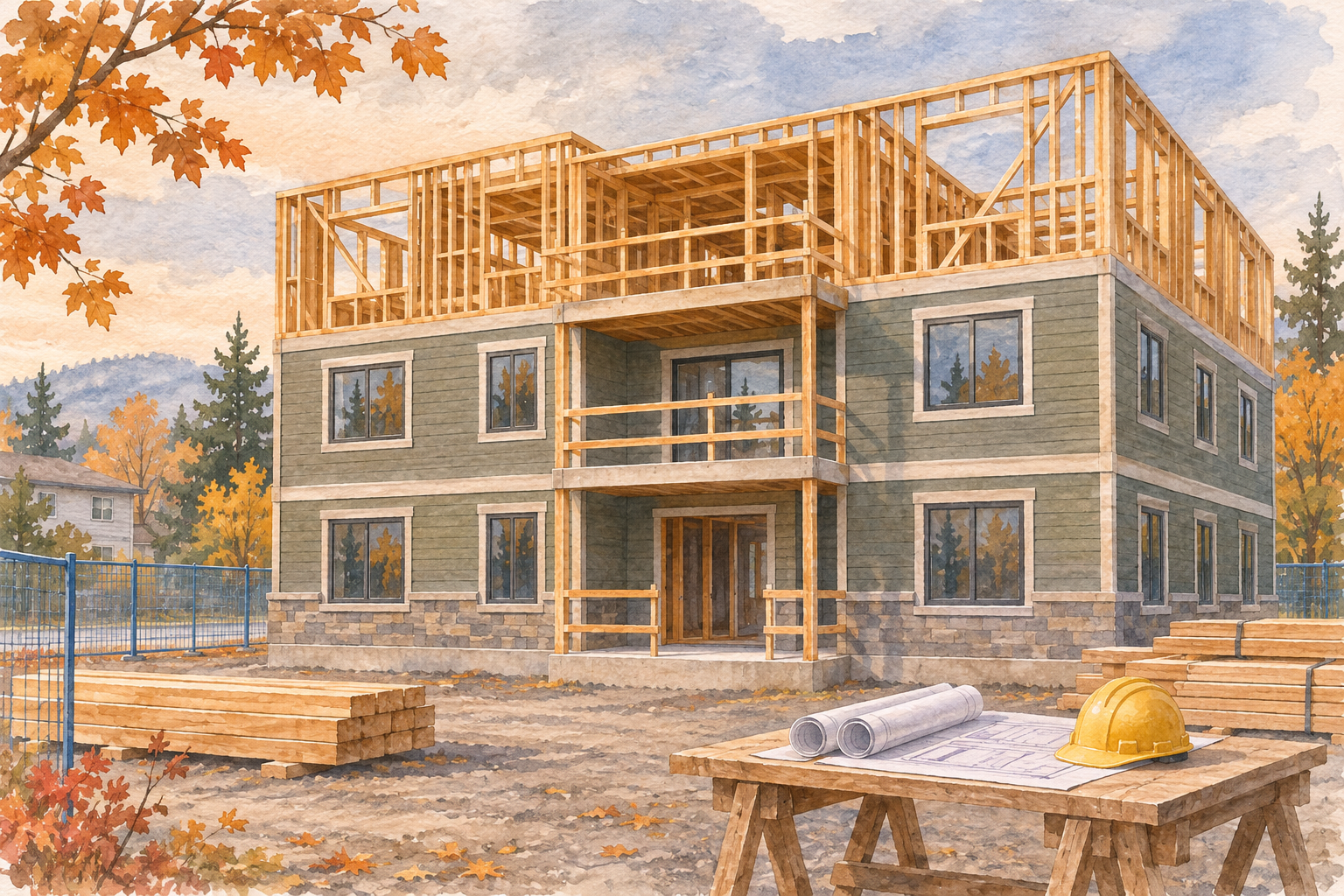
For a builder, the useful conversation starts with the full funding plan. Ask how advances will be released, what inspections or reports are needed, which costs must be paid first, and how much contingency and liquidity the lender expects.
Then work through the transition to the completed property's mortgage. What happens if construction takes longer, costs rise, lease-up is slower, or the finished appraisal is below the forecast? The construction exception leaves these risks to underwriting; it does not remove them.
A headline lending percentage should never stand in for a complete cash budget. Fees, insurance premiums, taxes, timing gaps and overruns all need to be addressed in the actual financing proposal.
Which Okanagan properties should take a closer look?
A small rental apartment building is an obvious candidate for a financing review. An owner approaching renewal, a buyer assessing an existing building, or a builder considering a modest apartment project may each have a different reason to ask about the new products.
Be precise about the intended use and ownership arrangement. Ask the insurer and lender to confirm eligibility if the proposal includes commercial space, planned strata sales or an unusual housing model. The backgrounder should not be treated as blanket approval for every property marketed as multi-family.
Local development rules still determine what can be built. In Kelowna, start with the City's zoning bylaw and property map. For sites elsewhere in the Okanagan, use the relevant municipality's current rules. Confirm permitted use, density, height, setbacks, servicing and approval requirements before assigning development value to a site.
My view is that more financing choice is worth welcoming, while keeping the land and building analysis disciplined. A seller should not assume the announcement raises a property's value. A buyer should not use maximum leverage to justify a price that the income and risks do not support.
Five questions to ask before committing
- Does this exact property qualify? Confirm unit count, legal structure, intended use and transaction type in writing.
- What will the lender actually offer? Compare rate, premium, fees, guarantees, covenants, prepayment terms and required cash.
- How does the proposal compare with current options? Review available CMHC and conventional financing as well as any new private-insurer product.
- Does the project withstand a less favourable outcome? Test lower rent, higher vacancy, unexpected repairs, cost overruns and refinancing risk.
- What remains before funding? Obtain the written conditions and timeline. Insurance eligibility alone is not a lender's commitment to advance money.
For the broader approval issue, see my guide to conditional mortgage approval. A multi-unit loan has its own requirements, but the practical lesson carries over: understand the outstanding conditions before making an unconditional commitment.
If you are considering a small apartment property or development site, contact me to discuss the Okanagan real estate side of the decision. Bring a qualified multi-unit mortgage professional into the financing conversation early.
All for now,
Michael
This article provides general real estate information, not mortgage, investment, tax or legal advice. The announced parameters do not guarantee product availability, insurance eligibility, financing, development approval or investment returns. Confirm the rules, underwriting and property-specific requirements with the lender, insurer and qualified advisers before committing. The example is hypothetical; illustrations do not depict actual properties. Prepared with AI assistance; sources checked November 6, 2026.
*Personal Real Estate Corporation